
100 Comprehensive Adverb of Manner Sentences List
Mastering English requires more than just basic vocabulary. To truly…

Mastering English requires more than just basic vocabulary. To truly express yourself, you must describe how actions occur with precision. This guide provides a practical adverb of manner list to help you refine your communication skills.
By using these descriptive words, you add color and detail to your daily speech. Understanding the importance of adverb of manner sentences allows you to transform simple statements into vivid descriptions. Whether you are writing an essay or chatting with friends, these tools are essential for clarity.
Our collection features a wide adverbs list designed for learners at every level. We explore various patterns, from positive statements to complex questions. You will find a helpful list of adverbs that covers daily-use examples, short phrases, and interactive practice worksheets. Start your journey today to improve your grammar and boost your confidence when using adverbs in your adverb list.
Key Takeaways
- Learn how to describe actions with greater precision and clarity.
- Explore a curated collection of 100 practical examples for daily use.
- Understand the grammatical patterns behind descriptive word placement.
- Practice with diverse formats including questions and negative structures.
- Improve your overall writing and speaking fluency through targeted exercises.
What Is an Adverb of Manner?
In the world of English grammar, adverbs of manner tell us exactly how something happens. As a key category within the types of adverbs, these words provide essential detail to your sentences. Understanding the adverb definition is the first step toward mastering adverbs in english grammar. When you look at any types of adverbs list, you will find that these specific words are vital for descriptive writing in english grammar.
These words function as parts of speech that modify verbs, adjectives, or even other adverbs. By using an adverb of manner sentence structure, you can transform a simple statement into a vivid description. Proper adverb of manner sentences structure ensures that your reader understands the intensity or style of an action. Consider this insight on the power of language:
“Language is the road map of a culture. It tells you where its people come from and where they are going.”
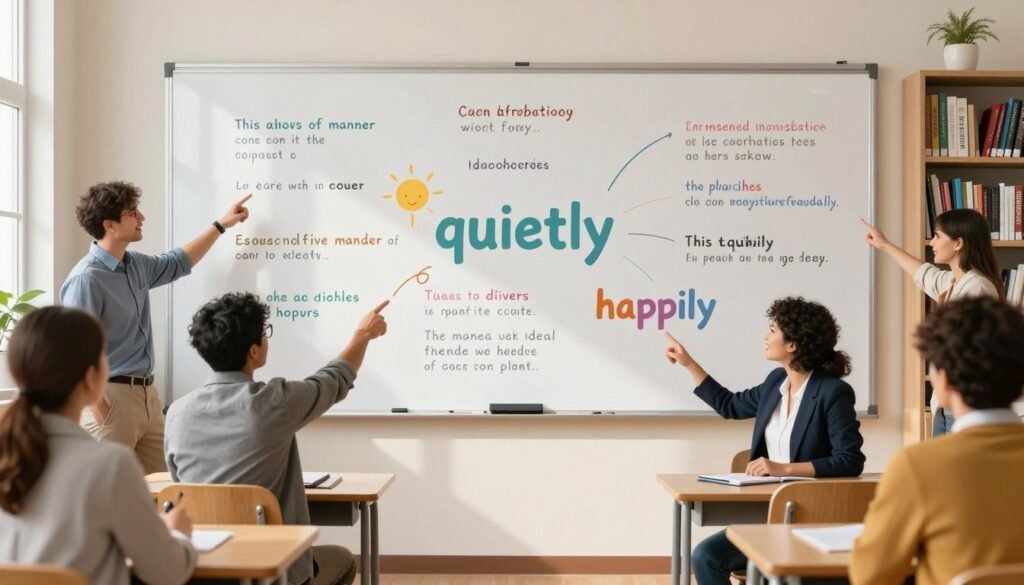
Learning how to use adverbs effectively requires attention to adverb placement in sentences. In most cases, you should place the adverb directly after the main verb or after the direct object. For example, you might say, “She sang beautifully,” or “He finished the task carefully.” Mastering this adverb sentence structure will help you construct the 100 clear, usable sentences we will explore throughout this guide.
Adverb of Manner Examples in Sentences
Adverbs of manner provide essential details that help readers visualize specific actions in a story. These examples of adverbs modifying verbs show exactly how an action is performed, adding depth to your communication. By using examples of manner adverbs, you can turn a simple statement into a vivid description.
Consider the difference between a basic sentence and one enhanced by adverb modifier words. For instance, saying “Sarah runs” is clear, but “Sarah runs quickly” tells us much more about the action. These adverb examples act as the bridge between a plain verb and a complete, descriptive thought.

When you look at sentence structure, you might notice that some modifiers are longer than others. While a single word like “happily” works well, you can also use adverbial clauses to provide more context. These adverb clause examples function just like single adverbs but offer a more complex way to describe the “how” of an action.
The following table provides a variety of examples of adverb sentences to help you see how these words fit into your daily writing.
| Sentence | Adverb Used | Function |
|---|---|---|
| He speaks clearly. | Clearly | Modifies the verb “speaks” |
| She danced gracefully. | Gracefully | Describes the action of dancing |
| They worked together. | Together | Shows the manner of working |
| The cat purred softly. | Softly | Explains how the cat purred |
Using these best adverb examples will help you master the art of descriptive writing. Whether you are writing a formal report or a casual email, these examples of adverb of manner sentences ensure your message is clear and engaging. Practice identifying these adverb of manner sentence examples in your favorite books to see how professional authors use them to build atmosphere.
Sentences With Various Adverbs of Manner
Adverbs of manner provide the essential detail needed to explain how an action is performed. By mastering proper adverb placement, you can transform simple statements into vivid descriptions. This adverb of manner list serves as a guide to help you refine your communication skills.

Sentences With Quickly
Using the word “quickly” helps you describe actions that happen with high speed. Learning how to use adverb of manner terms like this allows you to convey urgency effectively. These adverbial phrases show how the action of the verb is accelerated.
- Sarah finished her homework quickly so she could go outside.
- The athlete ran quickly across the finish line to win the race.
- Please pack your bags quickly because the taxi is waiting.
Sentences With Quietly
When you need to describe a soft or hushed action, “quietly” is the perfect choice. These examples of manner adverbs help the reader understand the volume of an event. You can use these examples of adverbials to set a calm or secretive tone in your writing.
“The secret of life is to appreciate the pleasure of being merely alive, and to live it quietly.”
Consider these sentences to see how the adverb modifies the verb:
- The students sat quietly while the teacher explained the lesson.
- He closed the door quietly to avoid waking the baby.
- She whispered quietly so that no one else would hear her secret.
Sentences With Carefully
Using “carefully” indicates that an action requires focus, precision, or caution. These adverbial phrases examples demonstrate how to emphasize the importance of a task. When you perform a task carefully, you ensure that every detail is handled with care.
- The surgeon operated carefully to ensure the patient’s safety.
- Please handle the glass vase carefully as it is very fragile.
- He carefully reviewed the contract before signing his name.
Sentences With Slowly
The word “slowly” is useful when you want to emphasize a deliberate or relaxed pace. These examples of adverbial phrases help the reader visualize the movement of the subject. Using this list of manner adverbs will help you control the rhythm of your sentences.
- The sun set slowly behind the distant mountains.
- She walked slowly through the park to enjoy the fresh air.
- The old clock ticked slowly in the silent room.
Positive Sentences With Adverbs of Manner
When you describe actions in a positive light, using an adverb of manner becomes an essential tool for clarity. These words are vital parts of speech that help you explain how someone or something completes a task. By exploring various types of adverbs, you can transform simple statements into vivid descriptions.
Beginners often start with simple words found in a basic adverbs list. For example, saying “The cat purred softly” or “She smiled happily” provides an immediate sense of the action. These simple structures help you build confidence before moving toward more complex sentence patterns.
Using adverb of manner sentence starters can make your writing feel more professional and fluid. While many people place these words after the verb, starting a sentence with an adverb can add emphasis. These sentence adverbs allow you to set the tone of your message right from the beginning.
As you progress, you might want to incorporate advanced adverbs for sentences to add nuance to your work. Understanding the different types of adverbs of manner allows you to choose the perfect word for every situation. Whether you are writing a story or a report, precision is key to effective communication.
“The difference between the right word and the almost right word is the difference between lightning and a lightning bug.”
Consulting a comprehensive types of adverbs list helps you expand your vocabulary beyond common terms. When you have a reliable adverb list at your fingertips, you can avoid repetition and keep your writing fresh. Refer to the table below for examples that range from simple to more descriptive language.
| Subject | Action | Adverb of Manner |
|---|---|---|
| The student | answered | correctly |
| The athlete | ran | effortlessly |
| The chef | prepared | meticulously |
| The bird | flew | gracefully |
Building a strong list of adverbs is a practical step toward mastering English grammar. By practicing these positive sentence structures, you ensure that your communication remains clear, engaging, and grammatically sound.
Negative Sentences With Adverbs of Manner
You might wonder how adverbs of manner function when you introduce negative words like “not” or “never.” These adverb of manner sentences require a specific flow to maintain natural rhythm. When you add negation, the position of the adverb often shifts to keep the meaning clear.
Learning about adverbs in english grammar helps you avoid common pitfalls. In negative sentences, the adverb often sits between the auxiliary verb and the main verb. For example, you might say, “She does not carefully read the instructions,” rather than placing the adverb at the very end.
Proper adverb placement in sentences is vital when using words like “hardly.” Because “hardly” carries a negative weight, it usually appears before the main verb to emphasize the lack of action. This nuance is a cornerstone of refined english sentence structure.
When you learn how to use adverbs in sentences, you discover that the object of the verb can also influence placement. If a sentence has a direct object, the adverb often moves to the end to avoid breaking the connection between the verb and its target. You might say, “He did not finish the project quickly,” to keep the focus on the task.
“Precision in language is the difference between being understood and being misinterpreted by your audience.”
Refining your adverb placement is a great way to improve your overall grammar. By contrasting positive and negative forms, you can see how the adverb modifies the verb differently. For instance, “He speaks loudly” becomes “He does not speak loudly” in a negative context.
The importance of adverb of manner sentences lies in their ability to add detail to every action. Mastering these patterns in english grammar ensures your writing sounds professional and polished. Consistent practice allows you to place these modifiers with confidence.
Reviewing examples of adverbs modifying verbs in negative structures will sharpen your skills. Whether you are writing or speaking, remember that the auxiliary verb acts as a guide for where your adverb should land. Keep your sentences balanced to ensure your message remains sharp and effective.
Question Sentences With Adverbs of Manner
When you want to know the “how” behind an action, using the right adverbial phrases is essential. Understanding the correct adverb sentence structure allows you to ask precise questions that get the information you need. Proper sentence structure ensures your inquiries sound natural in American English.
In yes-or-no questions, the adverb often sits after the main verb or at the end of the clause. Consider these adverbial phrases examples to see how they fit into your daily speech:
- Did she speak very softly during the meeting?
- Does he drive with extreme caution on icy roads?
- Can you finish the project in a timely manner?
When forming information questions, especially those starting with “How,” the placement of the modifier is key. The adverb of manner sentences structure typically follows the pattern: Question Word + Auxiliary Verb + Subject + Main Verb + Adverb. Here are some examples of adverbials used in this context:
- How did Sarah finish the race so quickly?
- How does the machine operate so quietly?
- How can we handle this situation more carefully?
Sometimes, you might need more detail than a single word can provide. Using adverbial clauses allows you to describe the manner of an action with greater complexity. These adverb clause examples show how to add depth to your questions:
- How did he act as if he were the boss?
- How did she dance as though she were floating on air?
Mastering this adverb of manner sentence structure helps you move beyond basic inquiries. By practicing these patterns, you will find that your ability to ask for specific details improves significantly. Always remember that the placement of the adverb can change the emphasis of your question, so choose your words with care.
Daily Use Sentences With Adverbs of Manner
Mastering these small but powerful words will transform how you describe your daily actions to friends and colleagues. By using adverb modifier words, you provide essential context that helps listeners understand exactly how an event occurred. These examples of adverbs are the secret to sounding more natural and fluent in American English.
When you are at home or the office, you might need to explain that you finished a task quickly or handled a fragile item carefully. Using examples of adverb of manner sentences allows you to clarify whether an action was done politely, safely, or easily. For instance, saying “Sarah spoke kindly to the new employee” is much more descriptive than simply saying she spoke to them.
In social situations, adverb examples help you convey your tone and attitude. You might tell a friend that you waited patiently for the bus or that you walked slowly through the park. These adverb of manner sentence examples act as sentence adverbs that paint a clearer picture of your daily experiences.
Whether you are shopping or traveling, these descriptive tools make your stories more engaging. Below are some of the best adverb examples categorized by common life scenarios to help you practice.
| Scenario | Action | Adverb Used |
|---|---|---|
| At Home | Cleaning the kitchen | Thoroughly |
| At Work | Answering emails | Promptly |
| Shopping | Choosing groceries | Wisely |
| Travel | Driving the car | Cautiously |
Using these examples of adverb sentences will boost your confidence in any conversation. You can also look for examples of adverbial phrases to add even more detail to your speech. Start practicing these today to see how much more effectively you can communicate your daily life.
Short Sentences With Adverbs of Manner
Mastering English sentence structure becomes much easier when you start with short, punchy examples. By focusing on brief phrases, you can learn how to use adverbs without feeling overwhelmed by complex grammar rules.
Short patterns are excellent for memorization and daily pronunciation practice. They allow you to see exactly how a verb interacts with a modifier to change the meaning of a thought.
When you understand how to use adverb of manner patterns, you gain the ability to describe actions with precision. These small building blocks serve as the foundation for more advanced communication skills.
You can use these adverb of manner sentence starters to expand your vocabulary and improve your writing speed:
- She speaks clearly.
- He runs fast.
- They work hard.
- The dog barks loudly.
This list of manner adverbs helps you practice different ways to modify your verbs. Try adding your own subjects or objects to these starters to create unique sentences that fit your specific needs.
For those ready to level up, incorporating advanced adverbs for sentences adds a layer of sophistication to your speech. Using words like meticulously or reluctantly can transform a simple sentence into a vivid description of an action.
100 Adverb of Manner Sentences
Learning how to use adverbs effectively starts with seeing them in action across many different contexts. This collection of adverb of manner sentences helps you understand how these words modify verbs to provide more detail. By reviewing these, you can improve your fluency and descriptive writing skills.
Below is a comprehensive adverb of manner list designed to cover various scenarios. Whether you are writing a formal essay or chatting with friends, these examples will help you express yourself with greater precision.
This adverbs list includes 100 unique sentences to help you practice. Use this examples of manner adverbs guide to identify how different words change the meaning of a sentence.
- She sang beautifully at the concert.
- He ran quickly to catch the bus.
- They spoke quietly in the library.
- The cat walked softly across the floor.
- I finished my homework easily.
- He drives carefully on rainy days.
- She smiled happily at the news.
- They worked hard to finish the project.
- The wind blew fiercely last night.
- He answered the question correctly.
- She danced gracefully on the stage.
- They waited patiently for the train.
- He laughed loudly at the joke.
- She typed the report slowly.
- The team played well today.
- He reacted calmly to the crisis.
- She dressed elegantly for the party.
- They argued heatedly about the plan.
- He cleaned his room thoroughly.
- She listened intently to the lecture.
- The sun shone brightly this morning.
- He spoke clearly during his speech.
- She organized her desk neatly.
- They arrived safely at their destination.
- He cooked the meal perfectly.
- She painted the wall smoothly.
- The dog barked aggressively at the stranger.
- He studied diligently for the exam.
- She walked briskly to the office.
- They behaved politely at dinner.
- He handled the situation bravely.
- She wrote the letter thoughtfully.
- The baby slept soundly all night.
- He performed the task efficiently.
- She sang softly to the child.
- They cheered wildly for the winner.
- He climbed the mountain cautiously.
- She handled the glass delicately.
- The car moved sluggishly in traffic.
- He explained the rules patiently.
- She decorated the room beautifully.
- They played the game fairly.
- He accepted the gift gratefully.
- She whispered secrets shyly.
- The rain fell steadily all day.
- He fixed the clock expertly.
- She read the book eagerly.
- They sat comfortably on the sofa.
- He spoke rudely to the waiter.
- She solved the puzzle quickly.
- The flowers grew rapidly in spring.
- He stood firmly by his decision.
- She dressed casually for the hike.
- They danced joyfully at the wedding.
- He checked the engine regularly.
- She searched the room frantically.
- The bird flew swiftly away.
- He greeted his guests warmly.
- She handled the crisis wisely.
- They lived happily ever after.
- He cut the paper neatly.
- She spoke honestly about her feelings.
- The fire burned brightly in the hearth.
- He worked independently on the task.
- She walked confidently into the room.
- They listened carefully to the instructions.
- He drove recklessly on the highway.
- She laughed nervously during the interview.
- The clock ticked rhythmically.
- He played the piano skillfully.
- She folded the clothes tidily.
- They waited anxiously for the results.
- He spoke firmly to the group.
- She painted the portrait vividly.
- The water flowed gently down the stream.
- He acted foolishly in the meeting.
- She answered the phone promptly.
- They discussed the matter openly.
- He treated his friends kindly.
- She moved silently through the dark.
- The team worked together cooperatively.
- He finished the race breathlessly.
- She held the baby tenderly.
- They planned the trip carefully.
- He spoke passionately about his art.
- She cleaned the kitchen thoroughly.
- The stars twinkled faintly above.
- He reacted spontaneously to the news.
- She typed the email hurriedly.
- They stood silently in the rain.
- He performed the surgery successfully.
- She sang the song melodiously.
- The engine hummed quietly.
- He walked aimlessly through the park.
- She accepted the challenge bravely.
- They cheered loudly for the team.
- He spoke softly to his dog.
- She dressed smartly for work.
- The snow fell silently.
- He finished the job perfectly.
This list of adverbs is a great resource for your daily practice. You can use these examples of adverb sentences to create your own unique phrases. Try changing the verbs to see how the meaning shifts.
When you review these examples of adverb of manner sentences, pay attention to the placement of the word. Most of these adverb of manner sentence starters show how the adverb follows the main verb. This is a common pattern in English grammar.
Keep this adverb of manner sentence examples list handy for your writing sessions. Using an adverb list like this will help you avoid repetitive language. It adds color and depth to your communication.
Finally, remember that this list of manner adverbs is just the beginning. Practice makes perfect, so try writing your own sentences using these words today. You will soon find that your ability to describe actions becomes much more natural.
Common Mistakes With Adverbs of Manner
Even experienced writers sometimes stumble when choosing between adjectives and adverbs. Mastering grammar is a journey, and identifying these frequent errors is the best way to refine your skills. By reviewing different types of adverbs, you can avoid common pitfalls that often confuse even native speakers.
One of the most frequent errors involves the confusion between “good” and “well.” While “good” is an adjective used to describe nouns, “well” is an adverb that describes how an action is performed. For instance, saying “He plays the piano good” is incorrect; the correct way to phrase this is “He plays the piano well.”
Another common issue is the incorrect placement of adverbs within a sentence. Adverbs of manner should generally follow the verb or the object of the verb to maintain clarity. Placing them too far from the action can make your sentence adverbs sound awkward or confusing to the reader.
Consider the following table to see how simple corrections can improve your writing:
| Incorrect Sentence | Correct Sentence | Reasoning |
|---|---|---|
| She sings beautiful. | She sings beautifully. | Use adverb, not adjective. |
| He ran quickly to the store. | He ran to the store quickly. | Better adverb placement. |
| They acted very rudely. | They acted rudely. | Avoid unnecessary adverbs. |
Sometimes, writers include unnecessary adverbs that clutter their prose. If the verb already implies a specific manner, adding an extra word is redundant. Reviewing a types of adverbs list helps you select the most precise words rather than relying on filler terms.
When you look at adverb examples, focus on how they modify the action. Using the best adverb examples in your daily writing will help you avoid these common traps. Consistent practice is the key to mastering grammar and ensuring your message is always clear and professional.
By understanding these types of adverbs of manner, you will gain confidence in your writing. Remember that clear communication is the ultimate goal of every sentence you construct.
Adverb of Manner Sentences Worksheet
This interactive worksheet is designed to help you refine your grasp of adverb modifier words in everyday English. By engaging with these tasks, you will gain confidence in your ability to describe actions with precision and clarity.
Understanding adverbial phrases is essential for effective communication. Use the following exercises to test your knowledge of how these words function within a sentence.
Proper adverb placement in sentences can change the entire tone of your message. Try to complete the following sentences by choosing the most appropriate adverb from the list: quickly, loudly, gracefully, or carefully.
“Language is the road map of a culture. It tells you where its people come from and where they are going.” — Rita Mae Brown
Learning how to use adverbs in sentences involves more than just memorization. It requires practice with real-world scenarios to ensure your adverb placement feels natural to native speakers.
Below is a quick reference table to help you check your progress. Use this to verify your understanding of sentence structure and the role of modifiers.
| Task Type | Focus Area | Difficulty |
|---|---|---|
| Fill-in-the-blank | Examples of adverbs modifying verbs | Easy |
| Sentence Reordering | Adverb of manner sentences structure | Medium |
| Error Correction | Adverb of manner sentence structure | Hard |
To master adverb sentence structure, try writing five original sentences using different adverbs of manner. Review your work against the examples provided in this guide to ensure your modifiers are placed correctly near the verbs they describe.
Frequently Asked Questions About Adverbs of Manner
Let’s clear up some common confusion regarding the role and placement of adverbs in sentences. Learning how to use adverbs correctly is a vital skill for anyone looking to add detail and clarity to their communication.
The standard adverb definition describes a word that modifies a verb, an adjective, or another adverb. When we look at examples of adverbs, we see they often answer questions like “how,” “when,” or “where” an action occurs.
You might wonder how to use adverb of manner effectively in your own writing. These words specifically describe the way an action is performed, such as “he ran quickly” or “she spoke softly.”
“Adverbs are the spice of language; they add flavor and precision to our everyday descriptions.”
It is important to note that not every word ending in “-ly” is an adverb. For instance, “friendly” or “lonely” are adjectives. When looking at examples of adverbials, remember that they can be single words, phrases, or even entire clauses that function as an adverb.
If you are confused about the structure, consider these distinctions:
- Adverbial phrases examples: “He walked in a hurry.” (A group of words acting as an adverb).
- Adverb clause examples: “He walked as if he were in a hurry.” (A group of words containing a subject and a verb).
Always remember that placement matters. While manner adverbs are flexible, placing them too far from the verb they modify can sometimes create ambiguity in your sentences.
Conclusion
Adverbs of manner bring life to your writing by describing exactly how an action unfolds. These essential parts of speech transform basic statements into vivid, descriptive narratives. Understanding the adverb definition helps you grasp how these words modify verbs to provide clarity.
Our guide provided 100 examples to support your journey through English grammar. You now have the tools to improve your speaking and writing skills. The importance of adverb of manner sentences lies in their ability to make your language more expressive and natural.
Pay close attention to your adverb placement within the english sentence structure. Choosing the correct form ensures your message remains clear to your audience. Practice these patterns across positive, negative, and question formats to build confidence.
You might explore advanced adverbs for sentences to add sophistication to your work. Reviewing adverbial clauses will further refine your command of adverbs in english grammar. These building blocks are vital for anyone looking to master the nuances of the language.
Download the provided worksheet to test your knowledge today. Try writing your own original sentences using both common and complex terms. Consistent practice turns these grammar rules into second nature for every English learner.