
Example Sentences of Future Perfect Continuous Tense
Have you ever wanted to describe an activity that stays…

Have you ever wanted to describe an activity that stays in motion until a specific moment arrives? Mastering the future perfect continuous tense allows you to express exactly how long an action will be happening before another event occurs. It is a powerful tool for storytelling and planning.
At its core, the future perfect continuous definition centers on duration. By using the phrase “will have been” followed by a verb ending in -ing, you highlight the length of an ongoing process. This structure helps listeners understand the timeline of your goals or daily routines with great clarity.
In this guide, we provide simple rules and practical future perfect continuous examples to help you gain confidence. Whether you are writing a report or chatting with friends, these patterns will make your English sound more natural and precise. Let’s explore how to use this grammar structure effectively in your everyday life.
Key Takeaways
- This grammar structure emphasizes the duration of an activity leading up to a specific point.
- The standard formula requires using “will have been” plus a present participle verb.
- It is ideal for describing long-term projects or habits that span across time.
- Using this form helps clarify the relationship between two different events.
- Practice is essential for mastering the flow of these complex sentences.
What Is the Future Perfect Continuous Tense?
Understanding the future perfect continuous tense allows you to paint a vivid picture of long-term progress in your future plans. This verb form is specifically designed to show that an activity will have been in progress for a certain amount of time before another future event occurs. Forming future perfect continuous sentences helps you emphasize the duration of an action rather than just the completion of it.
To use this tense correctly, you must follow a specific future perfect continuous tense structure. It combines the future perfect aspect with the continuous aspect to create a unique timeline. By mastering this, you can clearly communicate how long a task will have been underway by a specific moment in the future.
“The future perfect continuous tense is the perfect tool for highlighting the endurance and persistence of an action leading up to a future milestone.”
The standard future perfect continuous formula is quite simple to apply once you break it down into its core components:
- Subject (e.g., I, she, they)
- Will have been (the auxiliary verb phrase)
- Verb-ing (the present participle)
For example, if you say, “She will have been studying for three hours by the time you arrive,” you are highlighting the duration of her effort. The reference point is your arrival, while the duration is the three hours of study. This distinction is vital for beginners who want to express complex timelines with clarity and confidence.
Future Perfect Continuous Tense Structure
Building sentences in the future perfect continuous tense relies on a consistent pattern of auxiliary verbs. By mastering these tense forms, you can accurately describe actions that will continue up until a specific point in the future. The core of this structure is the fixed sequence “will have been,” which remains the same regardless of the subject.
Affirmative Future Perfect Continuous Sentences
To create a positive statement, you simply combine the subject with the auxiliary sequence and the present participle of the main verb. The formula is: Subject + will have been + verb-ing.
For example, you might say, “By next June, Sarah will have been working at the firm for five years.” This structure highlights the duration of an activity leading up to a future milestone.
Negative Future Perfect Continuous Sentences
When you need to express that an action will not be ongoing, the structure changes slightly. You must insert the word “not” between “will” and “have.”
The standard pattern is: Subject + will not have been + verb-ing. Following these future perfect continuous tense rules ensures your meaning remains clear. For instance, “They will not have been living in this city for long by the time they move.”
Interrogative Future Perfect Continuous Sentences
Asking questions in this tense requires moving the auxiliary verb “will” to the very front of the sentence. This inversion creates the interrogative form: Will + subject + have been + verb-ing?
If you are looking to practice, try creating your own questions like, “Will you have been studying for three hours by the time the test starts?” Engaging in regular future perfect continuous exercises will help you internalize these patterns quickly and effectively.
When to Use the Future Perfect Continuous Tense
The future perfect continuous tense serves a very specific purpose when discussing ongoing actions that reach a future point. It is primarily used to show that an activity will have been in progress for a certain amount of time before another event occurs. Understanding this future perfect continuous tense usage helps you express the duration of your plans with great clarity.
“Grammar is the heart of language, and mastering complex tenses allows you to paint a clearer picture of time and action in your mind.”
Using Future Perfect Continuous for Duration
When you want to emphasize how long an action has been happening, you focus on the duration. This is exactly where you use words like “for” to indicate a specific period. For example, you might say that by next Friday, you will have been working on your project for three weeks.
Learning how to use future perfect continuous tense effectively requires you to track the length of an event. It highlights the effort or the time invested in a task before a future deadline. This structure is perfect for professional settings or long-term personal goals.
Using Future Perfect Continuous With Time Expressions
To make your sentences clear, you should pair this tense with specific time markers. Using “by” is a common way to set a future reference point. These future perfect continuous uses help the listener understand exactly when the duration measurement ends.
The following table illustrates how different time expressions help define the scope of your actions:
| Time Marker | Example Context | Duration Focus |
|---|---|---|
| By noon | Studying for four hours | Morning progress |
| By next year | Living here for a decade | Long-term residence |
| By 5:00 PM | Waiting for two hours | Immediate delay |
| By the weekend | Training for six months | Preparation phase |
By combining these markers with the correct verb forms, you can communicate complex timelines with ease. Always remember that the goal is to show the continuity of the action leading up to that future moment.
25 Future Perfect Continuous Tense Examples
Learning how to use the future perfect continuous structure is much easier when you see it in action. By reviewing these 25 examples, you will gain a better grasp of how to describe ongoing actions that lead up to a specific point in the future.
Positive Future Perfect Continuous Sentences
These sentences show how to express that an action will have been happening for a certain duration. Consistency is key when practicing these forms.
- By next month, I will have been working at this company for five years.
- Sarah will have been studying medicine for four years by the time she graduates.
- They will have been traveling across Europe for three weeks by Friday.
- By midnight, the band will have been playing for four hours straight.
- He will have been training for the marathon for six months by race day.
- We will have been living in this house for a decade by next summer.
- The chef will have been cooking for the banquet since early morning.
- By the time you arrive, I will have been cleaning the kitchen for an hour.
- She will have been practicing the piano for two hours before her lesson starts.
Negative Future Perfect Continuous Sentences
Using the future perfect progressive in the negative form helps clarify what will not be happening over a duration. These examples highlight the negation of the auxiliary verbs.
- I will not have been working on this project for long by the deadline.
- They will not have been waiting for more than ten minutes when the bus arrives.
- He will not have been exercising for very long by the time he gets tired.
- We will not have been studying for the exam for more than an hour.
- She will not have been sleeping for long when the alarm goes off.
- The team will not have been practicing for the full session today.
- You will not have been driving for many miles by the time we stop.
- It will not have been raining for long by the time the sun comes out.
Question Sentences in Future Perfect Continuous
Asking questions using future perfect continuous sentences allows you to inquire about the duration of future events. These structures are helpful for planning and scheduling.
- Will you have been working here for a year by next December?
- How long will they have been waiting by the time we get there?
- Will she have been studying French for two years by the end of the term?
- Will the team have been training for the whole afternoon?
- How long will you have been living in New York by next spring?
- Will he have been running for an hour by the time he reaches the park?
- Will we have been traveling for more than a day by the time we land?
- How long will the machine have been running by the time it shuts down?
Future Perfect Continuous Tense Examples in Everyday English
You might be surprised how often native speakers use the future perfect continuous tense to talk about their busy schedules. While many people stick to simple structures, this specific form adds valuable context to your daily conversations. It helps you explain exactly how long an activity will have been in progress by a certain point in the future.
In the English language, choosing the right verb form changes how your listener perceives your message. For instance, if you say, “By 5:00 PM, I will have been working for eight hours,” you emphasize the duration of your effort. This is quite different from simply saying you will be working at that time.
It is helpful to compare this with the future continuous tense. While the latter focuses on an action happening at a specific moment, the future perfect continuous highlights the cumulative time spent on that task. Mastering these future tenses allows you to express your plans with much greater precision and clarity.
Consider the following table to see how these two forms differ in everyday scenarios:
| Scenario | Future Continuous | Future Perfect Continuous |
|---|---|---|
| Studying | I will be studying at 8 PM. | I will have been studying for three hours. |
| Exercise | She will be running tomorrow. | She will have been running for a mile. |
| Travel | They will be flying to Paris. | They will have been flying for ten hours. |
| Work | He will be finishing the report. | He will have been working all morning. |
Using these structures correctly makes your speech sound more natural and professional. Whether you are discussing a long-term project or a simple daily routine, these tools ensure your audience understands the full scope of your timeline.
Future Perfect Continuous Tense vs. Future Perfect Tense
Choosing between the future perfect continuous vs future perfect tense depends entirely on whether you want to emphasize duration or completion. While both forms look toward a specific point in the future, they paint very different pictures of how an action unfolds.
The future perfect tense is primarily used to signal that an action will be finished before a specific deadline. It focuses on the result rather than the process. For example, saying “By noon, I will have finished my report” highlights that the task is done.
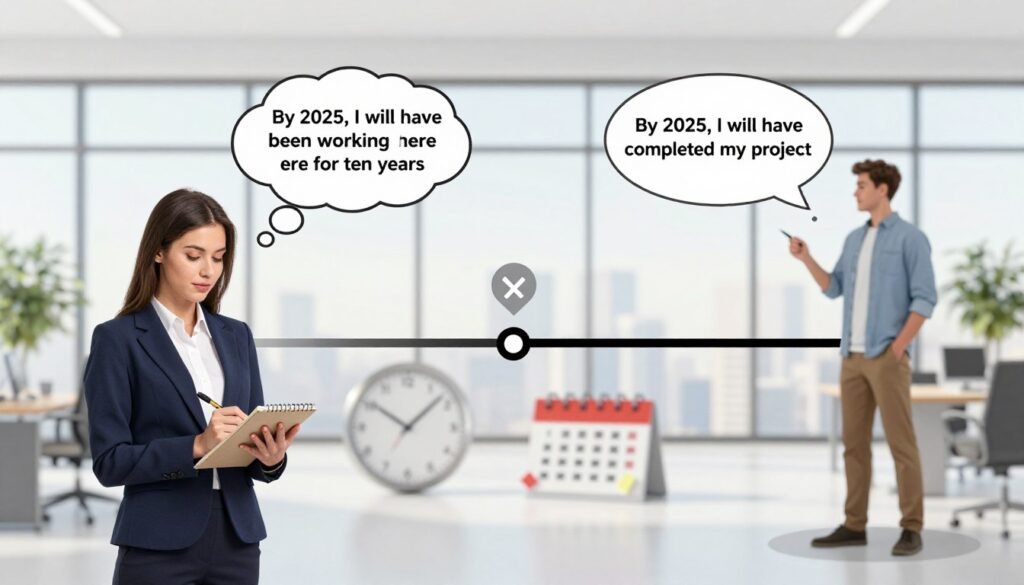
In contrast, the future perfect continuous tense highlights how long an activity will have been in progress up to that future point. It is the best choice when you want to emphasize the ongoing nature of a task. If you say, “By noon, I will have been working for four hours,” you are drawing attention to the duration of your effort.
“Precision in language is not just about grammar; it is about choosing the right tool to convey the exact nuance of your experience.”
Sometimes, both forms are grammatically possible, but they change the meaning of your sentence. Using a perfect tense correctly allows you to control exactly what your listener focuses on. Consider the following comparison to see how these tenses function in practice:
| Tense | Primary Focus | Example |
|---|---|---|
| Future Perfect | Completion of a task | I will have written the book. |
| Future Perfect Continuous | Duration of an activity | I will have been writing for months. |
| Combined Context | Result + Duration | I will have been writing for months and will have finished the draft. |
By mastering these subtle differences, you can express your future plans with much greater clarity. Whether you are discussing a project deadline or a long-term goal, selecting the right tense ensures your message is understood exactly as you intended.
Common Mistakes With Future Perfect Continuous Tense
Avoiding common errors is the fastest way to improve your command of english grammar. While this tense is powerful for describing ongoing actions, it is easy to trip over specific grammar rules. Many learners struggle with the length of the verb phrase, often leaving out necessary components.
A frequent mistake involves missing auxiliary verbs. You must include “will,” “have,” and “been” to form the tense correctly. For example, saying “I will waiting” is incorrect; it should be “I will have been waiting.” Remembering this sequence is vital for mastering complex verb tenses.
Another common issue is the placement of the word “not” in negative sentences. Always place “not” after the first auxiliary verb, “will.” Writing “I will have been not working” sounds unnatural. Instead, use the correct structure: “I will not have been working.”
Learners also frequently confuse “for” and “since” when discussing duration. Use “for” with a period of time, such as “for two hours,” and “since” with a specific starting point, like “since 5:00 PM.” Keeping these grammar rules in mind will help you avoid confusion.
| Common Error | Correct Form | Reasoning |
|---|---|---|
| I will waiting | I will have been waiting | Missing auxiliary verbs |
| I will have been not eating | I will not have been eating | Misplaced “not” |
| He will have been run | He will have been running | Incorrect verb form |
| I will have been here since 3 hours | I will have been here for 3 hours | Misuse of time markers |
Frequently Asked Questions About Future Perfect Continuous Tense
Understanding the nuances of this tense helps you describe ongoing actions in the future. Many students ask how this specific continuous tense differs from simpler future forms. The primary difference lies in the continuous aspect, which emphasizes the duration of an activity rather than just its completion.
When you use this structure, you are highlighting that an action will be in progress up to a certain point in time. For example, saying “I will have been working for five hours” focuses on the length of the effort. This is quite different from saying “I will have finished,” which only looks at the final result.
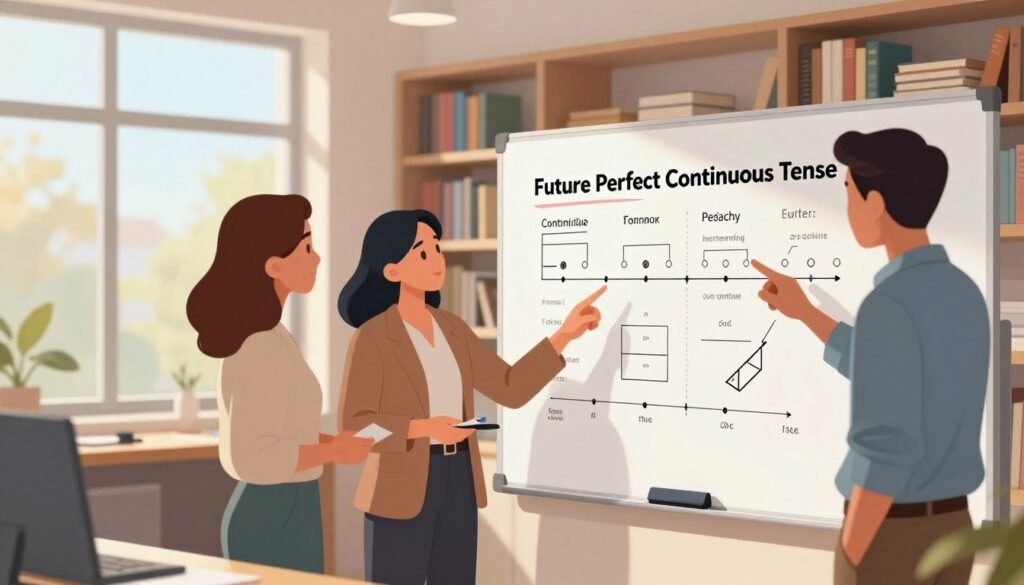
You might wonder if contractions are common in spoken American English. Yes, they are! You will often hear native speakers say “I’ll have been” instead of “I will have been.” Using these contractions makes your speech sound more natural and relaxed during casual conversations.
Here is a quick breakdown to help you distinguish between different future forms:
| Tense Form | Primary Focus | Example |
|---|---|---|
| Future Simple | Prediction or decision | I will study. |
| Future Perfect | Completed action | I will have studied. |
| Future Perfect Continuous | Ongoing duration | I will have been studying. |
Are there specific time expressions that work best with this tense? Usually, you will see phrases like “by next week,” “for two hours,” or “by the time you arrive.” These markers help clarify exactly when the continuous aspect of the verb begins and ends.
Remember that this continuous tense is not used with stative verbs like “know” or “believe.” You should stick to action verbs to ensure your sentences sound correct and logical. Practice these structures daily to gain confidence in your English communication skills.
Conclusion
Grasping the future perfect continuous tense elevates your command of American English. This structure relies on the pattern will have been combined with an -ing verb to highlight the duration of an action before a specific point in time.
You now possess the tools to distinguish this form from the standard future tense. By reviewing the 25 examples provided, you can see how these sentences function in real-world scenarios. Practice building your own affirmative, negative, and interrogative statements to gain confidence.
This specific verb form belongs to the family of progressive tenses. It offers a unique way to describe ongoing activities that lead up to future events. Using these patterns correctly helps you communicate with greater precision and clarity.
Try incorporating these phrases into your daily conversations at work or home. Consistent practice turns complex grammar into a natural part of your speech. Share your progress or ask questions to keep refining your skills as you continue your language journey.