
English Conversation at the Post Office
Navigating daily errands in a new country can feel overwhelming,…
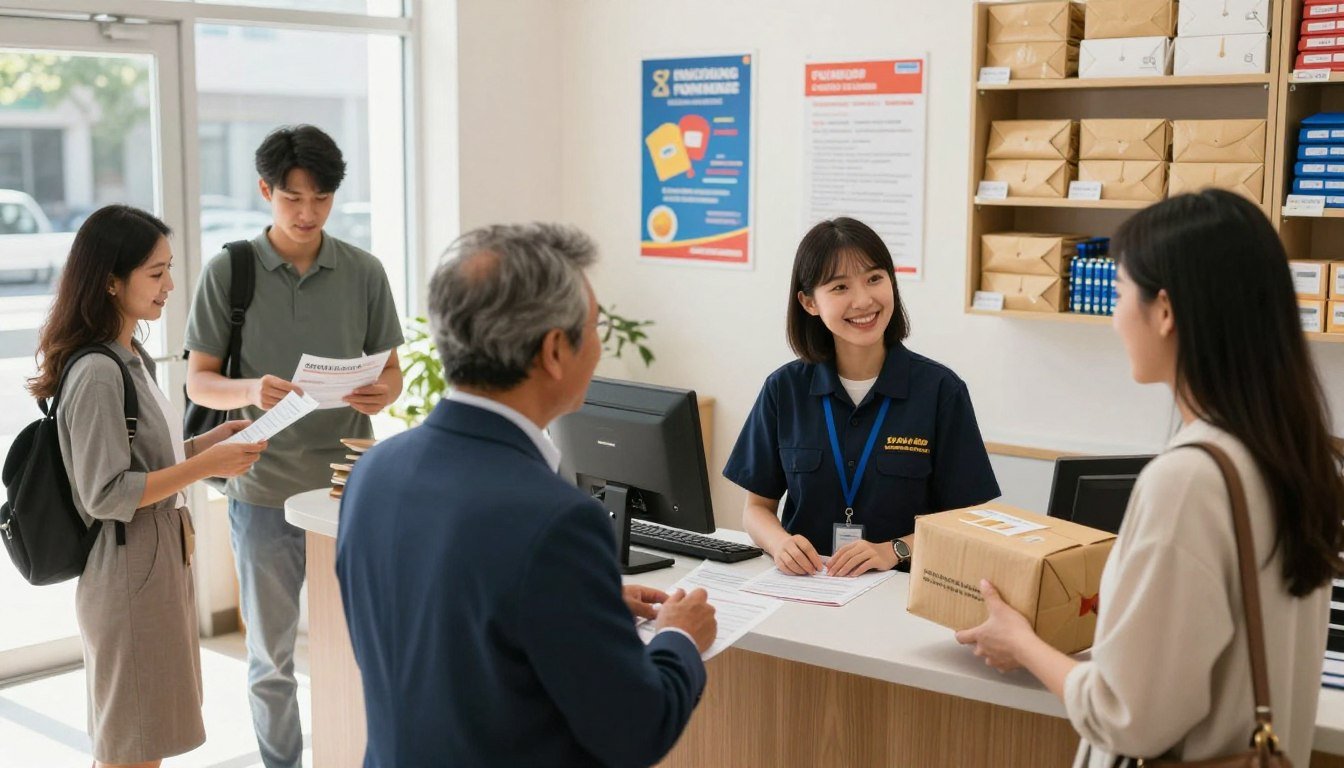
Navigating daily errands in a new country can feel overwhelming, especially when you need to mail packages or buy stamps. Mastering postal services communication is a vital step toward feeling independent and capable in your new community.
This guide provides a practical roadmap for speaking english in post office settings with total ease. You will learn essential phrases and natural post office dialogues that help you interact with clerks confidently. By practicing these common scenarios, you can handle your mailing needs without any stress or confusion.
We focus on clear, everyday vocabulary used across the United States. Whether you are sending a letter or asking for help with international shipping, these examples ensure you are ready for any visit. Let’s dive into these helpful scripts to improve your fluency today.
Key Takeaways
- Learn essential vocabulary for mailing letters and packages.
- Practice natural phrases for interacting with postal clerks.
- Gain confidence in handling common shipping requests.
- Understand how to ask for help with specialized services.
- Improve your overall fluency for everyday errands in the U.S.
English Conversation at the Post Office: Sending a Letter
Walking into a local branch to mail a letter is a perfect way to improve your english conversationahttps://fastspeakeasyenglish.gumroad.com/l/100AmericanEnglishConversationsl skills. Developing clear communication in english at the post office helps you feel confident when handling everyday errands in the United States.
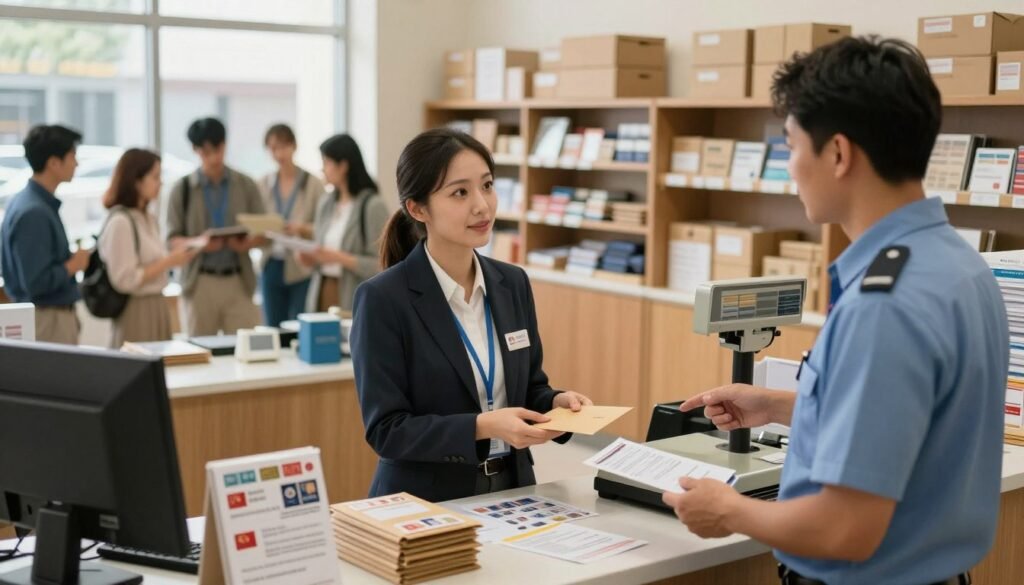
When you approach the counter, remember that clerks are there to assist you. Using polite phrases makes the interaction pleasant for both parties.
Customer and Postal Clerk Dialogue
Customer: “Excuse me, I would like to send this letter to New York. How much will it cost?”
Clerk: “Sure thing. Would you like to send it via regular mail or priority mail?”
Customer: “What is the difference?”
Clerk: “Priority mail is faster and includes tracking, while regular mail is more economical.”
Customer: “I will go with regular mail, please. Do I need any additional postage?”
Clerk: “Let me weigh it for you. It is under one ounce, so a standard stamp is sufficient.”
This exchange serves as excellent dialogue practice at the post office. Notice how the customer asks specific questions to clarify their options before making a decision.
Engaging in this type of post office vocabulary practice helps you master terms like postage, tracking, and standard stamp. Always remember to double-check that your envelope is clearly addressed before you reach the front of the line.
English Conversation at the Post Office: Sending a Package
Navigating the counter at your local post office becomes easy once you master a few key phrases. Learning essential post office vocabulary helps you feel confident when you approach the clerk to ship your items. Whether you are sending a birthday gift or important documents, clear communication ensures your package arrives safely.
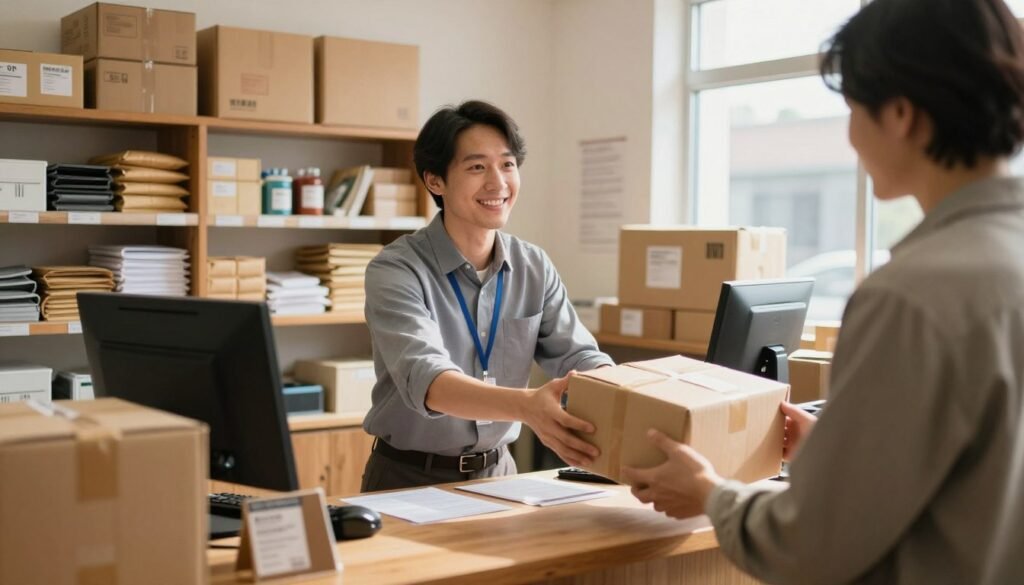
A typical dialogue at the post office often involves specific questions about your parcel. The clerk will usually ask about the weight, the contents, and whether the item is fragile. Being prepared with these details allows you to choose the best shipping method for your needs.
Customer and Postal Clerk Dialogue
Below is a common interaction you might experience when visiting a branch in the United States. These practical english phrases will help you describe your package and understand the clerk’s instructions.
Clerk: Good morning! How can I help you today?
Customer: Hi, I would like to send this package to California.
Clerk: Certainly. Is there anything fragile or liquid inside?
Customer: No, it is just a book and some clothes. Do I need to buy a box here?
Clerk: We have flat-rate boxes available, or you can use your own. Would you like to add insurance for the contents?
Customer: Yes, please add fifty dollars of insurance. How much will that be in total?
Effective mailing services communication relies on knowing the right questions to ask. Use the table below to understand the key factors that influence your shipping experience at the counter.
| Factor | Description | Why It Matters |
|---|---|---|
| Package Weight | Measured in pounds or ounces | Determines the base shipping cost |
| Contents | Description of items inside | Ensures safety and legal compliance |
| Insurance | Coverage for lost or damaged items | Provides financial protection |
| Delivery Speed | Standard vs. Express options | Affects the final price and arrival time |
English Conversation at the Post Office: Asking About Postage
Mastering the art of asking about postage is essential for anyone sending packages in English. When you visit a local branch, you might feel nervous about the costs or the different service levels available. However, asking for assistance at the post office is a standard part of the experience, and clerks are there to help you find the best rate.
If you are unsure about a price or a service recommendation, do not hesitate to ask for clarification. You can simply say, “Could you explain why this option is more expensive?” or “Is there a cheaper way to send this?” Being clear about your needs helps you manage your budget effectively.
Customer and Postal Clerk Dialogue
Customer: Excuse me, I would like to send this package to Chicago. How much will the postage cost?
Clerk: I can certainly help you with that. Let me weigh it first. It is about two pounds.
Customer: That is fine. What are my options for delivery speed?
Clerk: You can choose Priority Mail for two-day delivery, or Standard Ground if you are not in a rush.
Customer: Could you please tell me the price difference between those two?
Clerk: Priority is $15.00, while Ground is $9.50.
Customer: I will go with the Ground option, please. Thank you for your help.
Using essential post office phrases allows you to navigate these interactions with confidence. When you are sending packages in English, always confirm the delivery date before you pay. This ensures you are getting the service that fits your timeline.
| Inquiry Type | Example Phrase | Goal |
|---|---|---|
| Weight | “How much does this weigh?” | Determine base cost |
| Speed | “When will this arrive?” | Confirm delivery time |
| Options | “What is the cheapest rate?” | Compare services |
| Clarification | “Could you repeat that?” | Ensure understanding |
By practicing these exchanges, you will become much more comfortable communicating in English at the post office. Remember that the clerk is a professional who expects these types of questions every day.
English Conversation at the Post Office: Choosing a Shipping Service
Selecting the perfect delivery method is easier when you know exactly what questions to ask the clerk. A productive post office dialogue often starts with you clearly stating your priorities, such as whether you value speed over cost or need extra security for your items.
When you are talking at the post office, it helps to be prepared with the destination and the weight of your package. You can use specific english phrases for the post office to ensure you get the best value for your money.
Selecting the Best Delivery Option
Consider these common factors when deciding on a shipping service:
- Delivery Speed: Do you need it there by tomorrow or is next week fine?
- Tracking: Is it important to monitor the package location in real-time?
- Insurance: Does the item have high value and require extra protection?
“Always ask about the estimated delivery date before you finalize your payment to avoid any surprises.”
Here is a typical postal service conversation to help you practice your skills at the counter:
Customer: “Hi, I need to send this box to Chicago. What are my best options?”
Clerk: “It depends on your needs. We have Priority Mail for fast delivery or Ground Advantage for a more budget-friendly rate.”
Customer: “I need it to arrive within three days. Does that include tracking?”
Clerk: “Yes, both options include tracking. Priority Mail is your best bet for that timeframe, and it comes with $100 of insurance included.”
Customer: “That sounds perfect. I will go with the Priority option, please.”
English Conversation at the Post Office: Tracking a Package
When you send or receive important items, knowing how to monitor their progress is a key skill. Mastering post office english vocabulary allows you to resolve issues quickly if a shipment seems stuck or delayed. Whether you are checking a status online or visiting a branch, clear communication ensures you get the information you need.
Sometimes, tracking updates can be confusing. You might see terms like “out for delivery” or “delivery attempt made.” If your package has not arrived by the expected date, do not hesitate to ask for assistance.
Dialogue Between a Customer and a Postal Clerk
Customer: “Excuse me, I am worried about a package. The tracking status has not updated in three days.”
Clerk: “I can certainly help you with that. Do you have your tracking number and the receipt with you?”
Customer: “Yes, here it is. It was supposed to arrive yesterday, but the status just says ‘in transit’.”
Clerk: “Let me check the system. It looks like there was a minor delay at the sorting facility, but it is back on the move now. You should see it by tomorrow.”
Customer: “Thank you for checking. I feel much better knowing it is on its way.”
“Effective post office communication in English relies on having your tracking number ready before you approach the counter.”
When speaking english at the post office, it is helpful to understand common shipping terms. A “scanned” package means it has been processed at a facility. A “delivery attempt” indicates the carrier tried to drop off the item but could not access the location.
If you find yourself in a mailing conversation in English regarding a lost item, stay calm and provide all identifying details. Always keep your receipt until the package is safely delivered to your door.
English Conversation at the Post Office: Picking Up a Package
Navigating the process of retrieving a held parcel is simple if you know the right English phrases for post office interactions. When a carrier cannot leave a package at your door, they leave a notice. This notice indicates that your item is being held at the local branch. Mastering speaking at the post office helps you resolve these delivery issues quickly and efficiently.
Before you head to the counter, it is helpful to understand common terminology. To deliver means the carrier brings the item to your home. A hold occurs when the post office keeps your mail for a specific time. You must sign for an item if it requires proof of receipt, and you pick up a package when you collect it in person.
Effective communication at the post office relies on having your identification ready. You should always bring a government-issued ID, such as a driver’s license, to verify your identity. If you are sending someone else to collect your mail, they usually need a signed note from you and their own identification.
“The post office is a vital hub for community connection, ensuring that every parcel finds its way to the right hands through clear and polite interaction.”
Customer and Postal Clerk Dialogue
This postal service dialogue demonstrates how to request your held package politely. Using clear language ensures the clerk can assist you without confusion.
Customer: “Hello, I received a notice that a package was held for me. I would like to pick it up, please.”
Clerk: “Certainly. May I see your pickup notice and a valid photo ID?”
Customer: “Here you go. Is it possible for my spouse to pick up my mail if I am busy?”
Clerk: “Yes, but they must bring a signed authorization note from you and their own ID.”
| Term | Definition | Usage |
|---|---|---|
| Pick up | To collect an item | “I am here to pick up a box.” |
| Sign for | Provide a signature | “Do I need to sign for this?” |
| Hold | Keep mail at the office | “Please hold my mail for a week.” |
| Deliver | Bring to an address | “When will you deliver this?” |
English Conversation at the Post Office: Sending International Mail
Sending a package to another country is a fantastic way to engage in practicing english at the post office. While the process involves more paperwork than domestic shipping, it provides a perfect opportunity for improving language skills at the post office through real-world interaction.
When you visit the counter, you will likely need to fill out customs forms and verify that your items are not prohibited. Being prepared with questions about costs and delivery times helps you navigate these conversations with confidence.
Customer and Postal Clerk Dialogue
“Communication is the bridge between confusion and clarity when navigating international shipping requirements.”
Customer: Hello! I would like to send this small gift box to a friend in France. Could you help me with the international requirements?
Postal Clerk: Certainly! First, you will need to complete this customs declaration form. Please list the contents, their value, and whether they are gifts or merchandise.
Customer: I see. Are there any items that are prohibited from being sent to France?
Postal Clerk: Yes, you cannot send perfumes, lithium batteries, or perishable food items. Is there anything like that in your box?
Customer: No, it is just a book and a scarf. How much will the shipping cost, and how long will it take to arrive?
Postal Clerk: For a package of this weight, the priority rate is $45.00, and it should arrive within 6 to 10 business days.
Engaging in these post office dialogues in english allows you to practice specific vocabulary related to logistics and international trade. If you feel overwhelmed by the forms, do not hesitate to ask for clarification.
Here are some common phrases for post office conversation in english that you can use during your next visit:
- “Could you please explain how to fill out this customs form?”
- “What is the most cost-effective way to ship this internationally?”
- “Is there a tracking number included with this service?”
- “Are there any restrictions I should be aware of for this destination?”
English Conversation at the Post Office: Buying Stamps
Engaging in English dialogue at the post office starts with knowing how to ask for the right postage. Whether you are mailing a birthday card or a stack of documents, having the key vocabulary for post office conversations in English makes the process smooth and stress-free.
Many visitors feel nervous about speaking up, but clerks are usually very helpful. Learning a few simple phrases will help you feel confident during your next visit.
Customer and Postal Clerk Dialogue
Customer: “Excuse me, I would like to buy some stamps for a standard letter. Do you have any commemorative designs available?”
Postal Clerk: “Yes, we have several beautiful options. Would you like a single stamp or a full sheet of twenty?”
Customer: “I think a sheet of twenty would be great. Can I use these for international mail as well, or are they only for domestic use?”
Postal Clerk: “These are ‘Forever’ stamps, which are perfect for domestic letters. If you are sending mail abroad, you will need extra postage to cover the international rate.”
Customer: “That makes sense. I will take the sheet of stamps, and I will also buy a few extra stamps for future use. Thank you for your help with this English for postal services request!”
To help you prepare for your visit, refer to the following guide on common stamp options you might encounter during interactive English conversations at the post office.
| Stamp Type | Best Use | Quantity |
|---|---|---|
| Forever Stamp | Domestic Letters | Single or Sheet |
| Postcard Stamp | Standard Postcards | Roll or Sheet |
| Global Stamp | International Mail | Single or Pack |
| Commemorative | Special Occasions | Sheet Only |
English Conversation at the Post Office: Renting a PO Box
Navigating the process of renting a PO Box at your local post office is quite straightforward. Engaging in this task is an excellent way for learners to focus on improving spoken English at the post office. By asking clear questions about availability and terms, you gain confidence in handling administrative tasks in a professional setting.
When you visit the counter, you will likely engage in a postal services conversation regarding the different box sizes and rental durations available. It is important to have your identification ready, as the clerk will need to verify your information to complete the application.
Customer and Postal Clerk Dialogue
Customer: “Hello! I am interested in renting a PO Box. Are there any small boxes available at this location?”
Clerk: “Yes, we have a few small boxes available. Would you like to rent it for six months or a full year?”
Customer: “I think six months is fine for now. What do I need to provide to get started?”
Clerk: “You will need to fill out this form and provide two forms of valid identification, such as a driver’s license and a utility bill.”
Customer: “That sounds easy enough. Once I pay, do I get the keys immediately?”
Clerk: “Yes, you will receive two keys today. You can start using your new address format right away.”
Practicing effective communication at the post office ensures that you understand the rules regarding mail pickup and box maintenance. Clear dialogue helps you avoid confusion about how to address your incoming mail properly.
Participating in role-playing conversations at the post office is a highly recommended strategy for language learners. It allows you to practice formal vocabulary in a low-pressure environment while learning how to navigate real-world services.
| Box Size | Capacity | Best For |
|---|---|---|
| Small | Letters and small envelopes | Personal mail |
| Medium | Magazines and catalogs | Small businesses |
| Large | Priority mail packages | Frequent shippers |
English Conversation at the Post Office: Reporting a Lost Package
Learning how to handle unexpected issues is a key part of improving english skills at the post office. When a shipment fails to arrive on time, using the right english dialogue for post office scenarios helps you resolve the problem efficiently.
Customer and Postal Clerk Dialogue
Customer: Excuse me, I am here to report a package that never arrived. It was supposed to be delivered last Tuesday.
Postal Clerk: I am sorry to hear that. Do you have your tracking number with you?
Customer: Yes, it is 9400-1000-2000-3000-4000-50. The address was 123 Maple Street, Springfield.
Postal Clerk: Let me check our records. It appears the package was scanned as delivered, but I will open a formal inquiry for you.
Customer: Thank you. What are the next steps I should take while you investigate?
Postal Clerk: You will receive an email update within three business days. Please keep your receipt safe until we resolve this.
Engaging in this type of post office language practice ensures you can handle stressful situations with confidence. Always remember to speak clearly when providing dates and addresses to avoid confusion. Consistent english speaking practice at the post office will make you feel more comfortable during your future visits.
English Conversation at the Post Office: Asking About Delivery Times
Many people find speaking English in postal situations much easier when they understand how to ask about delivery times. Developing strong post office communication skills allows you to plan your shipments with confidence and clarity.
When you visit the counter, it is helpful to know that clerks provide estimates rather than guarantees. Using the right language ensures you get the most accurate information available for your specific mailing needs.
Customer and Postal Clerk Dialogue
Customer: “Hello! I need to send this package to California. How long will it take to get there?”
Postal Clerk: “If you choose our standard service, the estimated delivery is about five business days. Would you like to see a faster option?”
Customer: “Yes, please. What is the fastest way to send it?”
“Efficiency is the foundation of reliable service, but patience is the key to successful delivery.”
Postal Clerk: “Our priority service should arrive by the end of the second day. Please keep in mind that this is an estimate, not a guaranteed date.”
Customer: “That sounds perfect. I also have an international letter. How long does that usually take?”
Postal Clerk: “International mail varies by country, but it typically takes seven to ten business days. Engaging in this type of post office english conversation practice helps you prepare for any shipping scenario.”
Mastering these key phrases for post office interactions will make your future visits much smoother. Always remember to ask for a tracking number if you want to monitor your item’s progress after you leave the building.
English Conversation at the Post Office: Filling Out a Mailing Form
Navigating the paperwork at a local branch is a common part of using postal services in English. Whether you are shipping a gift or a business document, understanding the required forms is essential for a successful delivery. Building your english vocabulary for post office visits will help you handle these tasks with ease and confidence.
Dialogue for Completing Forms
The following conversation demonstrates how to ask a clerk for assistance when you are unsure about a specific section of a customs declaration form.
Customer: Excuse me, I need to send this package to Canada, but I am confused about the customs form. Could you help me?
Clerk: Certainly! You need to list the contents clearly, the total value of the items, and the weight. Do you have the recipient’s full address and phone number?
Customer: Yes, I have the address here. Do I need to sign the bottom section?
Clerk: Yes, your signature is required to certify that the information is accurate. Please fill out the sender information in the top box as well.
When you are sending mail vocabulary is your best tool for success. You should look for terms like “Declared Value,” “Country of Origin,” and “Recipient Details” on every label. Always double-check that your contact information is legible so the clerk can reach you if there is an issue.
For improving spoken English at the post office, try repeating these phrases aloud before you arrive. Practice asking, “Could you explain this section?” or “Is this the correct form for international shipping?” to build your comfort level.
| Form Field | Purpose | Required Action |
|---|---|---|
| Sender Info | Identify the shipper | Print full name and address |
| Declared Value | Determine insurance | Write the total dollar amount |
| Contents | Customs clearance | List items specifically |
| Signature | Legal verification | Sign and date the form |
Common Post Office English Phrases Used in Conversations
Mastering a few key post office dialogue phrases can turn a potentially stressful trip into a smooth, efficient experience. When you walk up to the counter, a simple “Good morning, I would like to send this package” is the perfect way to start your interaction.
Understanding postage terms in English is essential for ensuring your items arrive at their destination without delay. Familiarizing yourself with these core concepts helps you communicate your needs clearly to the postal clerk.
“Communication is the bridge between confusion and clarity, especially when navigating the services of a busy post office.”
To help with your mail conversation practice, consider these common categories and examples:
- Greeting: “Hello, I need to mail this letter to California.”
- Describing an item: “This is a small, fragile package containing a glass ornament.”
- Asking about postage: “How much does it cost to send this via Priority Mail?”
- Requesting tracking: “Could you please provide a tracking number for this shipment?”
- Clarifying delivery: “When can the recipient expect this to be delivered?”
Learning specific words for mailing in English will boost your confidence significantly. Key terms include an envelope for letters, a package for larger items, and a stamp for basic postage. If you are sending items abroad, you will likely need to fill out a customs form to comply with international regulations.
Always remember that the clerk is there to assist you. If you are unsure about a service, simply ask, “What is the most affordable way to send this?” Using these phrases ensures you get the right service every time you visit.
Frequently Asked Questions About English Conversation at the Post Office
Mastering a few common post office phrases will make your next trip to the post office much easier. Many learners feel nervous about speaking at the counter, but remember that postal clerks are there to help you.
“Communication is the bridge between confusion and clarity,” as many language experts often suggest. By using polite, direct language, you can ensure your mail reaches its destination without any stress.
If you are worried about what to say, start with simple questions. You can ask, “How much does it cost to send this to California?” or “What is the fastest way to ship this package?” These questions are perfectly acceptable and help the clerk provide the best service.
When you need to track an item, simply ask, “Can I get a tracking number for this?” If you are picking up a package, always have your identification ready. You might say, “I am here to pick up a package, and here is my ID.”
Using common post office phrases helps you feel more in control of the situation. Whether you are buying stamps or sending international mail, keep your sentences short and clear. You will find that your confidence grows with every successful visit to the counter.
Conclusion
Navigating a trip to the United States Postal Service becomes much easier when you feel prepared. Mastering English Conversation at the Post Office allows you to handle mailing letters, buying stamps, or shipping packages with total ease.
You now possess the tools to ask about delivery times and track your important items. Consistent practice remains the best way to build your skills. Try repeating these sample dialogues aloud to improve your pronunciation and speed.
Feel free to adapt these phrases to fit your specific mailing needs at your local branch. Using clear English Conversation at the Post Office helps you communicate your requests to postal clerks effectively. You will find that your confidence grows with every successful interaction.
Keep this guide handy for your next visit to the post office. Reviewing these common scenarios ensures you stay ready for any mailing task. Your ability to engage in smooth English Conversation at the Post Office will make every errand a simple and productive experience.