
English Conversation at the Cinema
Going to see a new blockbuster is a favorite pastime…
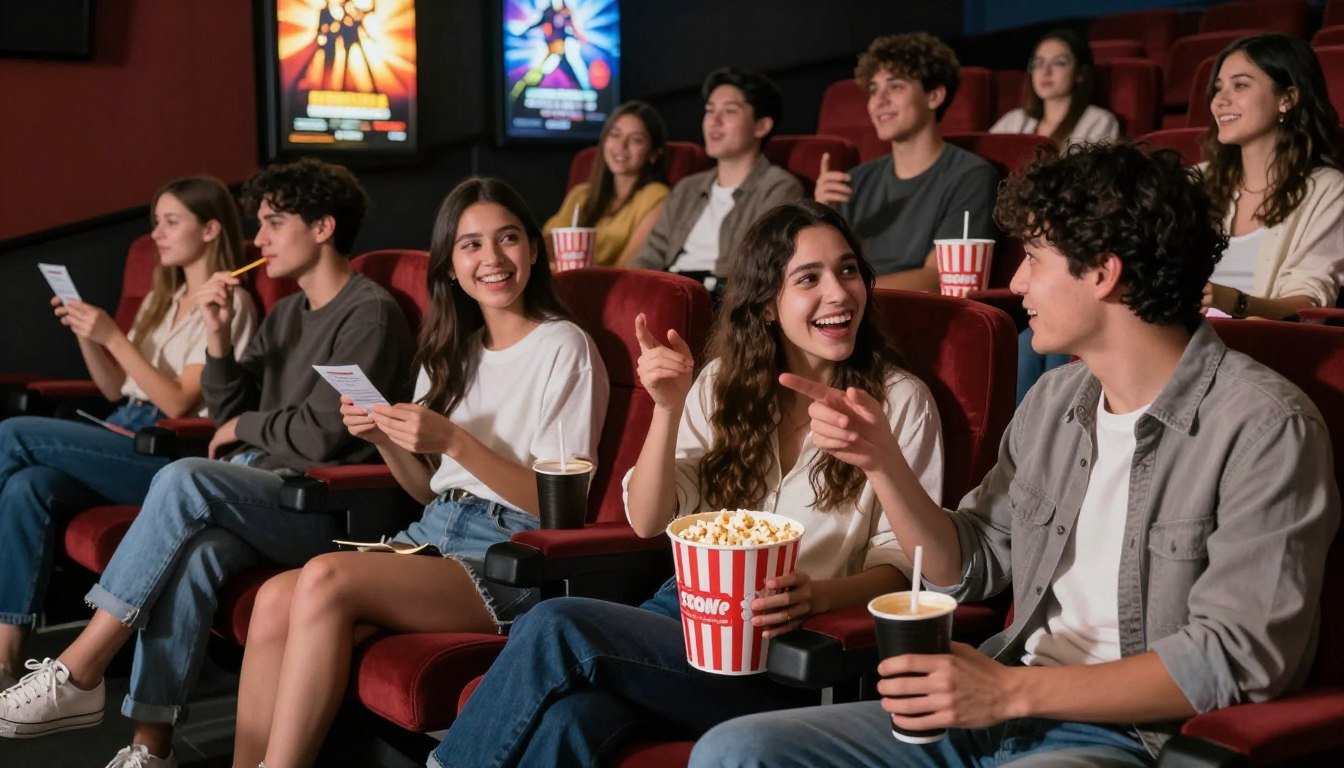
Going to see a new blockbuster is a favorite pastime for many people across the United States. Whether you are planning a date night or meeting friends, knowing how to navigate these social interactions is essential for fluency. This guide provides a comprehensive resource to help you master everyday interactions with confidence.
Our sixteen-part series breaks down the process into manageable steps. You will learn vital cinema vocabulary english to help you buy tickets, select snacks, and find your seat. We also cover common movie phrases in english that help you discuss plots or share opinions with others.
Each lesson moves from basic tasks like checking showtimes to handling complex situations. By practicing these realistic dialogues, you will feel prepared for your next trip to the theater. Let’s start building your skills today.
Key Takeaways
- Learn practical vocabulary for buying tickets and concessions.
- Master common phrases used when discussing films with friends.
- Understand how to navigate theater etiquette in the United States.
- Practice realistic dialogues to boost your speaking confidence.
- Follow a structured path from arrival to the final credits.
English Conversation at the Cinema: Buying Movie Tickets
Navigating the ticket booth is a classic scenario for practicing your English skills. Engaging in film dialogues english helps you feel more confident when visiting a local theater in the United States.
Whether you are planning a solo trip or a night out with friends, knowing how to ask for showtimes and prices is vital. This interaction is often the first step in talking about movies in english with staff members.
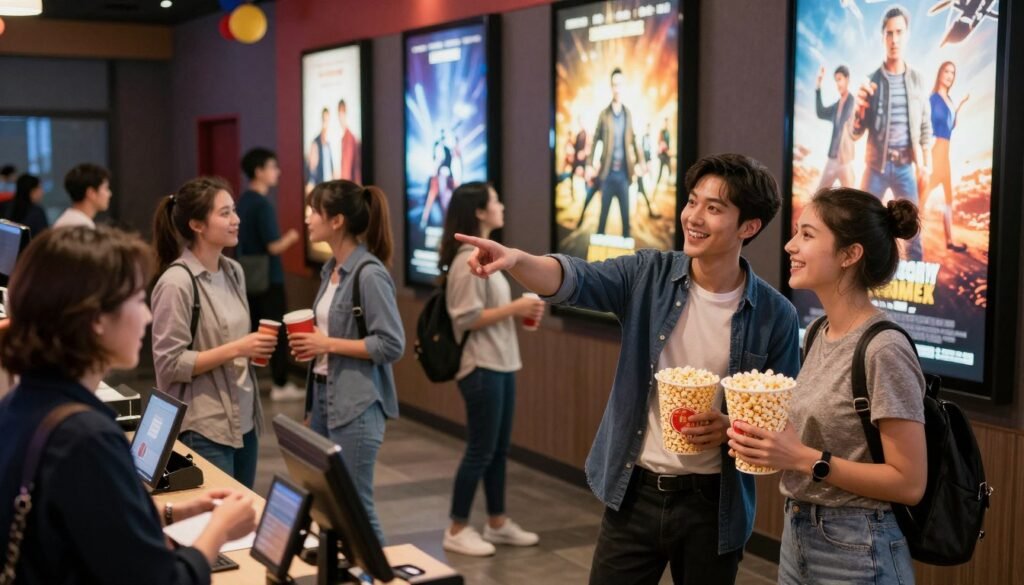
Customer and Ticket Clerk Dialogue
When you approach the counter, keep your request clear and polite. Using cinema small talk english can make the experience more pleasant for both you and the clerk.
Customer: Hi there! Could I get two tickets for the 7:00 PM showing of “Space Explorers,” please?
Clerk: Sure thing. That will be $28.00 total. Would you like to sit in the middle or closer to the front?
Customer: The middle would be great, thank you.
Below is a helpful guide to common phrases you might use during your visit to the box office.
| Phrase Type | Example Sentence | Purpose |
|---|---|---|
| Inquiry | What time does the next show start? | Checking schedules |
| Request | I would like two adult tickets. | Buying admission |
| Confirmation | Is this for the IMAX screen? | Verifying details |
| Payment | Do you accept credit cards? | Completing transaction |
Always remember to check your ticket after the transaction is complete. This ensures you have the correct date, time, and seat number before you head to the concession stand.
English Conversation at the Cinema: Asking About Movie Times
Mastering the art of asking for showtimes makes your trip to the movies much smoother. When you are discussing films in English with friends or staff, knowing how to inquire about schedules is a fundamental skill. It helps you avoid missing the start of the movie and ensures you have plenty of time to grab your snacks.
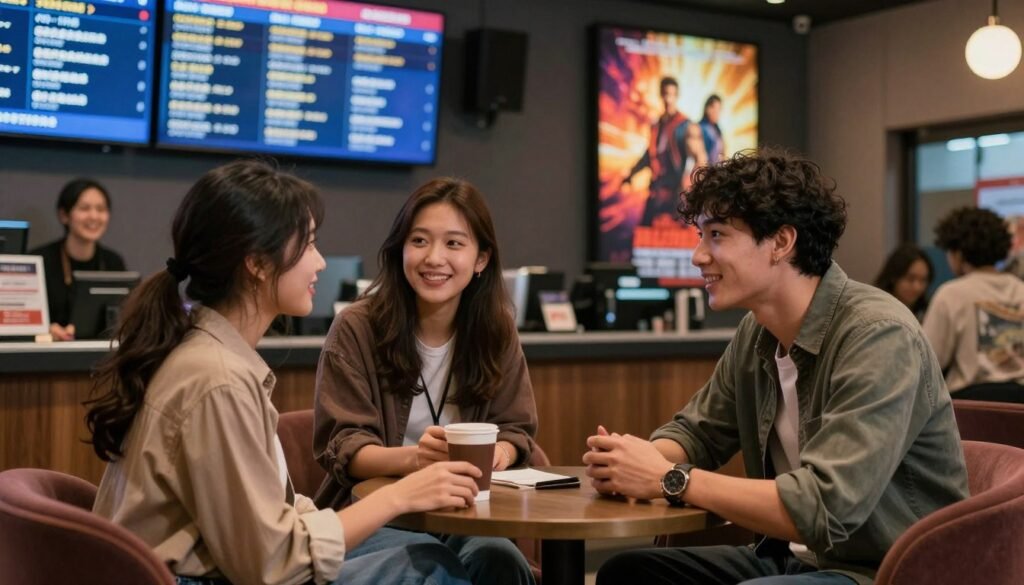
Whether you are visiting a local multiplex or a boutique theater, the process is usually the same. You want to be clear and polite while getting the information you need to plan your evening effectively.
Customer and Ticket Clerk Dialogue
“Excuse me, could you tell me what time the next showing of ‘The Galactic Journey’ starts?” the customer asks. The clerk smiles and replies, “Certainly! We have a screening at 7:15 PM and another one at 9:45 PM.”
The customer considers the options and says, “The 7:15 PM show sounds perfect. Is that the one in the main auditorium?” This type of English movie chatter is very common when you are trying to decide which screening is most convenient for your schedule.
“The best way to enjoy a movie is to arrive early enough to get settled before the trailers begin.”
To help you navigate these interactions, keep these cinema conversation phrases English learners often use in mind:
- “What time does the movie start?”
- “Are there any seats left for the 8:00 PM show?”
- “Is this the last showing of the night?”
- “How long is the movie, including trailers?”
Using these simple questions will help you feel more confident. Remember that being polite and direct is the best way to get the information you need quickly.
English Conversation at the Cinema: Choosing a Movie
When you head to the theater with friends, the fun starts with choosing what to watch. Engaging in a film discussion in English is a great way to practice your language skills while planning a night out. Whether you prefer action-packed blockbusters or quiet indie dramas, talking about movies helps everyone get on the same page before you reach the ticket counter.
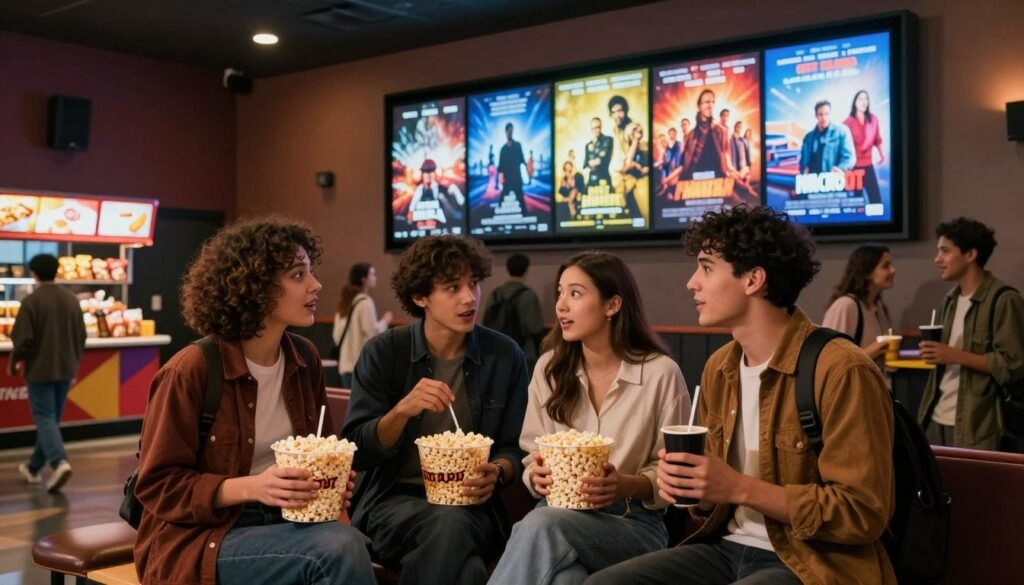
Friends Dialogue
Sarah and Mike stand in the lobby, looking at the digital display of showtimes. They need to decide on a film that suits both of their tastes.
Sarah: “I really want to see that new sci-fi thriller, but the reviews say it’s a bit slow. What do you think?”
Mike: “I’m not sure. I usually prefer comedies or action movies. How about that new superhero film instead?”
Sarah: “That sounds like a fun idea! I’ve heard the lead actor is fantastic in it. Let’s go with that one.”
Mike: “Perfect, let’s grab our tickets before the line gets too long.”
This type of movie theater dialogue is common when friends try to balance their personal preferences. By using polite suggestions and active listening, they can quickly reach a decision. If you are still unsure about what to pick, consider the following breakdown of popular genres to guide your next film discussion in English.
| Genre | Best For | Key Elements |
|---|---|---|
| Action | High energy | Stunts and pacing |
| Comedy | Relaxing | Humor and timing |
| Drama | Deep thought | Character development |
| Sci-Fi | Imagination | Future concepts |
English Conversation at the Cinema: Choosing Seats
Finding the perfect spot in a theater can make or break your movie experience. Whether you prefer the back row for extra legroom or the middle for the best sound, knowing how to communicate your needs is essential for cinematic conversations in English.
When you arrive at the box office, don’t be afraid to ask the clerk for their recommendation. A simple chat at the movies can help you secure a seat that offers the best view of the screen without any neck strain.
Engaging in an English language exchange at the cinema is a practical way to improve your speaking skills. You can ask about availability by using clear, direct questions that help the staff assist you quickly.
Customer and Ticket Clerk Dialogue
Customer: Hi there! I would like two tickets for the 7:00 PM showing of the new action movie, please.
Ticket Clerk: Sure thing. We have plenty of seats left. Do you have a preference for where you would like to sit?
Customer: We would love to sit somewhere near the center of the theater if possible. Are there any spots available in the middle rows?
Ticket Clerk: Let me check. Yes, I have two seats in row F, which is right in the center. Would that work for you?
Customer: That sounds perfect, thank you! We will take those.
Using phrases like “Do you have a preference?” or “I would love to sit near the center” makes your request sound natural and polite. Remember that clear communication ensures you get exactly what you want for your night out.
English Conversation at the Cinema: Buying Snacks and Drinks
Learning how to order snacks is a vital part of mastering theater conversations in English. Whether you are craving buttery popcorn or a cold soda, the concession stand is a hub of activity where you can practice your language skills in a real-world setting. Understanding these movie dialogues in English will help you feel more confident during your next visit to the theater.
Customer and Cinema Staff Dialogue
When you approach the counter, the staff member will usually greet you and ask what you would like to order. Here is a typical exchange you might hear:
Staff: Welcome! What can I get for you today?
Customer: Hi! I would like a large popcorn and two medium sodas, please.
Staff: Sure thing. Would you like any candy or nachos with that?
Customer: Yes, let me get a box of chocolate-covered raisins as well.
Staff: Great. That will be $18.50. Will you be paying with cash or card?
Customer: I will pay with my card.
Engaging in these types of film discussions in English allows you to become familiar with common pricing and payment terminology. You can use phrases like “I would like,” “Can I get,” or “That will be all” to keep your interaction smooth and polite.
To help you prepare for your next visit, the following table outlines common items you might find at a standard American cinema concession stand.
| Snack Item | Size Options | Estimated Price |
|---|---|---|
| Popcorn | Small, Medium, Large | $7.00 – $10.00 |
| Soft Drink | Small, Medium, Large | $4.00 – $6.50 |
| Boxed Candy | Standard Size | $3.50 – $5.00 |
| Nachos | Single Serving | $5.00 – $7.00 |
English Conversation at the Cinema: Asking About the Movie
Engaging in cinema chat in English helps you get the most out of your movie night. Whether you are curious about the content or the technical format, the staff is there to assist you. Being prepared with a few polite questions ensures a smooth experience before the lights go down.
When you approach the counter, keep your inquiries brief and clear. This is especially helpful during busy times when the staff needs to assist many guests quickly. Using polite phrases makes your interaction pleasant for everyone involved.
Customer and Cinema Staff Dialogue
Customer: Excuse me, could you tell me if this movie is suitable for children?
Staff: Yes, it is rated PG-13, so it is generally fine for older kids.
Customer: That is great to know. Is this screening in the standard format or IMAX?
Staff: This specific showing is in standard 2D format.
Customer: Perfect, thank you for your help with my spoken English at the movies today!
To help you prepare for your next visit, refer to the table below. These examples of english movie talk cover the most common details you might need to verify.
| Question | Purpose | Expected Answer |
|---|---|---|
| Is this movie in English? | Language check | Yes, it is in English. |
| What is the rating? | Content suitability | It is rated R. |
| Is it available in 3D? | Format preference | No, only 2D is available. |
| Are there any seats left? | Availability | Yes, we have plenty. |
English Conversation at the Cinema: Finding the Theater
Have you ever felt lost while trying to find your auditorium in a busy cinema? Navigating a large complex can be tricky, but mastering some basic cinema dialogue practice will help you feel much more confident. Whether you are looking for the restroom or your specific screen, knowing how to ask for help is a great skill.
Improving your movie theater English speaking ability allows you to move through the lobby with ease. When you approach a staff member, remember to be polite and clear. Using simple directional terms makes it easier for the staff to guide you to your destination quickly.
Customer and Cinema Staff Dialogue
Customer: Excuse me, could you please tell me where Auditorium 4 is located?
Staff: Of course! You need to head upstairs. Once you reach the top, turn to the left and you will see the entrance right next to the snack bar.
Customer: Thank you so much for your help!
Staff: You are very welcome. Enjoy the movie!
Learning these phrases is just as important as building your film discussion vocabulary. Being able to navigate the building ensures you do not miss the opening trailers. Refer to the table below for common terms you can use during your next visit.
| Directional Term | Usage Example | Context |
|---|---|---|
| Upstairs | The screen is located upstairs. | Vertical movement |
| To the left | The restrooms are to the left. | Horizontal orientation |
| Next to | It is next to the exit door. | Proximity reference |
| Straight ahead | Walk straight ahead to the lobby. | Direct path |
English Conversation at the Cinema: Asking About the Movie Duration
Understanding movie runtimes is a key part of mastering cinema conversation skills. When you visit a theater, knowing how long a film lasts helps you manage your schedule for the rest of the day or night.
Most movie listings show the total running time, but this often excludes the time spent watching trailers. It is helpful to remember that trailers usually add about 15 to 20 minutes to the total experience before the actual feature film begins.
Customer and Cinema Staff Dialogue
Engaging in dialogue practice at the movies allows you to feel more confident when asking staff for specific details. Here is a common interaction you might have at the ticket counter:
Customer: Excuse me, could you tell me how long the new action movie lasts?
Staff: The total running time is about two hours and fifteen minutes.
Customer: Does that include the trailers, or is that just the movie itself?
Staff: That is just the movie. With the trailers, you should expect to be here for about two hours and forty minutes total.
Customer: Great, thank you for the information!
This type of movie theater language learning is practical for any visitor. Refer to the table below to understand the common terms used when discussing time at the cinema.
| Term | Definition | Usage Context |
|---|---|---|
| Running Time | The length of the film | Total duration of the movie |
| Trailers | Previews of upcoming films | Shown before the main feature |
| Scheduled Start | The official showtime | When the trailers begin |
| Feature Film | The main movie | The primary content shown |
English Conversation at the Cinema: Talking About a Movie
The lights come up, and now it is time to share your honest opinion about what you just watched. Engaging in english conversations in a cinema setting is one of the best ways to build your confidence and fluency. Whether you loved the film or found it boring, expressing your thoughts helps you connect with others while practicing your vocabulary.
To get the most out of your experience, try using specific adjectives to describe the plot, the acting, and the soundtrack. Below is a sample of movie theater dialogue practice that you can use with your friends to improve your conversational skills.
Friends Dialogue
Sarah: That was quite an intense movie! What did you think of the plot?
Mike: Honestly, I thought the story was a bit confusing at first, but the ending really tied everything together. I did not expect that twist!
Sarah: I agree. The acting was superb, especially from the lead actress. However, I felt the soundtrack was a little too loud during the action scenes.
Mike: That is a fair point. It was definitely very dramatic, but it kept me on the edge of my seat the whole time.
When you participate in these types of film talk exercises, remember to focus on being descriptive. Instead of just saying a movie was “good,” try to explain why you liked it. Using phrases like “I was impressed by…” or “I found the pacing to be…” will make your English sound much more natural and professional.
English Conversation at the Cinema: Arriving Late
Mastering the art of polite inquiry when you are late is a key part of conversational English for the movies. While it can feel awkward to walk into a dark theater, knowing the right words helps you navigate the situation with confidence. These cinema chit-chat lessons ensure you remain respectful of other viewers while getting the help you need.
When you arrive after the show has started, it is important to check if you are still allowed to enter. Staff members can inform you if the main feature has begun or if you are still watching the trailers. They can also provide guidance on how to find your seat without causing a major disturbance to those already watching.
Customer and Cinema Staff Dialogue
Customer: Excuse me, I am so sorry I am late. Is it still okay to enter the theater for the 7:00 PM showing?
Staff: No problem at all. You are just in time, as the trailers are still playing. The main feature starts in about five minutes.
Customer: That is a relief. Is it very dark inside right now?
Staff: It is getting dim, but the ushers are available to help you find your seat. Please try to move quietly to avoid discussing films at the theater or talking loudly once you are inside.
When you are discussing films at the theater or simply trying to settle in, remember that keeping your voice low is essential. Using conversational English for the movies effectively means being mindful of your surroundings. The following table provides useful phrases for these moments.
| Situation | Polite Phrase | Purpose |
|---|---|---|
| Checking entry | “Is it still okay to go in?” | Confirming access |
| Asking for help | “Could you show me my seat?” | Requesting assistance |
| Apologizing | “Sorry for the disturbance.” | Showing courtesy |
| Clarifying time | “Has the movie started yet?” | Checking status |
English Conversation at the Cinema: Asking Someone to Be Quiet
Handling disruptions in the cinema requires a balance of firmness and courtesy. While chatting about cinema in English is a fun way to pass the time in the lobby, the screening room demands a different level of respect for other viewers.
Cinema Visitors Dialogue
If someone is talking loudly or using their phone, a polite request is usually the best approach. You can address the situation without causing a scene by keeping your tone calm and direct.
Visitor A: Excuse me, would you mind lowering your voice? It is a bit hard to hear the dialogue.
Visitor B: Oh, I am so sorry! I did not realize I was being that loud.
Visitor A: Thank you, I appreciate it. I really want to focus on the movie.
Engaging in movie talk in English is best saved for after the credits roll. When you keep your comments to a whisper or wait until you leave, you help maintain the atmosphere for everyone around you.
Improving your film discussion fluency means knowing when to speak and when to listen. By practicing these polite social cues, you ensure that your cinema experience remains enjoyable for yourself and your neighbors.
English Conversation at the Cinema: Reporting a Problem
Encountering a problem at the cinema can be frustrating, but knowing how to report it helps. Whether you are dealing with a broken seat, poor audio quality, or an uncomfortable room temperature, staying calm is the best way to get a quick resolution. Clear and polite communication ensures that the staff can assist you effectively.
Customer and Cinema Staff Dialogue
Practicing these scenarios is a great way to engage with dialogues in movies esl learners can use to build confidence. Below is a typical interaction between a customer and a staff member regarding a technical issue.
Customer: Excuse me, I am sorry to bother you, but the sound in theater four is very muffled. It is quite hard to hear the dialogue.
Staff: I am very sorry to hear that. Thank you for letting me know. I will check the audio settings immediately.
Customer: Thank you. Also, the seat in row F, number 12, seems to be broken and will not recline.
Staff: I apologize for the inconvenience. Please follow me, and I will move you to a better seat right away.
When you are talking about films in english, you often need to describe specific situations. Using these structured dialogues helps with your speaking skills improvement by providing real-world context for your vocabulary.
| Problem Type | Polite Phrase to Use | Expected Staff Response |
|---|---|---|
| Faulty Seat | “My seat is broken.” | “Let me find you a new one.” |
| Poor Sound | “The audio is too low.” | “I will adjust the volume.” |
| Blocked Screen | “I cannot see the screen.” | “I will ask them to move.” |
| Temperature | “It is too cold in here.” | “I will check the thermostat.” |
Common Cinema English Phrases Used in Conversations
Mastering the right vocabulary is essential for a smooth experience at the movies. By learning specific expressions, you can boost your cinematic language proficiency and feel more confident during your next visit to the theater.
It is important to use polite language when speaking with staff. Using phrases like “Could I please have…” or “Would it be possible to…” shows respect and helps you get better service.
Below is a guide to help you organize your thoughts and practice common interactions. These categories cover the most frequent situations you will encounter.
| Purpose | Key Phrase | Politeness Level |
|---|---|---|
| Buying Tickets | “Two tickets for the 7:00 PM show, please.” | High |
| Ordering Snacks | “I would like a large popcorn and a soda.” | Medium |
| Asking Directions | “Could you tell me where Theater 4 is?” | High |
To improve your dialogue comprehension practice, try reading these phrases aloud while focusing on your intonation. Clear pronunciation makes it much easier for the ticket clerk or staff member to understand your request quickly.
You can use these theater conversation exercises to test your skills:
- Roleplay: Practice asking for a seat in the middle of the row with a friend.
- Listening: Watch a movie trailer and try to summarize the plot in three simple sentences.
- Review: Reflect on the previous dialogues to identify which phrases felt most natural to you.
Consistent dialogue comprehension practice is the best way to become fluent. Remember that the goal of these theater conversation exercises is to help you communicate your needs effectively while enjoying the film. Keep practicing, and you will soon find that navigating the cinema is a breeze!
Frequently Asked Questions About English Conversation at the Cinema
Mastering cinema-related English can transform your next trip to the theater into a great learning opportunity. Many students ask how they can sound more natural when discussing their favorite films. Consistent movie dialogue practice is the most effective way to build confidence before you even step into the lobby.
By focusing on watching movies dialogues, you learn how native speakers use rhythm and intonation. This helps you move beyond basic textbook sentences. You will start to notice how people express excitement or disappointment about a plot twist in real time.
You might wonder which film talk phrases are most useful for daily life. It is helpful to keep a few simple expressions ready for when you want to share your opinion. For example, you can say, “The cinematography was breathtaking,” or “I found the ending quite unexpected.”
“Cinema is a matter of what’s in the frame and what’s out.”
If you are looking to improve your fluency, try using these film talk phrases during your next conversation with friends. Engaging in regular movie dialogue practice allows you to experiment with new vocabulary in a low-pressure environment. Remember that watching movies dialogues is not just about memorizing words; it is about understanding the flow of natural conversation.
| Goal | Strategy | Benefit |
|---|---|---|
| Fluency | Role-playing | Better confidence |
| Vocabulary | Active listening | Natural phrasing |
| Pronunciation | Shadowing | Clearer speech |
Do not be afraid to make mistakes while you practice. Every conversation is a step toward becoming a more confident English speaker. Keep listening, keep talking, and enjoy the magic of the movies.
Conclusion
Navigating a trip to AMC Theatres or Regal Cinemas becomes much easier when you have the right vocabulary. You now possess the tools to handle everything from buying tickets to reporting issues with your seat. These skills build a strong foundation for your fluency.
Consistent practice remains the best way to improve your comfort level. You should use dialogue exercises for movies to simulate real-world interactions. These activities help you internalize common phrases used at the box office or the concession stand.
Gaining confidence in speaking english at the movies opens up new social opportunities. You will find it easier to invite friends to see the latest blockbuster. You can share your thoughts on the plot, the acting, or the cinematography with ease.
Make it a habit to discuss films in english with your peers after the credits roll. This simple step reinforces your learning and makes your movie outings more enjoyable. Keep practicing these scenarios to ensure you feel ready for your next big night out at the theater.