
English Conversation at a Car Dealership
You want to buy a car, but standing in a…
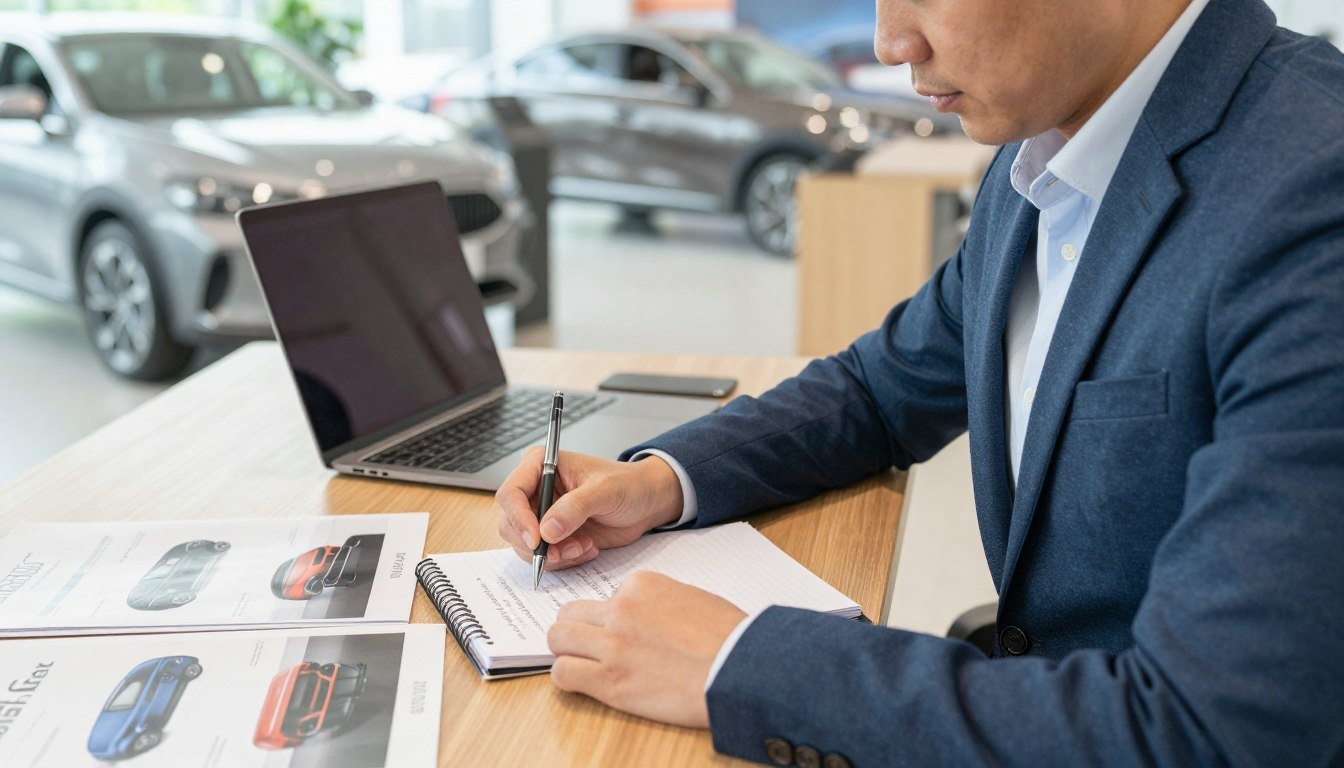
You want to buy a car, but standing in a dealership unsure what to say first can make even simple questions feel difficult. You do not need perfect English to make a careful decision: you can ask the salesperson to explain unfamiliar words, repeat a number, or give you time to think.
The out-the-door price is the total purchase amount, including the vehicle price and applicable taxes, title, registration, and dealer fees. You can also ask for a monthly payment estimate without agreeing to financing terms or committing to buy. The dialogues below give you practical language for real conversations, with phrases you can adapt to your own needs.
Key Takeaways
- Ask for an itemized written quote so you can see the vehicle price, fees, taxes, and any add-ons.
- Compare financing by annual percentage rate, loan term, amount financed, and total paid, not only the monthly payment.
- Keep the trade-in appraisal separate from the vehicle price while reviewing each figure.
- Ask what an unfamiliar product or contract term means before you agree to it.
- Check the signed paperwork against the terms you accepted, then inspect the vehicle at delivery.
Start by explaining what kind of vehicle you need, then move into the first dealership exchange.
English Conversation at a Car Dealership: Asking About Available Cars
If you know the kind of vehicle you need but not the exact model, tell the salesperson what you are looking for and ask what is available. A clear starting point helps the dealership salesperson narrow the choices, but a listing or display does not guarantee that a vehicle is still available.
Inventory can change, so ask the salesperson to confirm that the specific vehicle is on the lot and available to see. Automotive sales vocabulary can be unfamiliar at first; it is fine to ask whether a vehicle is new or used and what similar choices the dealership can show you.
A listing or display does not guarantee that a vehicle is still available. Ask the salesperson to confirm the specific vehicle before you make plans around it.
Customer and Salesperson Dialogue
Customer: Hi, I’m looking for a car for commuting and errands. Do you have the blue 2022 Honda Civic listed online?
Salesperson: I can check that for you. Are you looking for a new or used vehicle?
Customer: Used, please. If that Civic is no longer available, could you show me similar cars?
Salesperson: Sure. I’ll check the Civic first, then we can look at similar used sedans in our inventory.
Customer: Thanks. I’m happy to start with what you have available.
Try these opening questions when you want to get the conversation moving:
- “Could you help me find a car for commuting?”
- “Do you have any used cars under five years old?”
- “Can you check whether this listing is still current?”
- “Who can answer questions about the vehicles on the lot?”
The salesperson helps customers find and learn about vehicles, but you can set the pace and ask for plain explanations. Tell them how many people ride with you, how you use the car each week, and what you need to carry so the search can focus on your everyday needs.

English Conversation at a Car Dealership: Choosing a Car
The best vehicle for you depends on how you use it each day, not just how it looks on the lot. Start with your routine: passenger count, commute, cargo, and the features you value most.
Vehicle trim levels and equipment vary by model and model year, so confirm what is included on the exact vehicle you are considering. A trim name alone does not guarantee the same equipment across different versions.
Customer and Salesperson Dialogue
Customer: I drive about 30 minutes to work, usually with one passenger. I also need space for groceries and a folding stroller.
Salesperson: How often do you carry larger items, and do you need a third row?
Customer: Not often, and I don’t need a third row. Good fuel economy and easy parking matter most to me.
Salesperson: A sedan may suit your commute, while a smaller SUV could give you a higher seating position and a different cargo layout. We can look at both.
Customer: That sounds useful. Can you show me the cargo area in each one?
| Vehicle type | Common use | Trade-off to consider |
|---|---|---|
| Sedan | Commuting and everyday passenger trips | Lower roof and trunk opening may limit bulky cargo |
| SUV | Flexible passenger and cargo use | Size and fuel use vary widely across models |
| Minivan | Frequent passenger trips and family cargo | Larger body can be harder to park in tight spaces |
These are general comparisons, not promises about every model. While comparing vehicle trim levels, ask to see the equipment on the specific car rather than relying on a trim name in an advertisement. The salesperson can help you connect daily needs with the vehicle types available. Once you have one or two candidates, ask what each one costs.

English Conversation at a Car Dealership: Asking About Car Prices
When you hear a listed price, ask what it includes and request an itemized written quote. Get the full figure before deciding whether the price works for you.
An out-the-door quote can include the vehicle price, taxes, title, registration, dealer fees, and charged add-ons. Taxes and required fees vary by location, and fee names and treatment can vary too.
Customer and Salesperson Dialogue
Customer: I see the listed price. Could you give me a written, itemized out-the-door quote for this vehicle?
Salesperson: Yes. I’ll list the vehicle price, applicable taxes and charges, dealer fees, and any add-ons included in the quote.
Customer: Please show each add-on separately. I’d also like to know whether it is optional or required.
Salesperson: I can separate the items and explain how each charge is treated here.
Customer: Great. I want to review the complete amount before I decide.
| Price item | What it covers | What to clarify |
|---|---|---|
| Vehicle price | Price of the specific car | Which model year, trim, and vehicle identification number the quote covers |
| Taxes and government charges | Applicable taxes, title, and registration | Which charges apply in your location |
| Dealer fees | Fees charged by the dealership | What each fee covers and whether it is required |
| Add-ons | Additional products or equipment charged | Which items you selected and whether any can be removed |
When negotiating the out-the-door price, first make sure you understand dealer fees and handling dealer add-ons. Negotiating add-ons starts with asking what each item is and whether you chose it; fee names and treatment can vary by location. Compare the same specific vehicle and its written quote with other options before choosing.

English Conversation at a Car Dealership: Comparing Different Models
Ask the salesperson to explain the practical differences between your candidate vehicles without assuming that one is automatically better. Compare the exact cars, including model year, trim, mileage, condition, and included equipment.
Ask which exact trim and model year each quote refers to, because similar trim names do not guarantee identical equipment. If a car is used, asking about vehicle history can add useful context, but a vehicle history report may not include every event or repair.
Customer and Salesperson Dialogue
Customer: I’m considering a 2021 Toyota RAV4 LE and a 2022 RAV4 XLE. Could you explain the practical differences without assuming one is a better fit?
Salesperson: I can compare these two vehicles. The 2021 is an LE with 38,000 miles, and the 2022 is an XLE with 31,000 miles. Their condition and included equipment are not identical.
Customer: What equipment comes with each exact vehicle? Are both quotes for those model years and trims?
Salesperson: Yes. I can show you the equipment on each one. I can also provide the available vehicle history reports.
Customer: Does either report show title, accident, ownership, or service-history information?
Salesperson: I’ll show you what is reported. The report may not capture every event or repair.
Look at the report alongside the vehicle’s condition and ask questions about information that is unclear. A report can help frame the discussion, but it does not replace checking the specific car. When you have a preferred candidate, ask to drive it.
English Conversation at a Car Dealership: Taking a Test Drive
Call the dealership to arrange a test drive and confirm that the specific vehicle will be available to drive. Ask before you go what documents to bring and what procedures apply.
Dealerships may require a valid driver’s license and may set their own age, route, and insurance procedures for test drives. A test drive appointment gives the staff a chance to prepare the vehicle, but availability can change.
Customer and Salesperson Dialogue
Customer: Hi, can I take the 2022 Honda Accord for a test drive this afternoon?
Salesperson: I can check the schedule and confirm that it is available to drive. What time works for you?
Customer: Would 3:30 be possible? What documents should I bring?
Salesperson: Please bring your valid driver’s license. We’ll explain our test-drive procedures when you arrive.
Customer: Could we take a route with regular streets and some highway driving? That’s close to my usual commute.
Salesperson: I’ll let you know which route we can use and what our procedures allow.
During the vehicle test drive, check these four things:
- Adjust the seat and mirrors, then check your visibility in every direction.
- Drive on ordinary road conditions similar to the streets you use regularly.
- Notice how the brakes respond and how the steering feels during turns.
- Write down questions about noises, controls, or handling to ask afterward.
A route that reflects your normal driving can help you notice whether the car feels comfortable in familiar situations. Dealership rules may affect the route, so ask what is possible when scheduling a test drive. After taking a test drive, discuss any feature questions that came up.
English Conversation at a Car Dealership: Asking About Car Features
If you see an unfamiliar control, point to it and ask the salesperson for a plain-language explanation. One control at a time is easier to understand than a quick tour of every feature.
Ask whether the feature is included on this exact vehicle or is optional, and whether it needs a subscription or setup. The display, controls, and equipment can vary by vehicle, even when two cars have similar names.
Customer and Salesperson Dialogue
Customer: Could you explain what this button does? I’m not sure how to use it.
Salesperson: That button turns on the lane-departure alert. It gives you a warning if the vehicle detects that you are drifting from your lane.
Customer: Is that feature included on this exact car, or is it optional equipment?
Salesperson: It is included on this vehicle. Let me show you where to find the settings on the screen.
Customer: Does it need a subscription or any setup after I buy the car?
Salesperson: I can check what is needed for this feature and demonstrate the settings.
These practical questions work for safety, comfort, and connectivity features:
- “How does this feature work while I’m driving?”
- “Is it included on this exact vehicle?”
- “Does it need a subscription or setup?”
For discussing vehicle features, ask the salesperson to demonstrate the control rather than relying on a quick description. You can ask them to repeat an instruction or show it again while the vehicle is parked. Before negotiating, confirm the price for the exact vehicle and equipment you want.
English Conversation at a Car Dealership: Negotiating the Price
Respond to the written quote with a polite, specific counteroffer for the vehicle’s total price. Keep it focused on the out-the-door amount rather than a monthly payment.
Do not agree to a monthly payment before you know the vehicle price, down payment, loan term, and total amount financed. If you make an offer, ask the salesperson to confirm any agreed change in writing.
Customer and Salesperson Dialogue
Customer: Thank you for the written out-the-door quote. I’d like to offer $27,000 total for this vehicle, including the listed charges.
Salesperson: I’ll share that offer with my manager and see whether we can adjust the quote.
Customer: I understand. If the dealership can accept it, please show the revised amount in writing.
Salesperson: I’ll bring back an updated quote with any change clearly shown.
Customer: Thanks. I’ll review the new figure before deciding.
Use a calm four-step approach to keep the conversation clear:
- State your offer for the vehicle’s total price.
- Pause and give the salesperson time to respond.
- Ask what changed in the revised quote.
- Decide whether to accept the new amount or leave.
A clear offer gives both sides a specific figure to discuss without requiring you to accept financing terms on the spot. Keep a copy of each quote so you can see what changed. Once you have discussed the vehicle price, consider the possible ways to pay for it.
English Conversation at a Car Dealership: Asking About Financing Options
Before agreeing to a monthly payment, ask the finance manager to explain the full loan terms, including the annual percentage rate, loan term, amount financed, fees, and total of payments. Look beyond one number to compare the whole offer.
Compare the APR, loan term, amount financed, down payment, monthly payment, and total paid. A longer term can lower the monthly payment while increasing total interest, depending on the rate and loan.
Customer and Finance Manager Dialogue
Customer: Before we discuss a monthly payment, could you show me the full financing terms for this offer?
Finance Manager: Yes. I can show you the APR, loan term, amount financed, fees, and estimated monthly payment.
Customer: What is the total of all payments over the loan term? Is any fee included in the amount financed?
Finance Manager: I’ll show you how the fees are listed and what the total payments would be under this offer.
Customer: Thank you. I’d like to compare it with another option before I decide.
| Option | What to compare | Useful question |
|---|---|---|
| Dealership financing | APR, term, fees, amount financed, and total paid | “Can I see the full terms and total of payments?” |
| Bank or credit union | APR, term, fees, and total paid for the loan | “How does this offer compare with my other financing option?” |
| Paying without a loan | Total due and the payment method accepted | “What amount is due, and how can I pay it?” |
Comparing financing options lets you choose among the offers available to you rather than assuming one is best. A monthly payment estimate can help with budgeting, but it does not show the full cost unless you also know the loan term and total paid. After reviewing financing and loan terms, you can ask what your current vehicle may contribute toward the purchase.
English Conversation at a Car Dealership: Trading in an Old Car
Ask whether the dealership can appraise your current vehicle while you shop, then request the trade-in figure in writing. Keep the figures clear by asking how the appraisal was calculated and where the value appears in the written deal.
A loan balance can affect the final amount you owe without changing the trade-in appraisal figure itself. Trade-in value and positive or negative equity are different: the value is the offer for the car, while equity reflects that value compared with any loan balance.
Customer and Salesperson Dialogue
Customer: Can the dealership appraise my 2018 Subaru Outback while I’m shopping?
Salesperson: Yes. We’ll need to look at its condition and mileage. Do you have its service records?
Customer: I do. Could you explain how you calculated the offer and show the trade-in value as a separate figure in the written deal?
Salesperson: I’ll provide the appraisal figure and show where the trade-in credit appears. Do you still owe money on the vehicle?
Customer: Yes. I’d like the appraisal and loan balance listed separately so I can understand each amount.
Prepare these items for a trade-in appraisal:
- Vehicle identification and ownership documents.
- Service records and maintenance information you have kept.
- All keys, remotes, and accessories that came with the car.
- Disclosure of known issues, including damage or mechanical problems.
The final amount owed can reflect a loan balance as well as the vehicle’s trade-in value. Review both numbers separately rather than treating them as one appraisal figure. Once you understand the trade-in value, you can move on to questions about coverage after purchase.
English Conversation at a Car Dealership: Asking About Warranties
Ask what happens if a covered part needs repair after purchase, and find out who provides the coverage. Read the terms for what is covered, when protection begins, and what exclusions or deductibles apply.
An extended service contract is optional post-sale repair coverage, not another name for the manufacturer’s warranty. Ask whether an offer is optional and request its terms in writing before deciding.
Customer and Salesperson Dialogue
Customer: If a covered part needs repair after I buy the car, what would the manufacturer’s warranty cover?
Salesperson: I can show you the warranty information for this vehicle and explain when the coverage begins.
Customer: What exclusions or deductibles apply? Is the extended service contract you mentioned optional?
Salesperson: The contract is optional. I’ll show you its terms, including who provides it and what repairs it covers.
Customer: Please include the agreed coverage details in writing. I want to review them before signing.
| Coverage | Who provides it | What to check |
|---|---|---|
| Manufacturer’s warranty | Vehicle manufacturer | Covered parts, start date, exclusions, and deductibles |
| Dealer or third-party service contract | Dealer or contract provider | Optional status, covered repairs, exclusions, and claim process |
| Roadside assistance | Manufacturer, dealer, or another provider | Services included, provider, and coverage period |
Warranty coverage, an extended service contract, and roadside assistance are not interchangeable. Ask who pays for a covered repair and how to make a claim, since the provider and terms differ. Before signing, ask the salesperson or finance manager to put the agreed coverage details in writing.
English Conversation at a Car Dealership: Completing the Paperwork
Before you sign, check that the purchase agreement matches the vehicle and terms you accepted. Take the time you need to ask for an explanation of any unclear line.
The signed documents should match the agreed vehicle, price, fees, trade-in credit, financing terms, and selected add-ons. Do not sign a document that includes a product you did not choose or a figure you do not understand.
Customer and Finance Manager Dialogue
Finance Manager: Here are the documents. Please review them, and let me know if you have any questions.
Customer: I’ll check the vehicle identification number first. Is this VIN the same one on the vehicle I chose?
Finance Manager: Yes, that number identifies the vehicle listed in the agreement.
Customer: I also want to check the itemized charges, trade-in credit, loan terms, and the optional products I selected. Could you explain this fee?
Finance Manager: Certainly. I’ll explain the fee and make sure the figures match the terms we discussed.
Customer: Please give me a copy of every document I sign.
Use this final review list while completing the paperwork:
- Vehicle description and vehicle identification number.
- Vehicle price, itemized fees, and taxes.
- Financing terms and trade-in figures.
- Optional products and add-ons you selected.
A purchase agreement and related dealership paperwork should reflect the same terms you accepted in conversation. Ask for changes or explanations before signing, then keep copies of the completed sales paperwork. Once the signed documents are in order, arrange pickup and plan to check the vehicle at delivery.
English Conversation at a Car Dealership: Picking Up a New Car
When you arrive to collect the vehicle, ask to inspect it before driving away and check that it matches the agreed equipment and documents. Walk around it first and ask the dealership to record any damage or missing promised items.
Check the delivered vehicle against the agreement, and have the dealership record damage or missing items before you leave. Confirm that you have the keys, manuals, agreed accessories, and any remaining delivery paperwork.
Customer and Salesperson Dialogue
Customer: I’m here to pick up the car. Could I do a walk-around inspection before I drive away?
Salesperson: Of course. We can compare the vehicle with the agreed equipment and note anything that needs attention.
Customer: I see a scratch on the passenger door. Could you record it before I leave?
Salesperson: Yes. I’ll make a note of it. Here are the keys, owner’s manuals, and the floor mats you requested.
Customer: Thank you. Can you show me how to open the fuel door and adjust the display? When should I schedule my first service department appointment?
Salesperson: I can show you those controls and point you to the service information for this vehicle.
Before setting off, make sure the delivery paperwork is complete and ask about any remaining promised accessories. If you are collecting an electric vehicle, ask how charging works and where to find the charging information. You can also confirm how to contact the service department and arrange vehicle maintenance. A few reusable phrases can help you handle an unexpected question during the visit.
Common Car Dealership English Phrases Used in Conversations
If the conversation moves too quickly, use a simple phrase to slow it down. It is fine to pause and ask for a clearer explanation before responding.
A polite clarification request lets you check a detail without sounding confrontational. For example: “I want to make sure I understand. Could you explain what this charge covers?”
When you speak with a dealership salesperson or finance manager, choose the phrase that fits the moment:
- Asking someone to repeat: “Could you say that one more time, please?”
- Asking someone to explain: “Could you explain that in simpler terms?”
- Checking whether a statement is final: “Is that the final amount, or could it change?”
- Requesting a written quote: “Could you give me that quote in writing?”
- Asking for time to decide: “I’d like some time to review this before I decide.”
- Politely declining an optional product: “No, thank you. I don’t want to add that product.”
You do not need to explain a decision at length. A short, courteous sentence can keep the conversation clear, whether you are asking about automotive sales vocabulary or confirming a figure. If someone gives a long answer, you can repeat the part you understood and ask about the part that remains unclear.
You can pause and ask for a clearer explanation before responding. A polite question can clarify a detail without turning the conversation into a confrontation.
Pick the phrases that match the questions you are most likely to face, and practice saying them aloud.
Frequently Asked Questions About English Conversation at a Car Dealership
Yes, you can take a test drive without deciding to buy. A drive lets you assess the vehicle’s comfort and handling, and the dealership may set driver, age, route, and insurance requirements. Ask what to bring when you arrange the appointment. If a salesperson asks whether you are ready to purchase, you can say, “I’m still comparing my options.”
Ask for the vehicle price and trade-in appraisal as separate figures. Seeing each amount clearly helps you understand the final amount without mixing the car’s price with the value offered for your current vehicle. If you owe money on the current car, ask for the loan balance to appear separately too. Request a written breakdown if any figure is unclear.
No, you do not have to use the dealership’s financing. Compare its offer with one from a bank or credit union by looking at the annual percentage rate, loan term, fees, and total paid. The offer with the lowest monthly payment may have a longer term and a higher total cost. Ask for each option’s full financing terms in writing.
A dealership can include products in a purchase agreement, but the agreement should match the add-ons you selected. Ask for an itemized explanation of each product, and check whether you chose it before signing. If the agreement lists a product you declined, request a corrected version. Do not sign until the terms match your choices or the difference is explained in writing.
If a vehicle history report shows an accident, ask what is known about the damage and repairs, then have the vehicle’s condition checked. The report may include reported title, accident, ownership, and service-history information, but it may not capture every event or repair. Ask the salesperson to explain relevant report entries and provide the details in writing when possible.
Yes, you can leave before signing if you do not understand a document. Ask the finance manager to explain the wording or give you time to review it, and do not sign terms you do not understand or that differ from what you agreed to. Take a copy if one is available, and ask for any important explanation or change in writing.
Pause and ask for clarification before agreeing to any term you do not understand.
Conclusion
Clear questions matter more than perfect English when you are buying a car. Two habits can make the conversation easier: ask what an unfamiliar term means, and confirm important terms in writing before you agree.
Before contacting a dealership, choose three phrases from this article and practice saying them aloud. You might pick one for requesting a written quote, one for asking someone to repeat an explanation, and one for declining optional add-ons. Those phrases can also help when you confirm delivery paperwork or make a service department appointment later.
Write down your three chosen phrases and keep them handy for the visit.