
English Conversation at a Pet Store
A learner pauses at the entrance, unsure whether to ask…

A learner pauses at the entrance, unsure whether to ask first about animals, food, or supplies. A few polite, practical questions can make an everyday shopping conversation easier, even if English is not your first language. These examples show you how to ask, request clarification, and check important details without feeling that you need perfect grammar. An adoption fee is an amount an organization charges when an animal is adopted; what it covers varies. If an answer comes too quickly, you can ask someone to speak more slowly or repeat the information. You are allowed to take a moment, listen again, and make sure you understood before deciding. Start with a simple question about what you need, then move into asking about available animals.
Key Takeaways
- Ask one clear question at a time.
- Use “Could you…” or “Would you mind…” to sound polite.
- Ask for a slower explanation or a repeat when needed.
- Confirm details that affect a decision, such as records or product fit.
- Describe what you notice rather than guessing at an animal’s needs.
- Contact the appropriate professional for health concerns.
English Conversation at a Pet Store: Asking About Available Pets
A customer who sees an adoption notice can ask whether any animals are available to meet. Start simply, since not every pet store has animals available for adoption, and pet adoption requirements differ by rescue or shelter.
Common steps can include an application, a conversation about your home, and a meeting with the animal. Ask how that organization handles each step rather than assuming another rescue or shelter follows the same process.
Adoption requirements vary by organization, so ask what this rescue or shelter needs before you plan a visit.
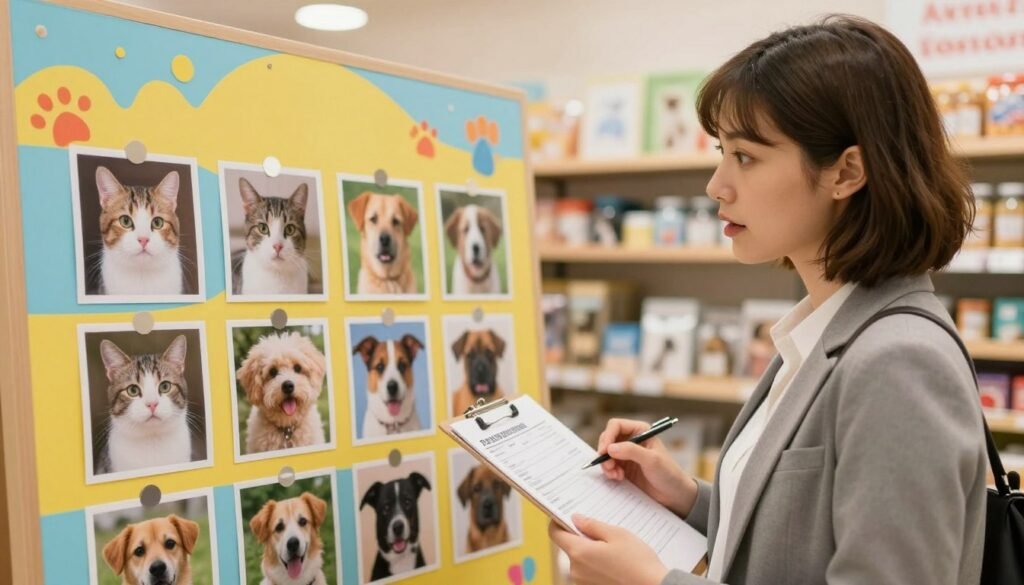
Customer and Pet Store Assistant Dialogue
Customer: Hi. I saw the adoption notice. Are any animals available to meet today?
Pet store assistant: There may be. The rescue or shelter has the current availability. I can help you contact them.
Customer: Thank you. What do the animal adoption forms usually ask about?
Pet store assistant: The organization may ask about your household, experience with pets, and plans for daily care. The exact questions vary.
Customer: Could I meet an animal before deciding?
Pet store assistant: Ask the rescue or shelter how meetings are arranged. Some schedule them in advance.
These three questions can help you prepare:
- What information does the application ask me to provide?
- Are there household requirements I should know about?
- How do I arrange a meeting with the animal?
If one profile catches your attention, ask about that specific animal. A question about a puppy’s needs is a good next step.
English Conversation at a Pet Store: Choosing a Puppy
A customer can ask what is known about a puppy’s age, routine, and behavior after watching it settle. Describe the moment you see, then ask for more context: one brief visit cannot show how a puppy will act at home.
A puppy’s behavior in a new or busy setting may differ from its behavior in a familiar home. Ask about observations and history without treating either as a guarantee about the puppy’s future personality.

Customer and Pet Store Assistant Dialogue
Customer: The puppy played for a little while and then settled down. What do you know about its usual routine?
Pet store assistant: The rescue shared some notes about its daily schedule. I can show you what they know, though this is a new place for the puppy.
Customer: Do you know the puppy’s age and what it has been like around people?
Pet store assistant: I can check the profile for its age and recorded history. Its behavior here may not tell us exactly how it will behave in a home.
Customer: That makes sense. What care needs should I think about for my household?
When describing animal behavior, keep your words specific and neutral:
- Describe what you observe, such as “The puppy rested after playing.”
- Ask what is known about the puppy’s history and routine.
- Consider whether the puppy’s care needs fit your household and schedule.
Customer: What food is the puppy eating now, and how should I choose food for a puppy?
English Conversation at a Pet Store: Asking About Kittens
If you see a kitten’s profile, ask whether the kitten is available through a rescue or shelter. Ask about adoption rather than assuming the animal is for sale or that the store handles the placement.
A short meeting cannot guarantee a rescue cat’s temperament or compatibility with your home. The rescue or shelter may have history and care notes that help you ask more informed questions.

Customer and Pet Store Assistant Dialogue
Customer: I saw this kitten’s profile. Is the kitten available through a rescue or shelter?
Pet store assistant: The profile is connected to a rescue. I can help you find its contact details so you can ask about adoption.
Customer: What is known about the kitten’s history?
Pet store assistant: The rescue can explain what information it has. Some details may be unknown, especially if the kitten was found without a known history.
Customer: Could I meet the kitten before I make a decision?
Pet store assistant: Ask the rescue how it arranges visits. A meeting can give you a chance to observe the kitten, but it cannot predict every part of life together.
Customer: I understand. What costs are involved in adopting the kitten?
That question moves naturally from asking about pet adoption to asking which costs apply to the animal.
English Conversation at a Pet Store: Asking About Pet Prices
Ask for the total cost and what the quoted amount includes. Get the details for the specific animal, because an animal’s price can depend on species, age, source, and included care or services.
Adoption fees and what they cover vary by organization. Ask whether vaccination records are available, and do not assume an adoption fee includes a standard set of services.
Customer and Pet Store Assistant Dialogue
Customer: I’m interested in this animal. Which costs are included in the amount quoted?
Pet store assistant: I can tell you what the listing says, but the total depends on this animal and the organization placing it.
Customer: Does the amount include any care or services? Are vaccination records available?
Pet store assistant: Those details can vary. The rescue or shelter can confirm what is included and whether it has vaccination records for this animal.
Customer: Could you help me check what I should expect to pay before I make a decision?
Pet store assistant: Certainly. Let’s confirm the specific charges and any included services with the organization.
Asking about the pet adoption process and checking vaccination records are both practical ways to understand what is included. Once the initial costs are clear, you can ask about the recurring cost of food.
English Conversation at a Pet Store: Buying Pet Food
A customer choosing food for a growing puppy can ask which label details matter and how to choose a dog food formula. Look at the stated use, then match it to the pet’s life stage.
In the United States, pet food labels use nutritional adequacy statements to show the life stage or stages a food is formulated to support. A veterinarian, not store staff, should advise you about a medical diet or an individual health need.
Customer and Pet Store Assistant Dialogue
Customer: I’m comparing these two bags for a growing puppy. Which label details should I check?
Pet store assistant: Start with the nutritional adequacy statement and the life stage it covers. The label also gives feeding directions.
Customer: What is the difference between puppy formula and large-breed puppy formula?
Pet store assistant: Check the stated use on each bag. A large-breed puppy formula is labeled for that use; your veterinarian can advise if your puppy has individual health needs.
| Label or formula | Stated use | What to check |
|---|---|---|
| Puppy formula | Growth life stage | Nutritional adequacy statement |
| Adult maintenance formula | Adult maintenance | Whether the life stage fits the dog |
| Large-breed puppy formula | Growth for large-breed puppies | Label’s stated use and directions |
Check these three label details before choosing:
- Nutritional adequacy statement
- Life stage
- Feeding directions
A food change is commonly made gradually, with the pace adjusted if the pet has trouble tolerating it. The customer can now ask what toys suit the same puppy.
English Conversation at a Pet Store: Choosing Pet Toys
If your dog quickly pulls apart soft toys, explain that habit and ask what alternatives to consider. Describe the play style, since a dog that chews may need a different option from one that mostly chases or carries toys.
No toy is risk-free or suitable for every animal, and a damaged toy should be removed from use. Ask about size and material, and watch how your own pet uses a new toy.
Customer and Pet Store Assistant Dialogue
Customer: My dog pulls apart soft toys pretty quickly. What alternatives should I consider?
Pet store assistant: Does your dog chew continuously, chase toys, or carry them around? That can help narrow down the options.
Customer: Mostly chewing and carrying. What size would be appropriate?
Pet store assistant: Compare the toy’s size with your dog and follow the product guidance. I can show you a few materials, but no toy suits every dog.
Customer: What should I watch for once we try one?
Pet store assistant: Check it during use. If it becomes damaged, take it away rather than leaving it for your dog.
Specific details about describing a pet’s behavior help the assistant understand what you need. Next, the customer can ask how to match a collar and leash to the dog.
English Conversation at a Pet Store: Buying a Pet Collar and Leash
Tell the assistant how your dog behaves on walks, then ask about collar fit and leash options. Fit comes first: the collar should sit securely without being uncomfortably tight.
No leash material is best for every dog or walking situation. When comparing leash materials, describe where you walk, how your dog pulls, and what feels manageable in your hand.
Customer and Pet Store Assistant Dialogue
Customer: My dog pulls during walks. I’m comparing these two materials. What should I consider when choosing a dog leash?
Pet store assistant: Think about the feel in your hand and the conditions where you walk. Different materials have different trade-offs.
Customer: How should this collar fit?
Pet store assistant: It should be secure but not too tight. Check the product’s fit guidance and make sure you can assess it comfortably on your dog.
| Material | Common feel | Practical trade-off |
|---|---|---|
| Nylon | Lightweight and flexible | Easy to carry; may feel narrow in the hand |
| Leather | Smooth and substantial | May soften with use; needs suitable care |
| Rope | Textured and flexible | Can feel grippy; thickness varies by product |
Ask to hold a leash before choosing if the store allows it. The conversation can shift from walking gear to broader questions about pet care.
English Conversation at a Pet Store: Asking About Pet Care
If your pet’s appetite changes, tell the assistant what you noticed and ask whether a veterinarian should assess it. Describe the change clearly, including when it began and what else is different.
A veterinarian is the appropriate professional to assess illness or injury. Breathing difficulty, collapse, suspected poisoning, or severe bleeding calls for urgent veterinary attention, not a store diagnosis.
Customer and Pet Store Assistant Dialogue
Customer: My cat has eaten less since yesterday. Can you help me decide what to do?
Pet store assistant: I can’t diagnose your cat. A veterinarian can assess the change. When did it start, and have you noticed anything else?
Customer: It began yesterday, and we changed the feeding routine this week. I’ll call the clinic.
Pet store assistant: That is useful information to share with them.
When contacting a veterinary clinic, share:
- The symptom you noticed
- When it started
- Any known change in food or routine
| Professional | Typical focus | Question to ask |
|---|---|---|
| Veterinarian | Illness, injury, and health assessment | Could you assess this change in appetite? |
| Groomer | Coat care and grooming services | What preparation does this appointment need? |
| Trainer | Learning and behavior skills | What training approach do you use? |
For illness or injury, seek veterinary guidance rather than relying on general pet care advice. An aquarium question calls for equipment-specific guidance, leading to fish and aquarium purchases.
English Conversation at a Pet Store: Buying a Fish and an Aquarium
Before bringing a fish home, ask what must be ready in its aquarium. Start with the species, since adult size, water conditions, and equipment needs are not the same for every fish.
Treat aquarium water to remove chlorine and chloramine before fish are exposed to it, and cycle a new aquarium before adding fish. Ask which equipment supports the needs of the particular species.
Customer and Pet Store Assistant Dialogue
Customer: What needs to be ready in the aquarium before I bring this fish home?
Pet store assistant: First, let’s confirm the fish’s adult size and water conditions. You’ll need suitable equipment, treated water, and a cycled aquarium.
Customer: Which aquarium supplies should I ask about?
Pet store assistant: Ask about filtration, temperature needs, and water conditioner. The right setup depends on the fish.
| Equipment | Main role | Question to ask |
|---|---|---|
| Filter | Supports aquarium water filtration | Which filter suits this aquarium and fish? |
| Heater | Provides heat when needed | Does this species need a heater? |
| Thermometer | Shows water temperature | What temperature range is appropriate? |
| Water conditioner | Treats water for chlorine and chloramine | How do I use this conditioner before fish are exposed? |
Customer: How do I know when the aquarium has been cycled and is ready for fish?
Get guidance for the specific fish and setup, rather than assuming one aquarium plan suits every species. From aquarium equipment, the conversation shifts to a bird’s distinct habitat needs.
English Conversation at a Pet Store: Buying a Bird and a Cage
Before choosing a cage, ask about the bird’s species and daily routine. Learn the bird’s needs first, since cage dimensions, bar spacing, and placement depend on the individual species.
Bird care and housing requirements are not identical across species. For specialized care, ask a veterinarian familiar with birds rather than applying general advice to every bird.
Customer and Pet Store Assistant Dialogue
Customer: What should I learn about this bird’s daily routine before choosing a cage?
Pet store assistant: Start with the species and ask about its daily care needs. Then compare cage dimensions and bar spacing with guidance for that bird.
Customer: Does cage placement matter too?
Pet store assistant: Yes. Ask what kind of location is appropriate for this bird, including the activity and conditions around the cage.
Customer: Who can answer questions about specialized care?
Pet store assistant: A veterinarian familiar with birds can advise you about the bird’s individual needs.
Questions about animal care advice work best when you name the species rather than asking for one rule for all birds. The customer can now ask where to find other supplies.
English Conversation at a Pet Store: Asking About Pet Supplies
For an upcoming trip, ask which carrier size may fit your pet and where to find it. Use measurements, not just the size printed on a box, because carrier labels can differ across brands.
A carrier should let the animal stand, turn around, and lie down comfortably. Check the specific manufacturer’s sizing guidance and any travel provider’s requirements, since a suitable carrier for one trip may not meet another provider’s rules.
Customer and Pet Store Assistant Dialogue
Customer: I need a carrier for an upcoming trip. Where can I find the carriers?
Pet store assistant: They’re on the travel-supplies aisle. Bowls and grooming items are nearby.
Customer: Which measurements should I compare with the carrier’s sizing guidance?
Pet store assistant: Measure your pet as the manufacturer directs, then check that the animal can stand, turn around, and lie down comfortably inside.
Customer: The trip has specific rules. Should I check those too?
Pet store assistant: Yes. Check the travel provider’s requirements as well. A carrier label alone does not confirm that it works for every type of travel.
Clear questions help when asking about pet supplies, especially when the product must fit an animal and a specific trip. If an item arrives damaged, the next conversation can focus on what happened and what options are available.
English Conversation at a Pet Store: Returning or Exchanging a Product
If you open a new item and find a cracked part, explain what is damaged and when you noticed it. Stay factual and say whether you are asking about a return, an exchange, or another available option.
Return and exchange policies vary by seller and product. Keeping the receipt and contacting the seller promptly can help clarify the options, but it does not guarantee a refund or exchange.
Customer and Pet Store Assistant Dialogue
Customer: I bought this bowl yesterday and found a crack when I opened the package today. Could you tell me what options are available?
Pet store assistant: I can check the store’s policy for this product. Do you have the receipt?
Customer: Yes. I took a picture of the crack, too. I’d like to ask whether an exchange is possible.
Pet store assistant: Thank you. Let’s review the policy and see which options apply to this item.
These four steps can help when returning a damaged product:
- Keep the receipt.
- Photograph the damage.
- Contact the seller promptly.
- Ask about return or exchange options.
A calm description makes the return policy for pet products easier to discuss without assuming the result. Once you know how to explain a problem, a few reusable phrases can help across many store conversations.
Common Pet Store English Phrases Used in Conversations
Keep a few flexible sentence starters ready for moments when a conversation moves quickly. One phrase at a time can help you ask about an item, get directions, or check a detail without memorizing a full dialogue.
A question asks for information, while a confirmation request checks that you understood a detail correctly. “Is this available?” asks a question; “So this size is for an adult dog, right?” asks the listener to confirm.
Ask for information when you need an answer, and ask for confirmation when you need to check what you heard.
Here is a compact phrase bank for everyday use:
To ask whether an item is available: “Do you have this carrier in another size?”
To ask where something is located: “Could you tell me where the grooming supplies are?”
To ask for slower speech or repetition: “Would you mind speaking a little more slowly?” or “Could you repeat that, please?”
To ask about store hours: “Could you tell me what time you close today?” If the hours vary by day, ask which day the posted hours refer to.
To confirm a product detail: “Just to confirm, this carrier meets the size guidance on the label, correct?” You can replace “carrier” with the detail you want to check.
“Could you…” makes a direct request polite, while “Would you mind…” softens a request for help. These expressions work for practical questions about shopping and care. Try them against common questions you may need to ask before you visit.
Frequently Asked Questions About English Conversation at a Pet Store
Conclusion
A confident conversation can begin with one specific question and a willingness to ask for clarification. Keep it simple: ask one clear question at a time, then pause long enough to hear the answer.
Confirm important details, such as vaccination records or a description of a pet’s symptoms, with the appropriate person. Store staff can help with products and general questions, while a veterinarian is the right professional to assess illness or injury.
You do not need to memorize every expression. Choose one question from the phrase bank, such as “Could you repeat that, please?” or “Are vaccination records available for this animal?” Practice saying it aloud before your next visit. In a real conversation, use your prepared question and follow up if anything remains unclear.