English Conversation at a Museum Gift Shop
At a museum gift shop, a few clear questions can…
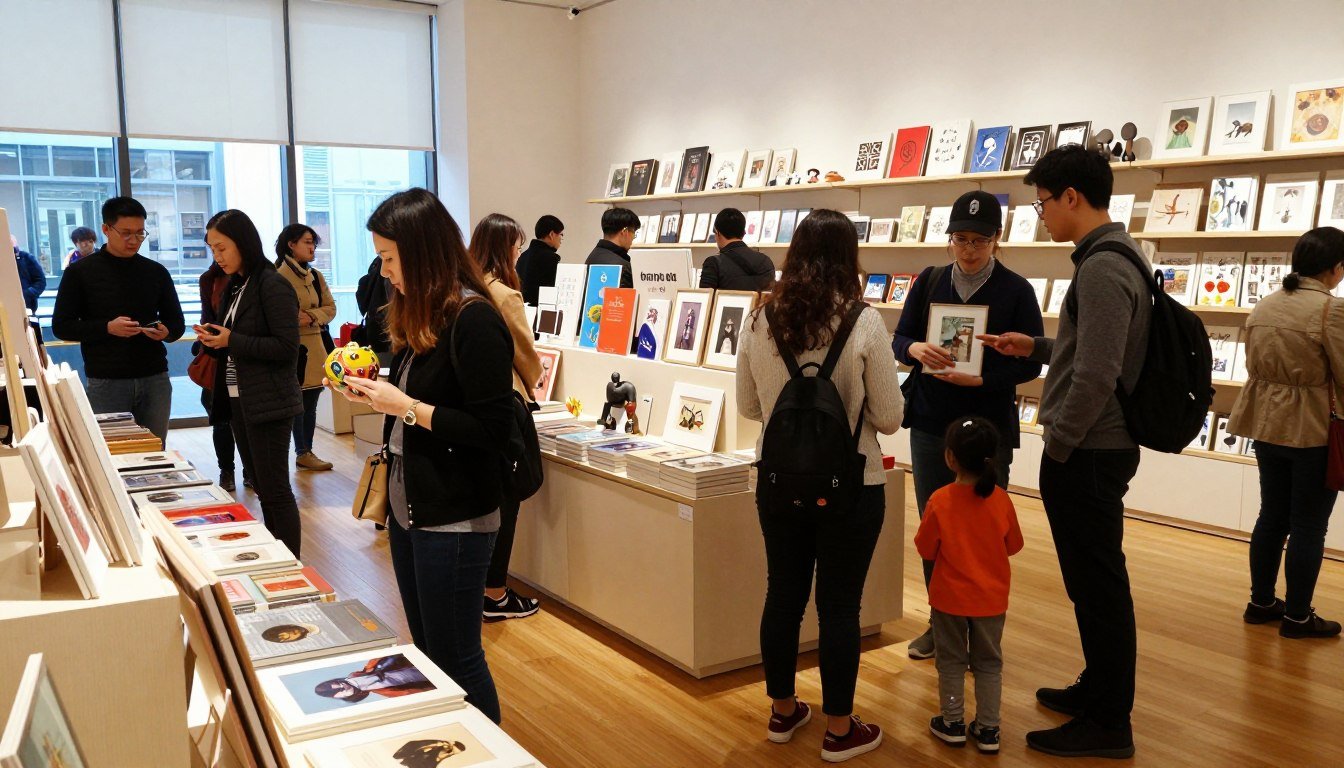
At a museum gift shop, a few clear questions can make browsing and buying feel easier. Simple, direct American English is enough to help you explain what you like, ask about an item, and understand the options before you pay. Sales tax is a state or local tax applied to taxable retail purchases.
You might ask about exhibit-inspired items, express preferences between two designs, or check which payment methods the shop accepts. Options vary by shop, so a polite question is useful when you are unsure. These conversations give you practical ways to browse, choose, and complete a purchase comfortably.
Key Takeaways
- Start with a friendly question about items connected to an exhibition.
- Describe what you enjoyed to help the shop assistant suggest relevant gifts.
- Check an item’s details, such as its image, size, material, or fit.
- Ask about prices, discounts, sales tax, and payment methods as needed.
- Keep your receipt in case you need to discuss a return or damaged purchase.
Begin with a polite question about exhibit-related items, then follow the conversation at your own pace.
English Conversation at a Museum Gift Shop: Asking About Souvenirs
A visitor who has just seen an exhibition can ask whether the shop has items connected to it. A clear description of what you enjoyed can help the shop assistant make useful souvenir recommendations.
Some products may be generally museum-themed rather than tied to the current exhibit. Ask about the connection instead of assuming that every design comes from the galleries you visited.
Ask whether an item relates to the exhibit, since some merchandise is museum-themed without being exhibit-inspired.
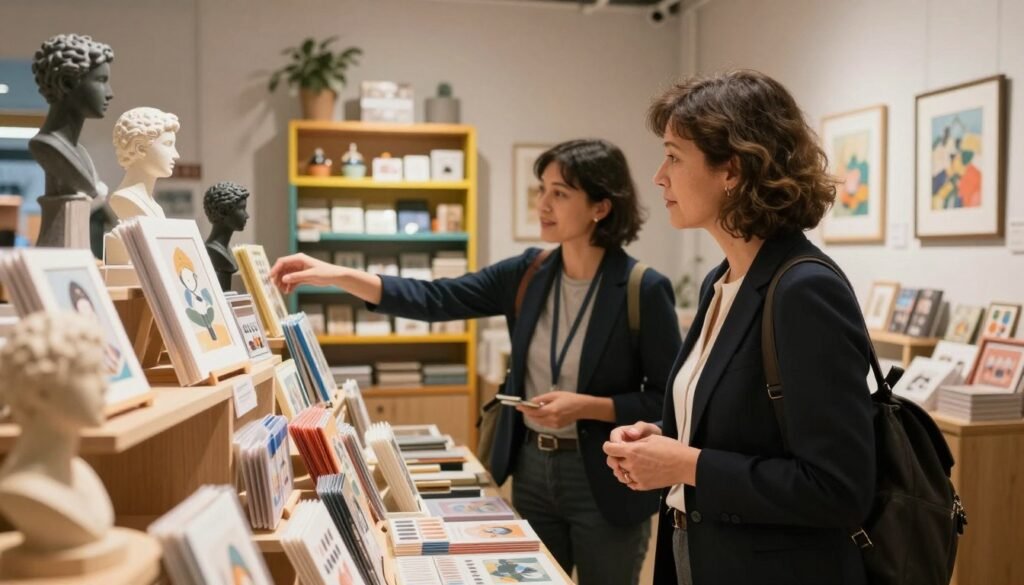
Customer and Shop Assistant Dialogue
Customer: I just saw the exhibition on ancient Egypt. Do you have anything related to this exhibit?
Shop Assistant: We have a few exhibit-inspired items. The illustrated notebook and the small sculpture are popular with visitors.
Customer: I especially enjoyed the painted wall scenes. What would you recommend?
Shop Assistant: The notebook includes details based on those designs. Some of our other pieces are general museum souvenirs rather than merchandise from this exhibition.
Customer: That sounds interesting. Is this available in another style?
Shop Assistant: Yes, the notebook also comes in a smaller size. Could you tell me about this design? is another useful way to ask about an item’s details.
When browsing, these question starters can help you get the conversation going:
- “Do you have anything related to this exhibit?”
- “What would you recommend?”
- “Is this available in another style?”
- “Could you tell me about this design?”
Customer: I’ll take a look. I notice a postcard with one of the painted scenes.
English Conversation at a Museum Gift Shop: Buying a Postcard
To choose a postcard or art print as a gift, ask about the image and how the item is made. Check the back before assuming a postcard has room for your own message.
Postcards do not all have the same back layout, and some have printed text or a design that leaves little space to write. Ask whether the image shows the artwork you remember and whether the card is blank.
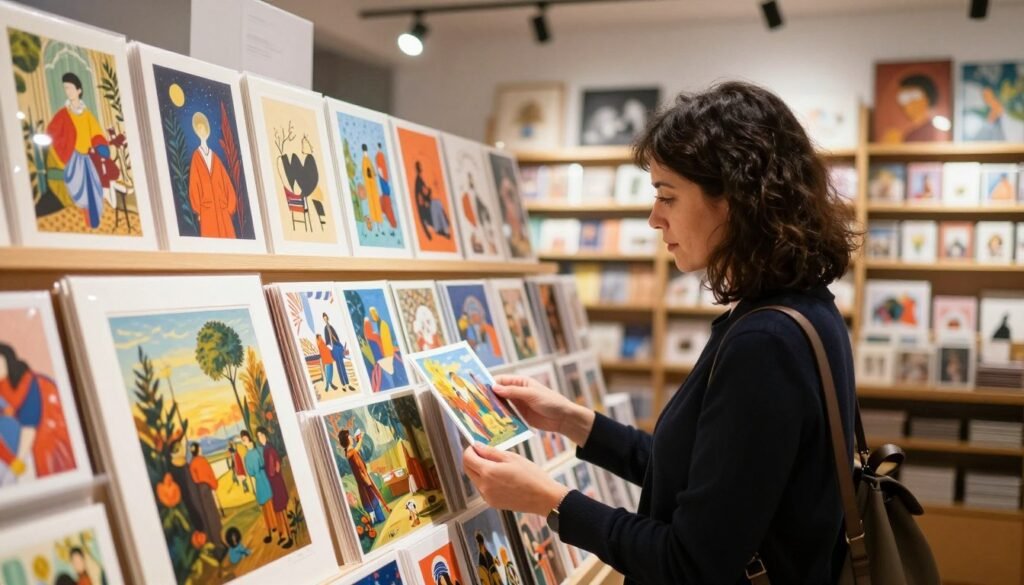
Customer and Shop Assistant Dialogue
Customer: I’m choosing between these two images for a friend. Which one shows the painting with the blue figures?
Shop Assistant: This postcard shows that painting. The other image is based on a detail from a different work.
Customer: Is this card blank, or does it have printed text on it?
Shop Assistant: It has the museum name printed on the back, with space for a short message. The layout can differ from one postcard to another.
Customer: Could I see the art print, too? I’d like to compare the size before I decide.
Shop Assistant: Certainly. The print has its dimensions on the label, and its surface is designed for display.
Customer: The postcard feels right for a small keepsake. I’ll choose this one.
When choosing a postcard or art print, compare its intended use with the details you care about:
| Item | Typical use | What to check |
|---|---|---|
| Postcard | Send or give as a small keepsake | Image and back layout |
| Art print | Display or frame | Dimensions and print surface |
| Small reproduction | Compact display gift | Image detail and backing |
A small image-based gift can lead you to a more personal choice for a particular recipient.
English Conversation at a Museum Gift Shop: Asking About Prices
Ask “How much is this?” to check the price of one item, then compare another size or design with a neutral question. Specific wording helps you ask about souvenir prices without sounding demanding.
An item’s price can depend on its size, materials, and whether it is a reproduction or an original design. A larger print or a different finish may cost more than a similar-looking option.

Customer and Shop Assistant Dialogue
Customer: How much is this print?
Shop Assistant: It is $18.
Customer: And how much is the larger size?
Shop Assistant: The larger one is $26.
Customer: Is this one more expensive because it is a larger reproduction?
Shop Assistant: Yes. It is larger, and the print surface is different. The other design is an original illustration made for the shop.
Customer: Does the price include the frame?
Shop Assistant: The frame is sold separately, so the label lists the print price only.
These phrases make checking item prices and comparing prices straightforward:
| Phrase | What it asks | Example |
|---|---|---|
| How much is this? | Price of one item | How much is this print? |
| Is this one more expensive? | Relative price | Is the larger one more expensive? |
| Does the price include the frame? | Whether an added item is included | Does the price include the frame? |
Once you understand the cost, you can decide whether a book might suit the person you are shopping for.
English Conversation at a Museum Gift Shop: Buying Books About Art and History
Ask what a book covers and who it is written for before choosing it as a gift. The subject and reading level matter more than a striking cover when you want the book to suit someone else.
Do not choose a book based only on its cover: check whether it covers the right artist, period, or exhibit, and whether the language is appropriate for the recipient.
Customer and Shop Assistant Dialogue
Customer: I recognized this painting from the galleries. Does this book cover the artist’s work, or is it focused on a particular period?
Shop Assistant: It covers the artist’s work from that period and includes several paintings from the exhibition.
Customer: I’m shopping for my niece. Would it be suitable for a younger reader?
Shop Assistant: This edition is written for adults. The illustrated guide on the lower shelf has shorter text and is aimed at younger readers.
Customer: Is that one in English, and does it come in a smaller format?
Shop Assistant: Yes, it is in English, and this is the paperback edition.
Use this short checklist when selecting a book or other museum-themed gifts:
- Subject: artist, historical period, or exhibit
- Reading level: adult, teen, or younger reader
- Language: confirm the edition’s language
- Format or size: hardcover, paperback, or compact edition
A book is one kind of paper gift; wearable museum merchandise offers a different option.
English Conversation at a Museum Gift Shop: Buying a Museum T-Shirt
Ask whether a shirt’s design relates to an exhibit, what sizes are available, and whether you can try it on. Fit and availability vary by shop, so ask rather than assume.
Sizing and try-on options are not the same in every shop. A label can help, but asking about the fit and available changing arrangements gives you clearer information.
Customer and Shop Assistant Dialogue
Customer: This shirt has the spiral design from the new exhibition. Is it related to that exhibit?
Shop Assistant: Yes, the design was made for the exhibition merchandise.
Customer: What sizes are available?
Shop Assistant: We currently have small, medium, and large in this color. The size chart is on the tag.
Customer: Could I try it on before I decide?
Shop Assistant: We have a fitting room near the back. Some styles can be tried on, though that option depends on the shop and garment.
Customer: Thanks. I’ll check the size chart and see whether a fitting room is available.
A question about the exhibit-inspired merchandise also lets you confirm exactly what the design represents. You can ask, “Does this design come from a specific piece in the gallery?” or “Is the image printed on the front only?” If you are buying for someone else, describe the fit you want rather than guessing from the size label.
After clothing, smaller accessories may catch your eye, and their materials are worth asking about.
English Conversation at a Museum Gift Shop: Choosing Jewelry and Accessories
Ask what a piece is made from, how it fastens, and whether its design refers to an artwork. Say what appeals to you so the shop assistant can help you find a comfortable style.
An assistant may be able to describe the visible material without knowing the item’s full production history. Ask what details are available rather than expecting information about every stage of its making.
Customer and Shop Assistant Dialogue
Customer: What is this pendant made of?
Shop Assistant: The visible piece is brass, and the chain is stainless steel.
Customer: How does it fasten? I like the simpler design, and I’m looking for something lightweight.
Shop Assistant: It has a small clasp at the back. This one is light, and the other pendant has a heavier setting.
Customer: Does the pattern refer to an artwork in the museum?
Shop Assistant: It is based on a geometric motif from a gallery piece. I can describe the design, though I do not have more detail about its production history.
Customer: That helps. Is there any information about who made it or where it was made?
Shop Assistant: The product card lists the maker, but it does not include a full account of the process.
When describing an item’s material and design, you can use phrases such as “I prefer the smooth finish,” “I’m looking for a small accessory,” or “I like this pattern.” That gives the assistant a concrete direction without requiring technical vocabulary.
From the design, you can turn to the question of whether the piece was made locally.
English Conversation at a Museum Gift Shop: Asking About Local Products
Ask whether a craft was made locally, who made it, and what materials were used. Origin details can help you understand an item, though the shop may not carry locally made crafts in every category.
Pottery, textile items, and jewelry are possible categories, not products every shop stocks. If a label gives only basic information, the shop assistant may be able to tell you what else is known.
Customer and Shop Assistant Dialogue
Customer: Was this pottery made locally?
Shop Assistant: The label says it was made by a local artist. I can check the card for the artist’s name.
Customer: Who made it, and which materials were used?
Shop Assistant: The artist’s name is printed here. The piece is ceramic, and the card describes it as decorative.
Customer: Is it usable, or is it meant only for display?
Shop Assistant: It is intended as a decorative piece, not as a serving dish.
Questions about origin and use can vary with the type of craft. These are examples of items a shop might carry:
| Craft type | Question about origin or material | Question about use |
|---|---|---|
| Pottery | Was this made locally? | Is it decorative or usable? |
| Textile item | What material is this made from? | How should it be cared for? |
| Jewelry | Who made this piece? | Is the design based on an artwork? |
Knowing the likely origin can help you narrow down a gift for a particular person or occasion.
English Conversation at a Museum Gift Shop: Looking for a Special Item
Describe who you are shopping for, what they enjoy, and how easy the gift needs to be to carry. A few useful details help the shop assistant tailor a recommendation.
Ask the shop assistant about age suitability instead of judging it by an item’s appearance. A playful design alone does not tell you whether a product is intended for a child.
Customer and Shop Assistant Dialogue
Customer: I need a small gift for a child who loved the dinosaur gallery. Do you have something suitable for an eight-year-old?
Shop Assistant: We have an activity book and a small fossil model. The book is marked for younger readers, and I can check the model’s age guidance.
Customer: It’s for a friend’s child, and I’d like something easy to carry in a backpack.
Shop Assistant: The activity book is lightweight and fits in a small bag. The model comes in a box that is a little bulkier.
Customer: That sounds like the better fit. Is the book connected to the dinosaur gallery?
Shop Assistant: Yes, it includes activities based on the exhibit.
Before asking for a tailored recommendation, think through these four details:
- Recipient: child, friend, or family member
- Interests: a gallery, artwork, or subject they enjoyed
- Occasion: birthday, thank-you gift, or visit keepsake
- Size or portability: compact enough to carry or pack
After finding a possible gift, you can ask whether a museum membership changes its price.
English Conversation at a Museum Gift Shop: Asking About Discounts
Ask whether the museum membership discount applies to your item and what proof is needed. Check before paying, since membership discount conditions vary by museum.
Tax-free purchase eligibility and procedures depend on applicable rules and the buyer’s circumstances. A tax exemption does not automatically apply to every visitor or purchase.
Customer and Shop Assistant Dialogue
Customer: Does the museum membership discount apply to this book?
Shop Assistant: It applies to some items. I can check whether this book is included.
Customer: Should I show you my membership card before you ring it up?
Shop Assistant: Yes, please show it before payment so I can apply an eligible discount.
Customer: I also want to ask whether any tax exemption applies to my situation. What should I do?
Shop Assistant: Tax-free eligibility depends on the applicable rules and your circumstances. I can explain the information our shop uses, but I cannot assume you qualify.
Keep these three checks in mind when asking about museum membership discounts or tax-free purchases:
- Mention your membership before paying.
- Ask which proof, such as a membership card, is needed.
- Confirm any tax exemption with staff before relying on it.
Once you know whether a discount applies, you can move on to completing payment.
English Conversation at a Museum Gift Shop: Paying at the Checkout
At checkout, ask whether the shop accepts your preferred payment method, confirm the total, and request a receipt. Check the total before completing the transaction.
Sales tax rules vary by state and locality, and many U.S. retail transactions add sales tax at checkout rather than including it in the displayed price. Payment methods also vary by shop.
Customer and Shop Assistant Dialogue
Customer: Can I pay by card, or do you accept cash only?
Shop Assistant: We accept cash and most credit and debit cards.
Customer: Could you confirm the total, including sales tax?
Shop Assistant: The total is $24.60. It includes the applicable sales tax.
Customer: Great. I’ll pay by credit card. Could I have a receipt, please?
Shop Assistant: Certainly. Here is your receipt.
When checking payment methods and sales tax, you can ask a direct question about each option:
| Payment option | Useful question | What to confirm |
|---|---|---|
| Cash | Can I pay in cash? | Whether cash is accepted |
| Credit or debit card | Can I pay by card? | Whether the card is accepted |
| Contactless payment | Do you take contactless payments? | Whether contactless is available |
If the total differs from the displayed price, asking whether sales tax was added is a simple way to understand the amount. The displayed-price and tax rules can vary by location, so the receipt gives you a record of the completed purchase.
After paying, you can ask whether the item can be wrapped as a gift.
English Conversation at a Museum Gift Shop: Asking About Gift Wrapping
Ask “Could you wrap this as a gift?” and check whether the shop has a gift bag or suitable wrapping for the item. Explain what you need, especially if the gift is fragile or unusually shaped.
Gift wrapping options vary by shop and by item, and a fragile object or unusual shape may not fit standard wrapping.
Customer and Shop Assistant Dialogue
Customer: Could you wrap this as a gift?
Shop Assistant: I can check what we have for this item. Would you prefer paper wrapping or a gift bag?
Customer: Is a gift bag available, and would it be suitable for this ceramic piece?
Shop Assistant: We have a padded bag that may work. Standard paper wrapping could put pressure on the fragile edge.
Customer: Could you use the bag and make sure the piece is protected?
Shop Assistant: Yes. I’ll add tissue around it and place it carefully in the bag.
If you are unsure what the shop can provide, you can ask, “Do you offer gift wrapping?” or “Is there a bag that will protect this?” For an item with delicate parts, mention its shape or fragility before the assistant wraps it. A standard option may not suit an object with a sharp edge, a large base, or a breakable finish.
Once the purchase is complete, a few short phrases can help with other shop interactions.
Common Museum Gift Shop English Phrases Used in Conversations
If you notice damage before leaving, return to the shop assistant and explain what you see. Keep the receipt and show the item so staff can identify the purchase and discuss the available options.
Return policies vary by museum shop and item, and a receipt can help staff identify a purchase. Do not assume every shop handles a return or damaged item the same way.
Keep the receipt and show the damaged item to staff promptly, since return options depend on the shop and the item.
Use this phrase bank for common questions and concerns:
- Asking about a bag: “Do you have reusable shopping bags?”
- Requesting a specific bag: “Could I have a reusable tote bag?”
- Asking about returns: “What is your return policy?”
- Reporting damage: “I noticed this item is damaged.”
If an item is damaged, these four steps can help you explain the situation clearly:
- Keep the receipt.
- Avoid further handling if that might worsen the damage.
- Show the item to a shop assistant.
- Ask what options are available.
A personal reusable shopping bag may be fine for packing a purchase, but bag-handling options vary by shop. Some questions, especially about returns and damaged goods, depend on the shop’s own policies.
Frequently Asked Questions About English Conversation at a Museum Gift Shop
Conclusion
A shop conversation can begin with one straightforward question. A polite request and a clear description of what you want are enough to help the shop assistant understand whether you are looking for a particular item, asking about prices, or checking payment methods.
You do not need to memorize a long script. Choose one phrase that feels useful, say it aloud once or twice, and keep it ready for your visit. You might practice asking about an exhibit-related design or whether the shop accepts your preferred payment. Try that question during your next museum shop visit.