
Daily English Conversation Practice
Daily English conversation practice is one of the best ways…
Daily English conversation practice is one of the best ways to improve your speaking skills, learn new vocabulary, and become more confident when communicating in English. Whether you are a beginner or an intermediate learner, practicing everyday conversations can help you speak more naturally in real-life situations.
In this guide, you will find simple and practical English dialogues about greetings, introductions, family, hobbies, shopping, ordering food, asking for directions, and more. Each conversation includes common expressions that you can use in your daily life.
Read each dialogue aloud, practice with a friend, and try changing some words to create your own conversations.

Daily English Conversation Practice: Greeting Someone
Greetings are often the first step in an everyday conversation. Learning how to greet someone politely and respond naturally will help you start conversations with confidence.
Everyday English Dialogue
Emma: Hey, how are you doing?
Jack: I’m doing pretty well. How about you?
Emma: I’m good, thanks. It’s nice to see you!
Jack: Nice to see you too. How have you been?
Emma: I’ve been great. Just keeping busy with work.
Jack: I know what you mean. Well, have a great day!
Emma: You too! See you around.
Useful expressions:
- How are you doing?
- I’m doing pretty well.
- How have you been?
- It’s nice to see you.
- See you around.

Daily English Conversation Practice: Introducing Yourself
Introducing yourself is useful when meeting new classmates, coworkers, neighbors, or people at social events. You can start with your name and then share a little information about yourself.
Everyday English Dialogue
Mia: Hi! I’m Mia. I don’t think we’ve met before.
Ryan: Hi, Mia. I’m Ryan. Nice to meet you.
Mia: Nice to meet you too. Are you new here?
Ryan: Yes, I just started working here this week.
Mia: That’s great! What do you do?
Ryan: I’m a graphic designer. What about you?
Mia: I work in marketing.
Ryan: Cool! I guess we’ll be seeing each other around.
Mia: Definitely. Welcome to the team!
Useful expressions:
- I’m …
- Nice to meet you.
- I don’t think we’ve met before.
- Are you new here?
- What do you do?
- Welcome to the team!

Daily English Conversation Practice: Talking About Your Day
Talking about your day is a common way to connect with friends, family members, and coworkers. You can describe what you did, how you felt, and what you plan to do later.
Everyday English Dialogue
Alex: Hey, how was your day?
Sophie: It was pretty good, just a little busy. How about yours?
Alex: Mine was exhausting. I had three meetings this morning.
Sophie: Wow, that sounds stressful. Did you get everything done?
Alex: Almost. I still have a few emails to answer.
Sophie: Hopefully, you can relax tonight.
Alex: That’s the plan. I’m going to watch a movie and order some food.
Sophie: Sounds like a perfect evening!
Useful expressions:
- How was your day?
- It was pretty good.
- I had a busy day.
- That sounds stressful.
- Did you get everything done?
- That’s the plan.

Daily English Conversation Practice: Talking About Family
Family is a popular topic in everyday conversations. You might talk about your parents, siblings, children, or family activities when getting to know someone.
Everyday English Dialogue
Lily: Do you have a big family?
Noah: Not really. I have one older sister and a younger brother.
Lily: That’s nice! Are you close to them?
Noah: Yeah, we’re pretty close. We try to get together every weekend.
Lily: What do you usually do together?
Noah: We have dinner at my parents’ house or watch a movie.
Lily: That sounds lovely. I usually visit my family on Sundays.
Noah: Family time is important, isn’t it?
Lily: Absolutely!
Useful expressions:
- Do you have a big family?
- I have one older sister.
- We’re pretty close.
- What do you usually do together?
- We get together every weekend.
- Family time is important.

Daily English Conversation Practice: Talking About Hobbies
Talking about hobbies helps you discover shared interests and make new friends. You can discuss sports, reading, cooking, music, gaming, or other activities you enjoy.
Everyday English Dialogue
Chris: What do you like to do in your free time?
Olivia: I love reading and going for walks. How about you?
Chris: I’m really into photography.
Olivia: That’s interesting! What kind of pictures do you take?
Chris: Mostly nature and street photography.
Olivia: Do you ever share your pictures online?
Chris: Yeah, I post some of them on Instagram.
Olivia: I’d love to see them sometime.
Chris: Sure! I’ll show you my favorite ones.
Useful expressions:
- What do you like to do in your free time?
- I’m really into photography.
- I love reading.
- What kind of … do you like?
- Do you ever …?
- I’d love to see them.
Daily English Conversation Practice: Ordering Food at a Restaurant
Knowing how to order food in English is useful when eating at a restaurant. You may need to ask for a menu, choose a meal, request a drink, or ask for the bill.
Everyday English Dialogue
Waiter: Good evening! Here’s your menu.
Customer: Thank you. What would you recommend?
Waiter: The grilled chicken is very popular.
Customer: That sounds good. I’ll have the grilled chicken with rice, please.
Waiter: Of course. Would you like something to drink?
Customer: Yes, a glass of orange juice, please.
Waiter: Anything else?
Customer: No, that’s everything. Thank you.
Waiter: You’re welcome. I’ll be right back with your order.
Useful expressions:
- Could I see the menu, please?
- What would you recommend?
- I’ll have …, please.
- Would you like something to drink?
- That’s everything, thank you.
- Could I have the bill, please?

Daily English Conversation Practice: Shopping at a Store
Shopping conversations often involve asking about prices, finding products, checking sizes, and making decisions. These expressions can help you communicate clearly with store employees.
Everyday English Dialogue
Customer: Excuse me, how much is this jacket?
Shop Assistant: It’s $45.
Customer: Do you have it in a medium?
Shop Assistant: Let me check. Yes, we have one in medium.
Customer: Great! Can I try it on?
Shop Assistant: Of course. The fitting rooms are over there.
Customer: Thanks. It fits perfectly. I’ll take it.
Shop Assistant: Excellent. You can pay at the counter.
Useful expressions:
- How much is this?
- Do you have it in another size?
- Can I try it on?
- Where are the fitting rooms?
- I’ll take it.
- Can I pay by card?
Daily English Conversation Practice: Asking for Directions
When visiting a new place, you may need to ask someone how to get to a station, a store, a bank, or another location. Learning basic direction phrases can make traveling easier.
Everyday English Dialogue
Daniel: Excuse me, could you tell me how to get to the train station?
Woman: Sure. Go straight down this street.
Daniel: Okay. Do I need to turn anywhere?
Woman: Yes. Turn left at the traffic lights.
Daniel: Is it far from there?
Woman: No, it’s about a five-minute walk.
Daniel: Great. Thanks for your help!
Woman: No problem. You can’t miss it.
Useful expressions:
- Could you tell me how to get to …?
- Go straight ahead.
- Turn left at the traffic lights.
- Is it far from here?
- It’s about a five-minute walk.
- Thanks for your help!

Daily English Conversation Practice: Talking About the Weather
Weather is an easy conversation starter, especially when talking to neighbors, coworkers, or people you meet outside. You can discuss the temperature, rain, sunshine, or changes in the forecast.
Everyday English Dialogue
Ben: It’s really sunny today, isn’t it?
Anna: It sure is! It’s much warmer than yesterday.
Ben: I know. Yesterday was so cold.
Anna: Are you planning to go outside later?
Ben: Yeah, I might go to the park.
Anna: That sounds nice. Hopefully, the weather stays this way.
Ben: I hope so too. It’s perfect for a walk.
Useful expressions:
- It’s really sunny today.
- It sure is!
- It’s warmer than yesterday.
- What’s the weather like?
- Are you planning to go outside?
- Hopefully, the weather stays nice.

Daily English Conversation Practice: Making Plans With Friends
Making plans in English involves suggesting activities, choosing a time, and confirming where to meet. These expressions are useful when arranging outings with friends.
Everyday English Dialogue
Jake: Hey, are you free this Saturday?
Megan: I think so. What’s up?
Jake: Do you want to go to the movies?
Megan: Sure! What’s playing?
Jake: There’s a new comedy I’d like to see.
Megan: Sounds fun. What time should we meet?
Jake: How about 6:30 outside the cinema?
Megan: Perfect. I’ll see you there!
Jake: Great! See you Saturday.
Useful expressions:
- Are you free this Saturday?
- Do you want to …?
- What’s up?
- How about …?
- What time should we meet?
- Sounds good to me.
- I’ll see you there!

Daily English Conversation Practice: Talking on the Phone
Phone conversations are an important part of everyday communication. You may call a friend, return a missed call, ask to speak to someone, or leave a message.
Everyday English Dialogue
Sam: Hello?
Rachel: Hi, Sam! It’s Rachel. Is this a good time to talk?
Sam: Hey, Rachel! Sure, what’s going on?
Rachel: I just wanted to ask about our plans for tomorrow.
Sam: Oh, right. Are we still meeting at the café?
Rachel: Yes, unless you’d prefer somewhere else.
Sam: The café is perfect. Let’s meet at 10 a.m.
Rachel: Great! I’ll see you tomorrow.
Sam: Sounds good. Talk to you later!
Useful expressions:
- Is this a good time to talk?
- What’s going on?
- I’m calling to ask about …
- Are we still meeting …?
- Could you call me back?
- Talk to you later!

Daily English Conversation Practice: Asking for Help
Knowing how to ask for help politely is useful at school, at work, at home, and in public places. A simple request and a polite thank-you can make communication easier.
Everyday English Dialogue
Emily: Excuse me, could you help me with this box?
Michael: Of course. Where would you like me to put it?
Emily: Could you put it on that table, please?
Michael: No problem. Is this okay?
Emily: Yes, that’s perfect. Thank you so much!
Michael: You’re welcome. Do you need help with anything else?
Emily: No, I’m all set. I really appreciate it.
Michael: Anytime!
Useful expressions:
- Could you help me, please?
- Would you mind helping me?
- Could you put it over there?
- Thank you so much.
- I really appreciate it.
- I’m all set.
- Anytime!
Common English Phrases for Daily Conversations
Learning common English phrases can help you respond faster and sound more natural in everyday conversations. Here are some useful expressions grouped by situation.
Greetings and introductions
- Hi! How’s it going?
- It’s nice to meet you.
- Long time no see!
- How have you been?
- What brings you here?
Talking about everyday life
- How was your day?
- What have you been up to?
- I’ve been pretty busy.
- Nothing much, just relaxing.
- That sounds great!
Sharing opinions and reactions
- I think so too.
- That makes sense.
- You’re absolutely right.
- I’m not sure about that.
- Really? That’s interesting!
Making plans
- Are you free later?
- Do you want to hang out?
- How about tomorrow?
- That works for me.
- Let me know what you think.
Asking for help
- Could you give me a hand?
- Could you help me out?
- Would you mind showing me?
- I appreciate your help.
- Thanks for helping me.
Ending conversations
- It was nice talking to you.
- I’ve got to go now.
- See you later!
- Take care!
- Talk to you soon.
Try using a few of these expressions every day. The more often you use them, the easier it becomes to remember them when speaking.
Tips to Improve Your Daily English Conversation Practice
Improving your spoken English takes regular practice, patience, and a willingness to make mistakes. You do not need to memorize hundreds of phrases at once. Instead, focus on building a daily habit.
1. Practice speaking every day
Spend 10–15 minutes practicing English aloud. Describe your day, talk about your plans, or explain what you are doing. Speaking regularly helps you become more comfortable forming sentences.
2. Read dialogues aloud
Choose one conversation from this article and read both speakers’ lines. Pay attention to pronunciation, rhythm, and natural pauses. Then try repeating the dialogue without looking at the text.
3. Practice with a partner
Find a friend, classmate, or language partner who wants to improve their English. Take turns playing different roles in everyday situations, such as ordering food or asking for directions.
4. Listen to natural English conversations
Listen to beginner-friendly podcasts, videos, and English-learning dialogues. Notice how speakers greet each other, ask questions, respond, and connect their ideas.
5. Learn phrases instead of individual words
Rather than memorizing only the word “recommend,” learn a complete expression such as “What would you recommend?” Full phrases are easier to use in real conversations.
6. Record yourself speaking
Record a short conversation or a description of your day. Listen to the recording and identify words that are difficult to pronounce or sentences that need improvement.
7. Learn how to ask follow-up questions
Good conversations involve more than answering questions. If someone says, “I love cooking,” you can ask, “What do you like to cook?” Follow-up questions help keep conversations going.
8. Do not worry about every mistake
Mistakes are a normal part of language learning. Focus first on communicating your meaning clearly. Over time, you can work on grammar, pronunciation, and vocabulary.
9. Review useful phrases regularly
Keep a notebook or digital list of expressions you want to remember. Review them each week and create your own example sentences.
10. Practice real-life situations
Imagine you are at a restaurant, shopping mall, bus station, or workplace. Practice the phrases you might need in each situation so you are better prepared when the moment comes.

Frequently Asked Questions About Daily English Conversation Practice
1. How can I practice daily English conversation as a beginner?
Start with short, simple dialogues about familiar topics, such as greetings, introductions, family, and daily routines. Read them aloud, repeat useful phrases, and practice speaking for a few minutes every day.
2. How much time should I spend practicing English conversation each day?
Even 10–15 minutes of focused daily practice can help you build a consistent learning habit. As you become more comfortable, you can gradually increase your practice time.
3. What topics should I practice for everyday English conversations?
Start with greetings, introducing yourself, talking about your day, family, hobbies, food, shopping, weather, and making plans. These topics are common in everyday situations.
4. How can I speak English more naturally?
Listen to natural conversations and learn complete phrases rather than translating every word from your first language. Pay attention to common expressions, pronunciation, and how speakers respond to each other.
5. Is it better to practice English alone or with someone else?
Both methods are useful. Practicing alone helps you build confidence and improve pronunciation, while practicing with another person helps you develop listening skills and respond spontaneously.
6. How can I remember English phrases more easily?
Use spaced repetition, write your own examples, and practice phrases in realistic situations. Reviewing a small number of expressions regularly is often more effective than trying to memorize too many at once.
7. Can watching English videos improve my conversation skills?
Yes. English videos can help you hear natural pronunciation, common expressions, and different speaking styles. To get more benefit, pause the video, repeat useful lines, and try using those phrases in your own conversations.
Conclusion
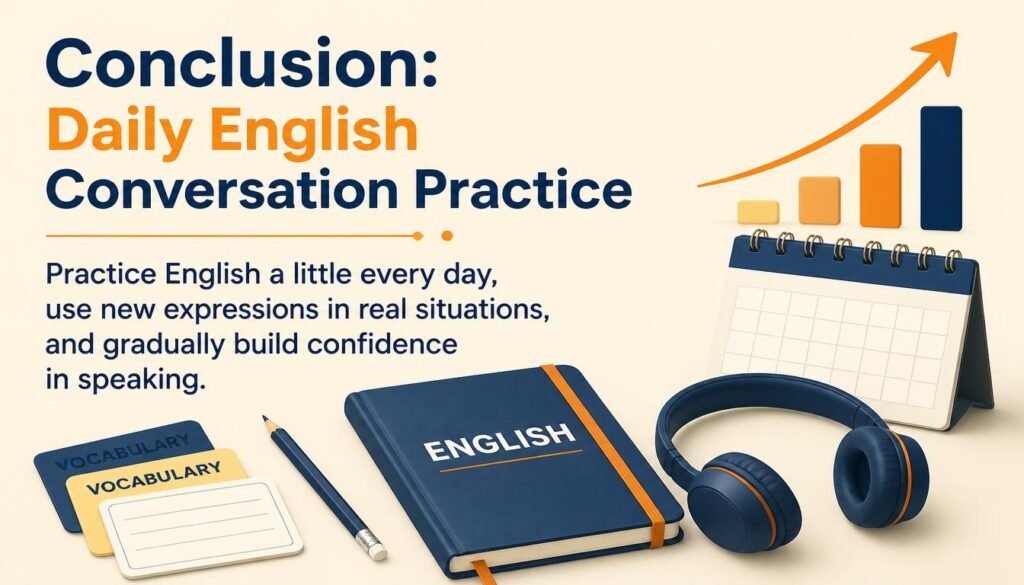
Daily English conversation practice can help you improve your speaking skills, expand your vocabulary, and feel more confident in everyday situations. From greeting someone and introducing yourself to ordering food, shopping, and asking for help, the expressions in this guide can prepare you for many real-life conversations.
The key is to practice consistently. Read the dialogues aloud, repeat useful phrases, listen to spoken English, and try having short conversations whenever you have the opportunity.
Remember, you do not need perfect English to communicate effectively. Start with simple sentences, keep learning from your mistakes, and gradually challenge yourself to speak more.
Practice a little every day, and take one step closer to speaking English with confidence!