
English Conversation at a Restaurant: Useful Dialogues and Phrases
Dining out in the United States offers a wonderful way…

Dining out in the United States offers a wonderful way to immerse yourself in local culture. Whether you are grabbing a quick lunch or enjoying a formal dinner, knowing how to navigate these social interactions builds immense confidence. This guide provides the essential tools you need to handle every step of your meal with ease.
We will explore how to make reservations, request specific seating, and ask thoughtful questions about the menu. You will also learn how to handle special dietary needs, address service issues, and settle the bill politely. Mastering these skills transforms your dining experience from stressful to enjoyable.
By practicing these short dialogues and reusable phrases, you will sharpen your listening abilities and improve your pronunciation. These practical examples prepare you for real-world scenarios, ensuring you feel ready to speak clearly whenever you dine out.
Key Takeaways
- Learn how to book tables and request preferred seating areas.
- Discover polite ways to ask questions about ingredients or menu items.
- Practice phrases for communicating allergies or special dietary requests.
- Gain confidence in handling common service issues or complaints.
- Master the vocabulary needed to request the check and pay your bill.
- Improve your overall fluency through targeted, real-world dialogue practice.
English Conversation at a Restaurant
Navigating a meal in the United States becomes much easier when you understand the typical flow of a restaurant visit. Mastering an english conversation at a restaurant is a key step toward feeling confident while dining out. By learning the standard sequence of events, you can turn any meal into a successful restaurant language practice session.
The typical experience begins with a warm greeting from the host and ends with you leaving a tip for your server. Along the way, you will use various dining out english phrases to request a table, order your meal, and ask for the check. Understanding these steps is the best way to improve english speaking skills in a real-world setting.
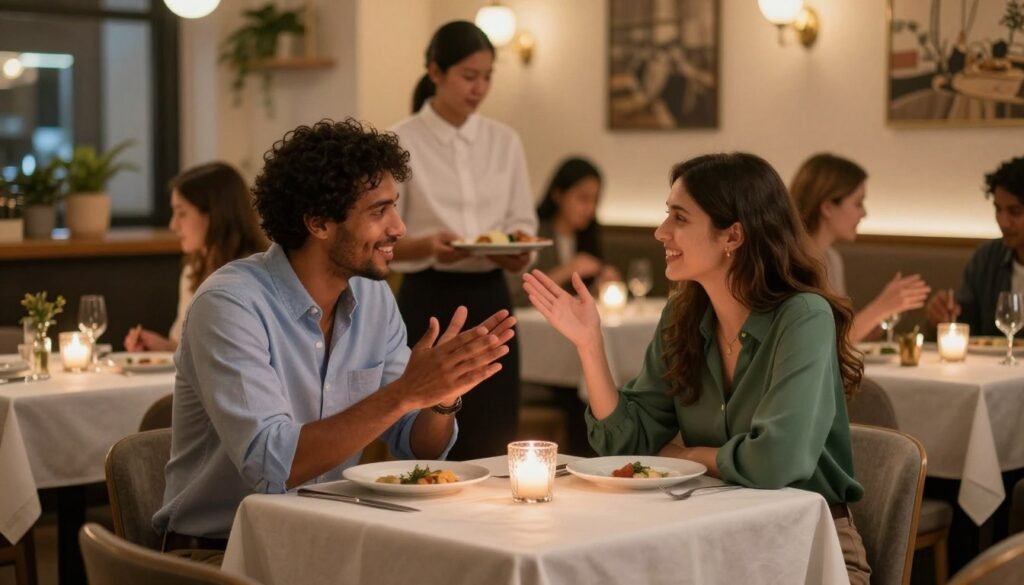
Politeness is the foundation of conversational english for dining out. Using simple, respectful words like “please,” “thank you,” “excuse me,” and “could I” makes your requests sound natural and friendly. When you practice these dining out language skills, you show respect to the staff and ensure a smoother experience for everyone involved.
To truly master restaurant conversation skills, try using techniques like shadowing. This involves listening to native speakers and repeating their words to mimic their rhythm and tone. Consistent restaurant conversation practice will help you feel more comfortable speaking english at a restaurant, whether you are ordering a simple coffee or a full dinner.
Remember that eating out in english is meant to be an enjoyable experience. If you are unsure about a menu item, do not hesitate to ask questions using conversational english for dining. Learning how to speak english at a restaurant takes time, but every interaction is a chance to grow. With regular restaurant english conversation, you will soon find that your conversation skills at a restaurant become second nature.
Whether you are focusing on english for dining out or simply looking to refine your english conversation skills in a restaurant, consistency is key. Keep practicing these interactions to ensure you are ready for your next meal. Dedicated restaurant english speaking practice will help you navigate any dining out in english scenario with ease.
English Conversation at a Restaurant: Making a Reservation
A successful night out often begins with a simple, well-phrased reservation request. Using the right restaurant english dialogue ensures that your plans are set correctly before you even arrive at the venue.
When calling to book, starting with “I’d like to make a reservation” is a polite and standard way to open the conversation. If you have a specific time in mind, asking “Do you have anything available at seven?” is a natural way to check for openings. These dining dialogues help you navigate english for restaurant situations with ease and confidence.
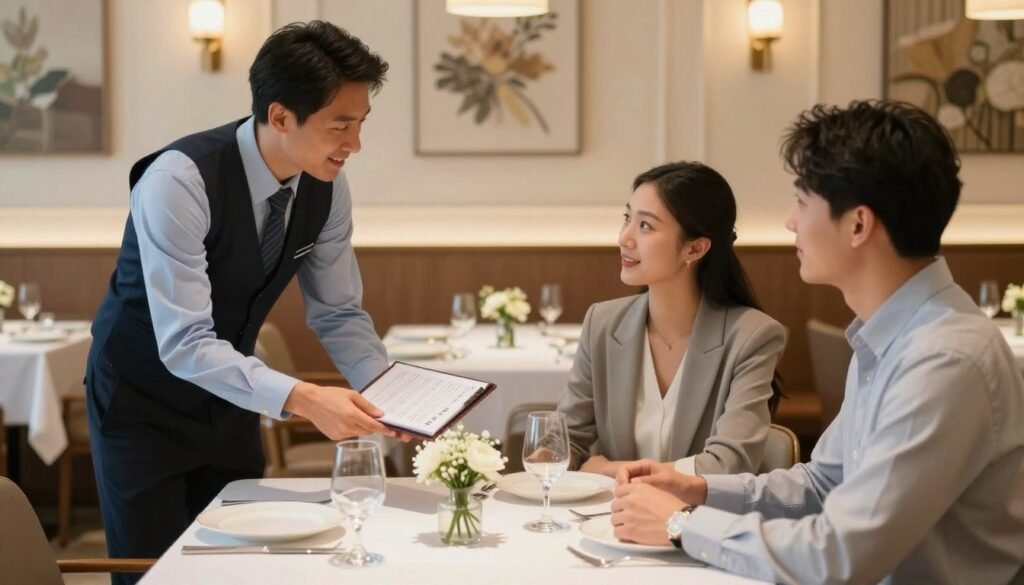
Customer and Restaurant Staff Conversation
Practicing role play scenarios at a restaurant is a great way to improve your fluency. Below is a common restaurant dialogue in english that you can use for restaurant dialogue practice.
Staff: Good evening, The Golden Bistro. How can I help you?
Customer: Hi, I’d like to make a reservation for this Friday, please.
Staff: Certainly! What time would you like to come in?
Customer: Do you have anything available at seven?
Staff: Let me check. Yes, we have a table for four at seven. Would you prefer indoor or outdoor seating?
Customer: We would prefer an outdoor table, please.
Staff: Perfect. May I have your name and a phone number for the booking?
Customer: It is Alex Miller, and my number is 555-0199.
Staff: Thank you, Alex. We have you down for four people this Friday at 7:00 PM on the patio.
To master restaurant conversations in english, it helps to organize the key information you need to provide. Use this guide to prepare for your next role play in a restaurant.
| Category | Example Detail | Purpose |
|---|---|---|
| Date | This Friday | Confirming the day |
| Time | 7:00 PM | Setting the arrival |
| Party Size | Four people | Ensuring space |
| Preference | Outdoor patio | Personal comfort |
Engaging in dining out dialogues regularly will make you feel more comfortable in any english restaurant dialogue. Whether you are using restaurant role-play english for study or travel, these phrases are essential for english dining dialogues.
English Conversation at a Restaurant: Arriving and Getting a Table
Your dining experience begins the moment you step through the restaurant doors. Knowing how to handle the initial interaction with the host is a vital part of speaking english at a restaurant. Whether you have a booking or are walking in, clear communication ensures a smooth start to your meal.
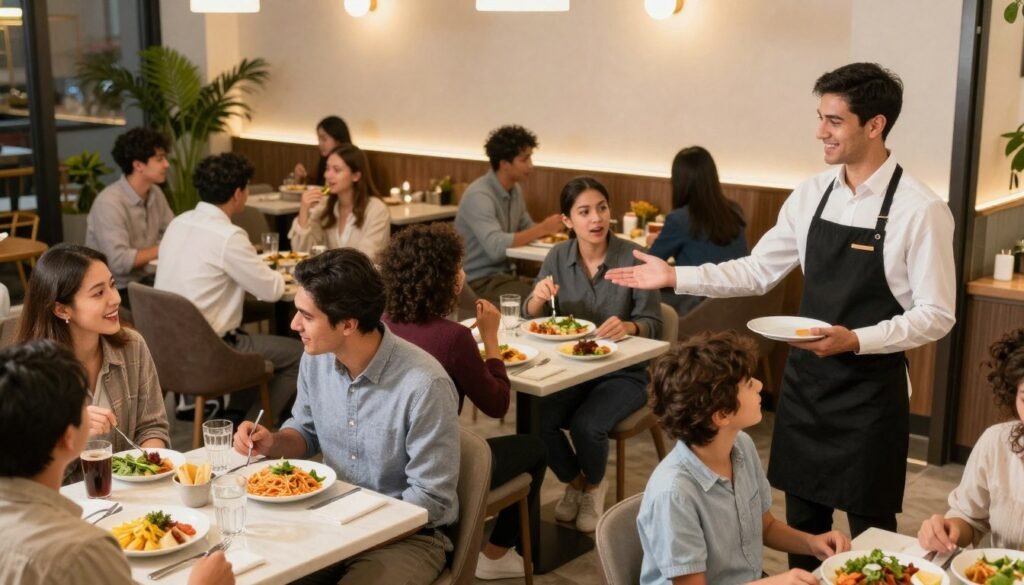
It is important to understand the difference between your requests. Asking for “a table for two” is a general request for seating, while “a reservation for two” confirms that you have already booked a spot in advance. Using the correct dining out conversation english helps the host assist you much faster.
Customer and Host Conversation
When you approach the host stand, start with a friendly greeting. You might say, “Hi, we would like a table for two, please.” If you have a booking, you should state, “We have a reservation for two under the name Miller.”
If the restaurant is busy, you may need to ask about availability. Natural restaurant conversation starters include asking, “How long is the wait?” or “Do you have any tables available right now?” If you have a preference, you can politely ask, “Could we sit by the window?”
The following table outlines common phrases used during this stage of your dining out dialogue:
| Scenario | Customer Phrase | Purpose |
|---|---|---|
| No Reservation | “Do you have a table for two?” | Requesting immediate seating |
| With Reservation | “I have a reservation for four at 7:00.” | Confirming a booking |
| Checking Wait Time | “How long is the wait for a table?” | Inquiring about availability |
| Seating Preference | “Could we sit by the window, please?” | Requesting a specific spot |
Mastering these conversation starters for restaurants will make you feel more confident. Remember that speaking english in a restaurant is all about being polite and clear. With these phrases, you are ready to enjoy your meal.
English Conversation at a Restaurant: Ordering Food
When you are ready to eat, using the right food ordering expressions in English will help you get exactly what you want. Navigating a menu can feel overwhelming, but knowing a few key phrases makes the process much smoother. Whether you are at a casual diner or a fine-dining establishment, clear communication is the key to a great meal.
There are several ways to place an order, each with a different level of politeness. Using “I’ll have” is a standard, direct way to state your choice. If you want to sound a bit more formal, “I’d like” is a perfect choice. For a softer, more polite approach, “Could I get” is widely used in the United States. These phrases for ordering in English allow you to tailor your tone to the environment.
Customer and Waiter Conversation
When you are ready to start talking to waitstaff in English, you can ask if they have a moment. A simple, “Are you ready to take our order?” or “Could we order now?” works well. Here is a typical exchange you might encounter:
Waiter: Are you ready to order, or do you need a few more minutes?
Customer: We are ready. Could you recommend a good appetizer?
Waiter: The calamari is very popular today.
Customer: That sounds great. I’ll have the calamari to start. For my entrée, I’d like the grilled salmon, and could I get a glass of iced tea with that?
Waiter: Certainly. So, that is one calamari, one grilled salmon, and an iced tea. Is that correct?
Customer: Yes, that is perfect, thank you.
Using these English food ordering phrases ensures that both you and the server are on the same page. Always listen carefully when the waiter repeats your order back to you. Confirming your choices helps avoid mistakes before the kitchen begins cooking. Mastering these food ordering expressions will give you the confidence to enjoy any dining experience in the U.S.
English Conversation at a Restaurant: Asking About the Menu
Effective communication in a restaurant setting starts with knowing how to inquire about your food. When you are dining out, it is perfectly normal to ask for details about how a dish is prepared or what specific ingredients are included. Mastering the art of communicating at a restaurant ensures that you make informed choices and avoid any unwanted surprises.
Asking About Ingredients and Dishes
If you have food allergies or specific dietary preferences, you must be clear when speaking with your server. You can ask direct questions to ensure your meal is safe and enjoyable. For example, you might ask, “Does this dish contain any nuts, dairy, or shellfish?” to protect your health.
Beyond allergies, you may want to know more about the composition of a meal. Using phrases like “What comes with the chicken?” or “Is this dish spicy?” helps you understand the flavor profile and portion size. Servers are usually happy to explain the preparation methods, such as whether an item is grilled, fried, or steamed.
The following table provides useful questions to help you navigate any menu with confidence:
| Question Type | Example Phrase | Purpose |
|---|---|---|
| Allergy Check | “Is this prepared with butter?” | Avoid dairy |
| Spice Level | “How spicy is the curry?” | Check heat |
| Side Dishes | “What comes with the steak?” | Know sides |
| Preparation | “Is the fish pan-seared?” | Understand cooking |
English Conversation at a Restaurant: Making Special Requests
Customizing your order is a standard part of the American dining experience. Whether you have specific dietary restrictions or simply prefer your food prepared a certain way, restaurant staff are generally happy to accommodate your needs. The key to a smooth interaction is clear and polite communication.
When you want to change an item, avoid using short, demanding commands. Instead of saying “No onions,” try a more courteous approach like, “Could you please leave off the onions?” This small shift in language makes the request feel like a collaboration rather than a demand, which often leads to better service.
Asking for Changes to Your Order
If you have food allergies, it is vital to inform your server before the kitchen begins preparing your meal. Clearly stating your needs ensures that the staff can take the necessary precautions to keep you safe. You might say, “I have a severe nut allergy; could you please ensure my dish is prepared without any nuts?”
“The secret of a good restaurant is that you’re eating there because you want to be there, and the staff is there because they want to serve you.”
Beyond allergies, you may want to adjust how a dish is served. Common requests include asking for sauces on the side, requesting less salt, or swapping a side dish for a healthier alternative. Using phrases like “Would it be possible to…” or “I would prefer…” helps maintain a friendly atmosphere throughout your meal.
| Request Type | Polite Phrase | Example |
|---|---|---|
| Ingredient Removal | Could you please leave off…? | Could you please leave off the onions? |
| Sauce Preference | Could I have the sauce on the side? | I’d like the dressing on the side, please. |
| Dietary Adjustment | Is it possible to substitute…? | Can I substitute the fries for a salad? |
| Seasoning | Could you go light on the…? | Could you go light on the salt, please? |
English Conversation at a Restaurant: Dealing With Problems
Navigating a dining mishap requires a calm and polite approach. Even in the finest establishments, errors can happen, and knowing how to address them ensures your meal remains enjoyable. By staying respectful and clear, you can resolve most issues quickly without causing any tension.
Wrong Order Conversation
If you receive a dish that you did not request, it is often a simple mistake by the kitchen staff. You can address this without placing blame by using a soft, inquisitive tone. For example, saying, “Excuse me, I think this was meant for another table,” is a perfect way to alert the server to the error.
Customer: “Excuse me, I think this was meant for another table. I ordered the grilled salmon, but this looks like the steak.”
Waiter: “Oh, I am so sorry about that mix-up! Let me take this back and bring your salmon right away.”
Complaint About Food Conversation
Sometimes, a dish might arrive cold, undercooked, or simply not prepared to your liking. When this happens, it is important to be direct but kind. Using phrases like, “I’m sorry, but this is not what I ordered,” or “Could you please replace it?” helps the staff understand your needs immediately.
- Always start with a polite “Excuse me” to get the server’s attention.
- Clearly explain the issue without being aggressive.
- Ask for a solution, such as a replacement or a correction to the dish.
- Maintain a friendly smile to keep the interaction positive.
Remember that restaurant staff want you to have a great experience. If you approach the situation with patience, they will usually be more than happy to fix the problem for you. Clear communication is the key to turning a minor inconvenience into a solved problem.
English Conversation at a Restaurant: Talking About the Food
Engaging in casual dining conversation makes every meal more enjoyable. When you are out with friends, using the right mealtime language helps you share your experience and connect with others. Learning how to express your thoughts about a dish is a key part of talking at a restaurant.
Commenting on the Food and Drinks
Knowing how to talk at a restaurant in English allows you to share your opinions on flavor, temperature, and texture. You might say, “This is delicious,” or mention that “The sauce is a little spicy.” These informal English phrases at a restaurant help keep the mood light and friendly.
If you want to be polite, you can offer a taste to your companion by asking, “Would you like to try some?” Such casual dining discussions are common when sharing appetizers or trying new menu items. Using these expressions makes talking in English while dining out feel natural and relaxed.
“One cannot think well, love well, sleep well, if one has not dined well.”
To keep your casual dining English conversation flowing, try asking follow-up questions. You could ask, “Is this your favorite dish?” or “What do you think of the seasoning?” These questions show interest and make mealtime conversations much more engaging for everyone at the table.
| Category | Positive Comment | Constructive Feedback |
|---|---|---|
| Flavor | This tastes amazing! | It is a bit too salty. |
| Temperature | It is served perfectly hot. | The soup is a little cold. |
| Texture | The steak is very tender. | This is a bit overcooked. |
| Portion | The portion size is generous. | It is a very small serving. |
Using these casual dining expressions will help you navigate any meal with ease. Remember that talking at a restaurant in English is all about sharing your experience and enjoying the company of others. Practice these phrases to feel more confident during your next outing.
English Conversation at a Restaurant: Asking for the Bill
Knowing how to ask for the final payment is a key part of the American dining experience. In the United States, the most common term you will use is the “check.” While the word “bill” is widely understood, you will find that servers and locals almost exclusively use “check” when referring to the total cost of the meal.
When you are ready to wrap up your dining experience, you can use a few polite phrases to get your server’s attention. A simple, “Could we have the check, please?” is always appropriate and polite. If you are not in a rush, you might say, “Whenever you’re ready, could we get the check?” to show that you are happy to wait for them to finish their current tasks.
Customer and Waiter Conversation
It is helpful to understand how to handle specific situations, such as asking for separate checks or timing your payment. The following dialogue demonstrates a typical interaction at the end of a meal.
Customer: Excuse me, could we have the check, please?
Waiter: Of course! Would you like to pay together, or would you prefer separate checks today?
Customer: Could we do separate checks, please? That would be much easier for us.
Waiter: Certainly. I will bring those right over for you.
The table below provides a quick reference for the different ways you can request your payment depending on your specific needs.
| Request Type | Suggested Phrase | Context |
|---|---|---|
| Standard Request | “Could we have the check, please?” | General use for any table. |
| Patient Request | “Whenever you’re ready, could we get the check?” | When the server is very busy. |
| Group Request | “Could we get separate checks, please?” | When splitting the cost with friends. |
| Quick Request | “We’re in a bit of a rush, may we have the check?” | When you have a time constraint. |
English Conversation at a Restaurant: Paying the Bill
Understanding how to handle the final bill is a key part of mastering dining etiquette in English. In the United States, the process usually involves reviewing the check, choosing a payment method, and calculating a gratuity based on the service provided.
Paying and Leaving the Restaurant
When you are ready to settle up, you can ask your server for the check. If you are dining with friends, you might need to ask if you can split the bill. Using proper dining etiquette phrases helps clarify whether you want separate checks or one total bill. This is a standard part of english language restaurant etiquette that ensures everyone is comfortable.
Here is a common dining etiquette dialogue. to help you navigate this step:
“Excuse me, could we have the check, please? Also, would it be possible to split this between two cards?”
“Certainly! I will bring that right over for you.”
After paying, remember to leave a tip, which is customary in the U.S. for good service. Before you head out, it is polite to offer a few dining etiquette in english. closing remarks. You might say, “Everything was great, thank you for your help,” or “Have a good evening.” Using these restaurant etiquette phrases makes your food etiquette conversation feel natural and appreciative. Mastering these restaurant etiquette phrases in english will leave a positive impression on the staff as you depart.
Common English Phrases Used at a Restaurant
Mastering a few key phrases can turn any dining experience into a smooth and enjoyable event. Whether you are visiting a local cafe or a fine dining establishment, having a set of must-know phrases for dining out in English will boost your confidence. These conversational English expressions allow you to interact with staff clearly and politely.
For beginners, it is helpful to focus on simple, direct requests. Phrases like “May I see the menu?” or “Could I have some water?” are essential English phrases for dining that you will use almost every time you eat out. Using these common restaurant phrases helps you avoid confusion and ensures your needs are met quickly.
To make your next meal easier, refer to the table below for organized restaurant conversation phrases. These dining out phrases cover the most frequent situations you will encounter.
| Category | Useful Phrase |
|---|---|
| Greeting & Seating | “Table for two, please.” |
| Ordering | “I would like to order the steak.” |
| Clarifying | “Does this dish contain nuts?” |
| Solving Problems | “Excuse me, this is not what I ordered.” |
| Paying | “Could I have the check, please?” |
When you practice these restaurant English expressions, try to speak slowly and clearly. If you are unsure about a menu item, do not hesitate to ask, “What do you recommend?” This is one of the most useful phrases for restaurant conversation because it invites the server to share their expertise.
Remember that politeness goes a long way. Adding “please” and “thank you” to your English phrases for eating out makes every interaction more pleasant. By keeping these simple tips in mind, you will find that your next experience with phrases for eating out is both successful and stress-free.
Restaurant English Vocabulary
Mastering english restaurant vocabulary is the key to a stress-free dining experience. When you understand the specific terms used in American eateries, you can navigate your meal with total confidence. Building your vocabulary for dining out helps you communicate your needs clearly to the staff.
In a typical restaurant, you will interact with different people. The host greets you at the door, while your server takes your order and brings your food. Understanding this restaurant english vocabulary ensures you know exactly who to ask for help.
Menus are often divided into specific sections. An appetizer is a small dish eaten before the main meal, known as the entrée. You might also order a side dish, like vegetables or fries, to accompany your meal. Finally, you can finish with a dessert, which is a sweet treat served at the end.
Using the right dining out vocabulary makes ordering much easier. Here is a quick guide to help you practice:
- Utensils: You use a fork, knife, and spoon to eat your meal.
- Beverages: This includes soft drinks, water, or alcoholic spirits.
- Check: This is the final bill you pay before leaving the restaurant.
To improve your dining vocabulary practice, try using these phrases in complete sentences. For example, you could say, “Could I please see the dessert menu?” or “May I have the check, please?” Using this restaurant vocabulary english helps you sound more natural.
Developing your restaurant conversation vocabulary is a great way to feel comfortable in any setting. Whether you are focusing on food vocabulary for restaurants or general vocabulary for restaurant conversations, consistency is vital. Mastering eating out vocabulary in english and dining out vocabulary in english will transform your next visit into a delightful experience.
English Conversation at a Restaurant: Frequently Asked Questions
Mastering dining etiquette requires confidence and the right phrases. Many learners wonder how to handle specific situations like food allergies or splitting the bill at places like The Cheesecake Factory or Olive Garden.
Use polite structures such as I’d like, Could I, and Would you mind to ensure your requests sound natural. These phrases help you navigate substitutions or ask for the check without feeling awkward. Being clear and kind makes every interaction smoother.
Review these dialogues aloud to build your speaking speed. Try role-play scenarios with a partner to simulate real dining environments. Applying this vocabulary during your next meal out turns study time into practical experience.
Keep practicing these patterns to improve your fluency. Your ability to communicate effectively grows with every order you place. Enjoy your journey toward speaking English with ease in any restaurant setting.