
English Conversation at the Car Repair Shop
A clear description of what the car is doing gives…

A clear description of what the car is doing gives the shop a better place to start. If your vehicle makes a new sound, drives differently, or shows a warning light, you can explain what you observed without having to name the cause. The conversations here are models you can adapt to your own words. In an English conversation at the car repair shop, the service advisor explains services, estimates, and scheduling; the technician inspects or repairs the vehicle. A diagnostic trouble code is an alphanumeric identifier a vehicle’s computer stores when it detects a condition that may need diagnosis.
Tell the shop when a symptom started and what makes it change, such as speed, weather, or whether the engine is warm. A warning light or sound alone does not identify a failed part, so avoid guessing. If you keep vehicle maintenance records, bring them or mention relevant recent service. The dialogues use courteous, everyday American English, with practical questions you can borrow when you need clarification.
Key Takeaways
- Describe what you notice and when it happens.
- Ask what an inspection found before discussing a repair.
- Request a clear explanation of charges and proposed work.
- State exactly which work you authorize.
- Keep the final invoice with your vehicle records.
Start with the first dialogue and practice describing one specific symptom in your own words.
English Conversation at the Car Repair Shop: Describing a Car Problem
If a sound changes with speed, tell the technician when it begins rather than naming a part you suspect. Specific details help with describing car symptoms, including explaining engine noises and describing dashboard warning lights. A light or noise is a clue, not proof that a particular part has failed.
Describe what you notice and when it happens. A warning light or sound alone does not identify a failed part.
Customer and Mechanic Dialogue
Customer: “There’s a high squeal when I start moving, and it gets quieter after a few minutes.”
Technician: “Does it happen when you turn or press the brake?”
Customer: “Mostly when I first pull away. I also feel a vibration through the steering wheel around highway speed.”
Technician: “I’ll note both concerns and check the vehicle. Is the engine warning light on?”
Customer: “Yes, it came on yesterday and stayed on. I don’t know what it means.”
Technician: “That’s useful. We’ll inspect it rather than assume what caused it.”
Saying “the engine is broken” without explaining when the noise occurs gives the technician less to work with. A concise observation is more useful than a diagnosis you are unsure about.
| What you notice | What to say | Useful detail |
|---|---|---|
| A squeal | “I hear a squeal when I pull away.” | It fades after a few minutes. |
| A vibration | “The steering wheel vibrates at speed.” | It begins near highway speed. |
| An engine warning light | “The engine warning light came on.” | It stayed on after restarting. |
| Trouble starting | “The car takes longer to start.” | It happens after the car sits overnight. |
Once you can explain the concern and its timing, you are ready to arrange a time for the shop to inspect it.
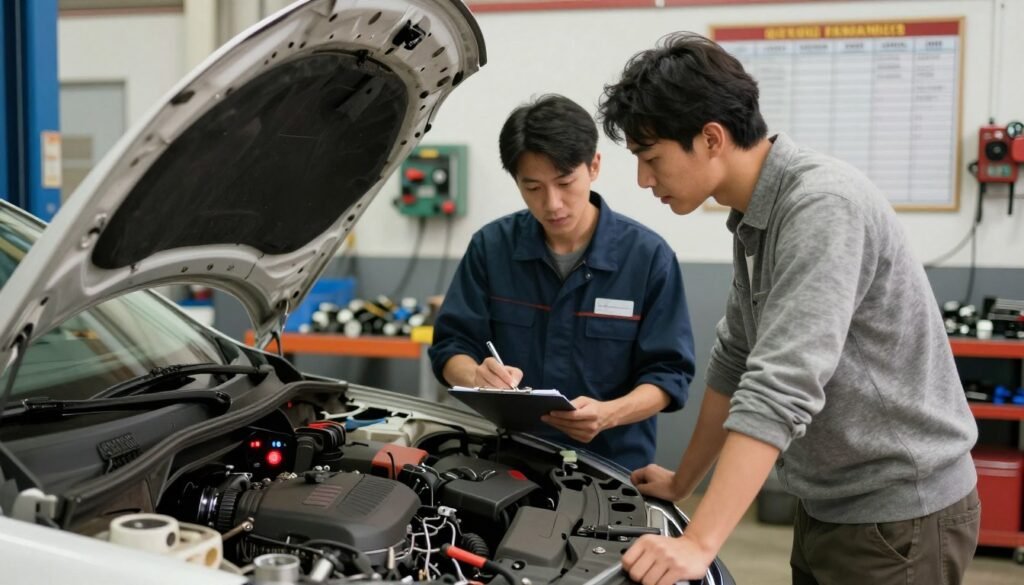
English Conversation at the Car Repair Shop: Booking a Repair Appointment
A useful booking call starts with the vehicle and the reason you need service. Be direct about the concern, whether the car can be driven, and which times work for you. Share enough information for the service advisor to plan the visit, without trying to diagnose the problem.
Customer and Service Advisor Dialogue
Customer: “I’d like to schedule a repair appointment for my 2018 Honda Civic. It has started shaking when I accelerate.”
Service advisor: “We have an opening Tuesday morning or Wednesday afternoon. Can you drive it here?”
Customer: “I can, but I’d prefer the earlier time. Do you have a rental car available?”
Service advisor: “I can check availability, but I can’t guarantee one until we confirm it. What’s the best way to reach you?”
Customer: “Please call my cell phone. If I miss the call, you can leave a message.”
Service advisor: “I’ll note that and confirm the appointment time.”
When scheduling a service appointment, ask how the shop will contact you and tell the advisor if your number or availability changes. Scheduling routine maintenance can follow the same pattern: name the service you want and identify any additional concern.
- Year, make, and model of the vehicle
- A concise description of the issue
- When the issue occurs
- Your preferred appointment times
- A reliable contact method
Asking about arranging a rental car is reasonable, but availability and terms depend on the shop and its arrangements. With a visit planned, you can ask what charges may apply before authorizing work.

English Conversation at the Car Repair Shop: Asking About Repair Costs
Before work begins, ask which charges are confirmed and which depend on diagnosis. Ask plainly about repair estimates, labor costs, and discussing diagnostic fees so you know what the shop proposes to charge. An estimate is not permission for every possible repair.
Customer and Mechanic Dialogue
Customer: “Is there a separate fee for diagnosing the problem?”
Technician: “Yes, the diagnostic inspection has a fee. I can ask the service advisor to explain what it covers.”
Customer: “Will the repair estimate separate parts and labor?”
Technician: “Yes. The estimate will list those charges separately, along with any other listed charges.”
Customer: “Please have the shop call me before adding work that isn’t on the estimate.”
Technician: “I’ll note that request for the service advisor.”
When explaining labor costs, the shop should be able to identify the labor charge on the estimate. Ask about diagnostic fees before testing begins, and confirm what the fee covers. Policies differ, so don’t assume a diagnostic charge will be credited toward a repair.
| Charge | Question to ask | What to confirm |
|---|---|---|
| Diagnostic fee | “Is diagnosis charged separately?” | What inspection the fee covers |
| Parts | “Are parts listed separately?” | Which parts are included |
| Labor | “Can you show the labor charge?” | Which repair the labor covers |
| Taxes or other listed charges | “What are these additional charges?” | Each item shown on the estimate |
Clear answers about costs make it easier to understand what routine services include, starting with an oil change.
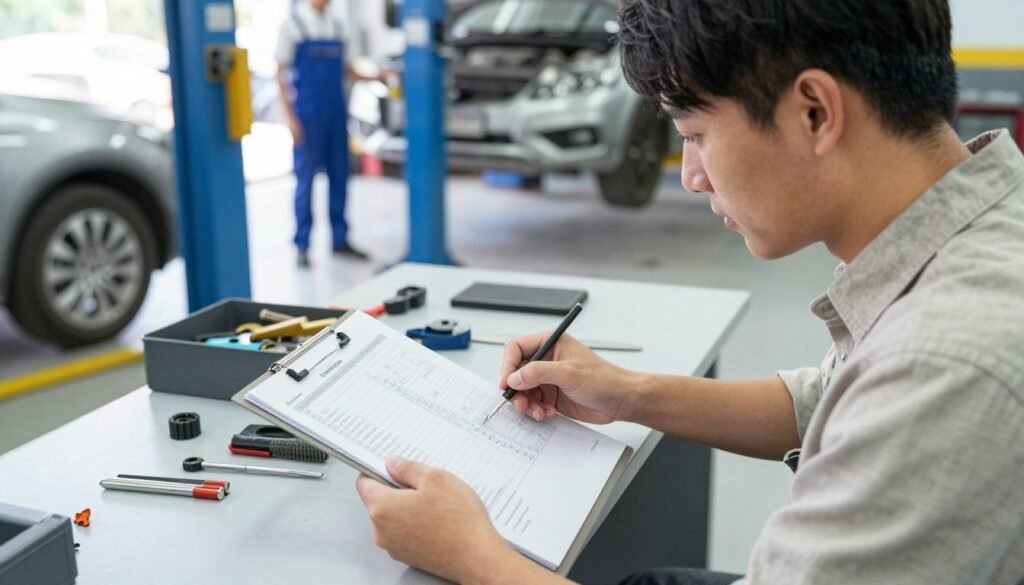
English Conversation at the Car Repair Shop: Getting an Oil Change
At a routine visit, say exactly which service you want before discussing any additions. Separate the request from recommendations so you can decide what belongs on the work order. Your vehicle’s owner’s manual and vehicle-specific maintenance schedule, not a universal interval, should guide oil-change timing.
Customer and Mechanic Dialogue
Customer: “I’m here for an oil change. Please let me know if you recommend any other maintenance.”
Technician: “I’ll check the schedule and vehicle information. If we find another service to recommend, the service advisor can explain it.”
Customer: “I’d like the oil change done, but please ask me before adding anything else.”
Technician: “Of course. We’ll keep the requested service separate from any suggested work.”
Customer: “Can you update my vehicle maintenance records after the service?”
Technician: “Yes, we can include the service information with your paperwork.”
Use these questions to clarify what the requested service includes and to keep any extra recommendation distinct from the work you asked for.
- “What oil type or specification does my vehicle require?”
- “Does the service include replacing the filter?”
- “Is any additional service being recommended?”
- “Will you update my maintenance record?”
After a routine service, a safety-related concern may call for a more urgent inspection, especially if the brakes feel different.
English Conversation at the Car Repair Shop: Checking the Brakes
Tell the shop promptly if the brake pedal feels different or stopping feels less predictable. Describe the change, such as a new squeal or a pedal that feels softer than usual. A change in braking ability is a safety concern, not a routine noise to ignore.
Customer and Mechanic Dialogue
Customer: “I hear a squeal when I brake, and yesterday the pedal felt softer than usual.”
Technician: “I’ll record both observations for the brake inspection. Does the change happen every time you stop?”
Customer: “The squeal is occasional, but the pedal has felt different on every drive.”
Technician: “We’ll inspect the braking system and explain what we find.”
Customer: “What did the inspection show? Do the brake pads need replacement, or do other brake components need attention?”
Technician: “I’ll have the service advisor go over the findings and recommendations with you.”
This dialogue is an example, not a diagnosis. A squeal can have different causes, and only an inspection can determine what is happening. Ask what the technician found and which components are affected rather than assuming that a sound means the pads need replacement.
If stopping feels unreliable, tell the shop clearly and ask how to proceed safely. A brake concern that affects control deserves attention before a routine noise does, and the discussion can then move to engine symptoms or a warning-light diagnosis.
English Conversation at the Car Repair Shop: Fixing Engine Problems
A warning code is a starting clue for diagnosis, not a parts order. Ask what it means in the context of the vehicle’s symptoms, especially when describing engine trouble such as rough running or difficulty starting. A diagnostic trouble code identifies a detected condition or system, but it does not by itself prove which part has failed.
Customer and Mechanic Dialogue
Customer: “The engine has been running roughly, and it hesitated when I started it this morning.”
Technician: “I’ll note that. Would you like us to test the vehicle and inspect the cause?”
Customer: “Yes. I’m requesting a diagnostic inspection. What will the test tell us?”
Technician: “It can show a stored code or other findings that help guide diagnosis. More testing may be needed to identify the cause.”
Customer: “If there’s a diagnostic fee, is it applied to a repair?”
Technician: “That depends on the shop’s policy. The service advisor can confirm it before the test.”
Requesting a diagnostic test does not mean you have authorized a repair. Ask the technician to explain the result in everyday language: what system or condition was detected, what further checks are needed, and what is still uncertain. Diagnostic trouble codes guide the next step, but they are not a list of parts to replace.
Once you understand the test result, you can discuss a separate no-start problem that may involve the battery, while keeping an open mind about its cause.
English Conversation at the Car Repair Shop: Replacing a Car Battery
If the car is slow to start, describe what happens before asking for a replacement. Give the pattern, including whether the issue follows a night parked outside or a recent jump-start. A no-start problem is not always caused by the battery, so ask what testing supports the recommendation.
Customer and Mechanic Dialogue
Customer: “The engine turns over slowly, especially in the morning. Could you check the battery and charging system?”
Technician: “Yes. We can test both and explain the results.”
Customer: “What did the tests show, and what replacement do you recommend?”
Technician: “The service advisor can go over the test results, the recommended part, and its stated warranty before you decide.”
Customer: “Please tell me what testing was performed before I authorize a replacement.”
Technician: “I’ll make sure that request is noted.”
These questions help you understand the recommendation and add useful information to your vehicle maintenance records.
- “When did the starting problem begin, and when does it happen?”
- “Has the vehicle needed a jump-start recently?”
- “What testing did you perform on the battery and charging system?”
- “Does the replacement part have a stated warranty?”
Battery testing helps narrow down a starting concern; another routine check, such as a tire inspection, also benefits from your observations.
English Conversation at the Car Repair Shop: Checking the Tires
Mention when a vibration occurs and whether you have noticed any visible tire changes. Report what you see, such as uneven wear or a tire-pressure warning, without treating either as a complete diagnosis. Before agreeing to replace tires, ask which tire or condition prompted the recommendation.
Customer and Mechanic Dialogue
Customer: “The car vibrates at higher speeds, and I noticed that one tire looks more worn than the others.”
Technician: “I’ll note that and check the tires. Has the tire-pressure warning appeared?”
Customer: “It came on once last week, then went away. What did the inspection find?”
Technician: “The service advisor can explain the condition and the options the shop recommends.”
Customer: “Which tire needs attention, and what condition led to that recommendation?”
Technician: “We’ll identify the inspection findings so you can compare the options.”
A warning light, visible wear, or vibration can help describe vehicle symptoms, but none tells the whole story by itself. Ask which tire the shop inspected, what it found, and whether replacement is recommended for one tire or more. The shop’s findings should explain the recommendation before you consider replacement parts.
When an inspection leads to a replacement recommendation, the next practical question is what type of part the shop proposes to install.
English Conversation at the Car Repair Shop: Asking About Replacement Parts
Ask what part the shop recommends and whether it can offer more than one option. Compare the details before approving replacement parts, including how each choice changes the estimate and any stated parts warranty. OEM parts are made for the vehicle manufacturer’s specifications; aftermarket parts are made by other companies.
Customer and Mechanic Dialogue
Customer: “What replacement part are you recommending, and is it OEM or aftermarket?”
Technician: “The service advisor can confirm the available part options and explain them on the estimate.”
Customer: “Are there alternatives, and how would each one affect the estimate?”
Technician: “We can explain the listed options, the price difference, and any stated warranty for each part.”
Customer: “Please include the part type and warranty information so I can review them before authorizing the replacement.”
Technician: “I’ll pass that request to the service advisor.”
OEM describes a part made for the vehicle manufacturer’s specifications. Aftermarket describes a part made by another company. Neither label alone means a part is always better; ask what options fit the vehicle and what warranty terms the shop states. Discussing replacement parts this way keeps the decision tied to the recommendation and estimate.
| Part option | Who makes it | Question to ask |
|---|---|---|
| OEM | Made for vehicle manufacturer specifications | “Is an OEM option available?” |
| Aftermarket | Made by another company | “What aftermarket option do you offer?” |
| More than one option | Availability depends on the repair | “Can I compare the listed options?” |
| Warranty terms | Stated for the specific part | “What warranty applies to this part?” |
Once the proposed work and parts are clear, you can ask how long the repair may take.
English Conversation at the Car Repair Shop: Asking How Long Repairs Will Take
Ask for the shop’s current timing estimate and what could change it. Get the conditions as well as the expected timing, since parts availability or further inspection can affect the repair. A timing estimate is a plan, not a promise that the vehicle will be ready at a specific time.
Customer and Service Advisor Dialogue
Customer: “When do you expect to begin the repair?”
Service advisor: “We expect to start after the inspection is complete. If we find something that changes the plan, I’ll contact you.”
Customer: “Does the timing depend on receiving a part or doing more inspection?”
Service advisor: “It may. I’ll update you if either affects the schedule.”
Customer: “Could you call me with updates? If a test drive would help confirm the repair, please let me know.”
Service advisor: “Certainly. We can discuss whether a test drive is useful for this concern.”
| Shop update | Customer question | What to clarify |
|---|---|---|
| Waiting for diagnosis | “When will you know more?” | Expected time for an update |
| Waiting for a part | “Is a part affecting the schedule?” | Whether arrival changes timing |
| Repair in progress | “When should I expect another update?” | Who will contact you and how |
| Ready for pickup | “What time can I collect the car?” | Pickup timing and any next steps |
Transportation needs can change while a vehicle is in the shop, so agree on a contact method that works for you. When the shop is ready to proceed, make sure the proposed work and permission are clear.
English Conversation at the Car Repair Shop: Approving a Repair Estimate
Before saying yes, match the proposed work to the problem you brought the car in for. Check the scope of the estimate, including its total and what remains unknown. Approval for a diagnostic test is separate from approval to perform a repair.
Customer and Service Advisor Dialogue
Customer: “Can you confirm which repairs are listed and the estimated total?”
Service advisor: “The estimate lists the recommended repair, parts, labor, and the charges shown here.”
Customer: “If the technician recommends additional work, will you call me first?”
Service advisor: “Yes. We’ll explain the new recommendation and ask for your authorization.”
Customer: “I approve the listed repair only. I’m not approving any additional work.”
Service advisor: “I’ll record those limits on the work order.”
Clear authorization prevents “go ahead” from being misunderstood as permission for work you did not discuss. For understanding an estimate, make the limits of your approval specific and ask which charges are still estimated or unknown.
- Confirm each repair listed on the estimate.
- Ask which charges are estimated or still unknown.
- State exactly which work you approve.
- Ask the shop to get permission before adding work.
Approving diagnostic tests allows the shop to perform the agreed tests; it does not automatically authorize a repair based on the result. Once the work is complete, compare what was done with what you authorized and review the paperwork.
English Conversation at the Car Repair Shop: Picking Up the Repaired Car
At pickup, ask the shop to walk you through the work before you pay and leave. Ask for a clear account of what was repaired, whether any additional work was authorized, and whether the original concern was checked after the repair. If the final invoice differs from the approved estimate, ask for an explanation rather than assuming an unexplained charge is correct or incorrect.
Customer and Mechanic Dialogue
Customer: “Could you walk me through what was repaired?”
Technician: “The invoice lists the work completed. The service advisor can explain the charges and any later authorization.”
Customer: “Was any additional work done, and when was it approved?”
Technician: “The work order should show what was authorized. I can help review the repair notes.”
Customer: “Did you check whether the original concern was resolved? Is anything still showing?”
Technician: “I’ll explain what we checked and note any remaining concern for the service advisor.”
Review the final invoice alongside the estimate and any later authorization. If a line is unclear, ask what it covers and when you approved it. Keep the paperwork so the repair and vehicle maintenance records stay together.
- Review the work listed on the invoice.
- Compare charges with the approved estimate and any later authorization.
- Ask about warning lights or concerns that remain.
- Keep the invoice with your vehicle records.
After checking the paperwork, a few short phrases can help you practice for future conversations.
Common Car Repair Shop English Phrases Used in Conversations
A short, direct question can help you get a clearer answer without needing technical vocabulary. Keep it specific to the decision in front of you, whether you are asking for a test, an estimate, or warranty coverage. Ask the shop to explain the written terms of any labor and parts warranty rather than assuming coverage is identical across repairs.
| Conversation goal | Useful phrase | When to use it |
|---|---|---|
| Explaining a symptom | “It happens when I turn left.” | Describe a repeatable condition |
| Requesting a test | “Could you test it before recommending a part?” | Ask for a diagnostic check |
| Asking for a written estimate | “Could you give me the estimate in writing?” | Review proposed charges |
| Confirming approval limits | “Please call me before doing any additional work.” | Set a clear authorization limit |
| Asking about warranty terms | “What does the written warranty cover?” | Review labor and parts coverage |
For warranty coverage, ask whether the written terms cover the part, labor, or both, and what conditions apply. A request for a repair warranty is a request for the shop to explain the actual terms, not a reason to assume every repair has the same coverage. Phrases such as “Could you explain what you found?” invite a plain-language answer about an inspection.
If you want more guidance on a shop conversation or a decision that comes afterward, these common questions address situations that can be harder to script.
Frequently Asked Questions About English Conversation at the Car Repair Shop
A repair-shop conversation can raise questions that do not fit neatly into a scripted exchange. When the situation is uncertain, ask for an explanation tied to your vehicle and the shop’s written terms. For a safety concern, get qualified help rather than relying on a warning light or a general rule alone.
When a warning or symptom may affect safety, use the owner’s manual and seek qualified help instead of guessing at the cause.
Use the answers below as starting points, then ask the shop to explain how its findings apply to your vehicle. State rules, shop policies, and vehicle condition can affect the right next step.
Conclusion
Confidence at the service counter starts with noticing and describing one detail clearly. Tell the shop what the car does, when it happens, and what changes it instead of guessing which part failed. Then ask for a clear explanation of the findings and proposed work before you authorize a repair.
You do not need technical vocabulary to ask useful questions or set limits on approved work. Before you contact the shop, write down the symptom, when it occurs, and one question you want answered. Keep that short note handy for your next visit.