
English Conversation at the Laundromat
A first visit can feel easier once you know that…
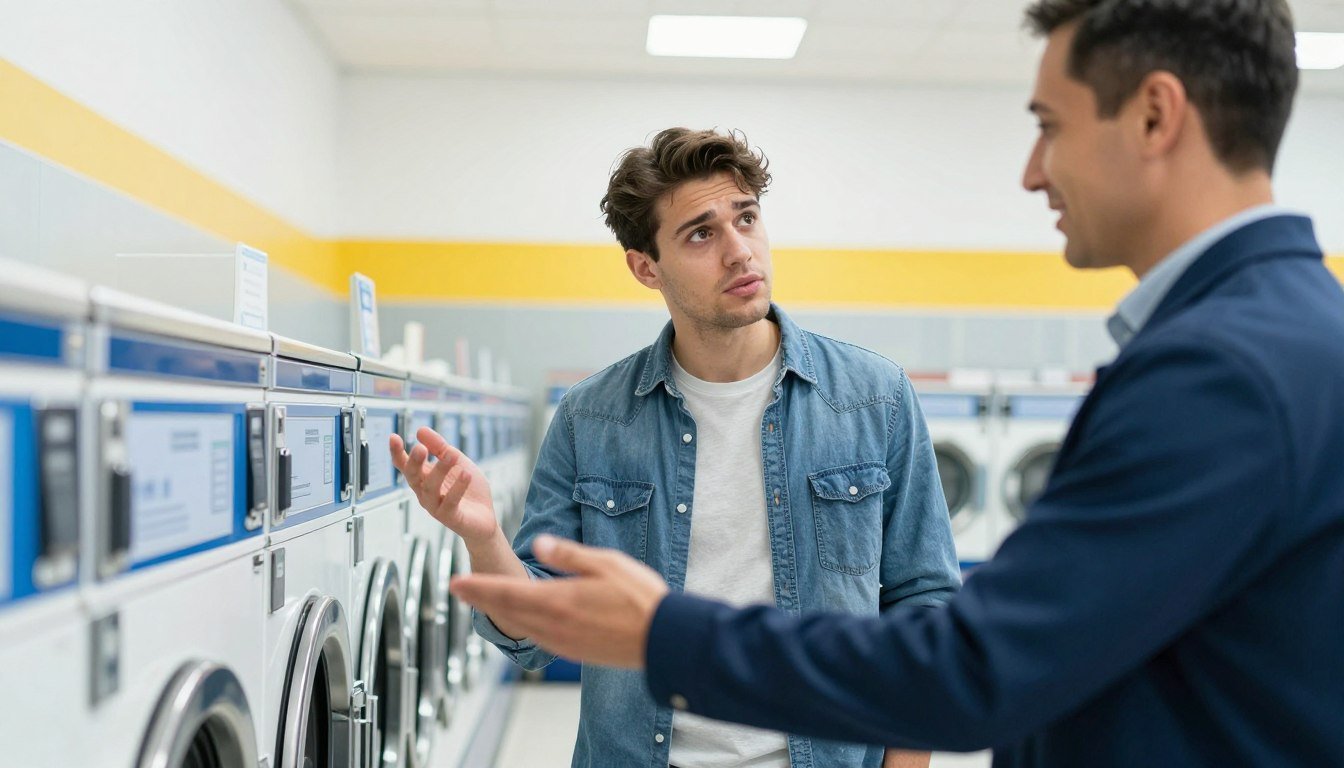
A first visit can feel easier once you know that a short question is enough to get help. If you are new to laundry in the United States, you do not need to know every machine setting before you walk in. This guide uses American English and gives you practical laundry vocabulary for beginners, so you can ask for help without preparing a long speech. A wash cycle is a washer program that determines how it cleans a load. Machine options, prices, and policies vary by location, so follow the instructions where you are. You can ask the laundromat attendant, the person who helps customers, when a control or sign is unclear. Starting a conversation with another customer is optional: a friendly greeting can lead to polite small talk with strangers, but you can simply focus on your laundry. You will have useful words for common moments, from asking a question to collecting your clothes. Start with the most immediate task: operating a washer.
Key Takeaways
- A short, clear question is enough to ask for help.
- The laundromat attendant can clarify local machine instructions.
- A wash cycle is the program that determines how a load is cleaned.
- Machine options, prices, and policies differ by location.
- You can be polite without making small talk with strangers.
English Conversation at the Laundromat: Using a Washing Machine
A customer with a full laundry bag pauses at an unfamiliar front-load washer. A front-load washer opens at the front, and machine layouts differ, so do not guess at a compartment that has no label. Check the machine’s instructions and ask the attendant before pressing a control you do not understand.
Check the instructions and ask before pressing a control you do not understand.
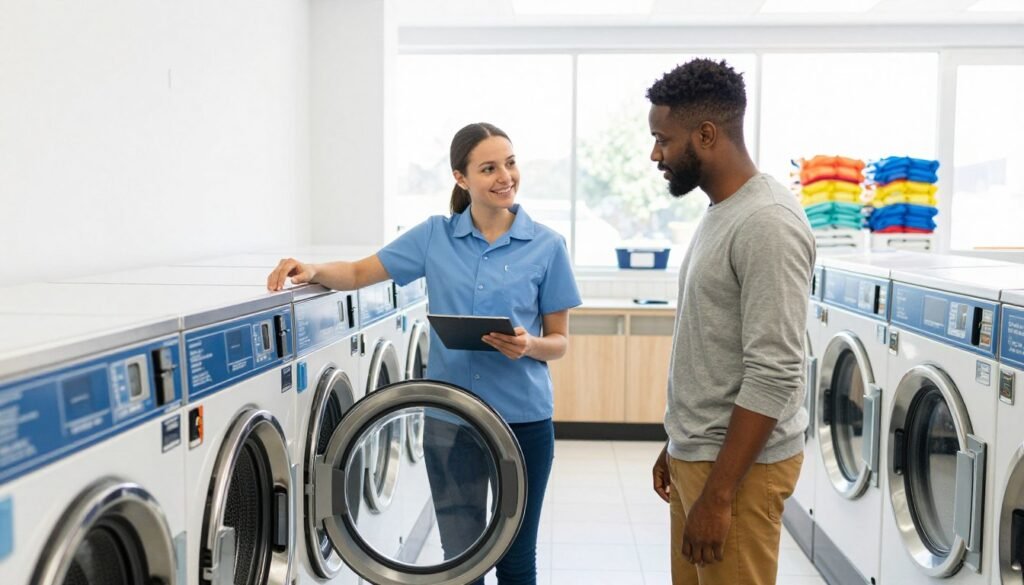
- Check the machine number and its posted instructions.
- Load clothes without packing the drum tightly.
- Add detergent in the labeled dispenser or as directed.
- Ask before pressing start if a control is unclear.
Customer and Laundromat Attendant Dialogue
Customer: “Hi, I’m using this front-load washer for the first time. Which compartment should I use?”
Attendant: “The labels are inside the dispenser. Pull it out and look for the detergent marking.”
Customer: “I see it now. Does the washer number match the number above the door?”
Attendant: “Yes. It’s number twelve. The instructions are posted beside it.”
Customer: “Could you show me where the start button is?”
Attendant: “Sure. Choose your settings first, then press the green button.”
Asking how to use a washer is a normal request, whether you are asking how to use a washing machine with digital controls or a row of coin-operated washers. Once the washer is loaded, the next thing to clarify is what the machine costs and accepts.
English Conversation at the Laundromat: Asking About Washing Machine Prices
A customer checks the payment panel before putting clothes into the washer. Ask the price and payment method before you start; posted prices and accepted payment methods vary by laundromat. Check the machine or posted signs instead of assuming every washer takes coins.
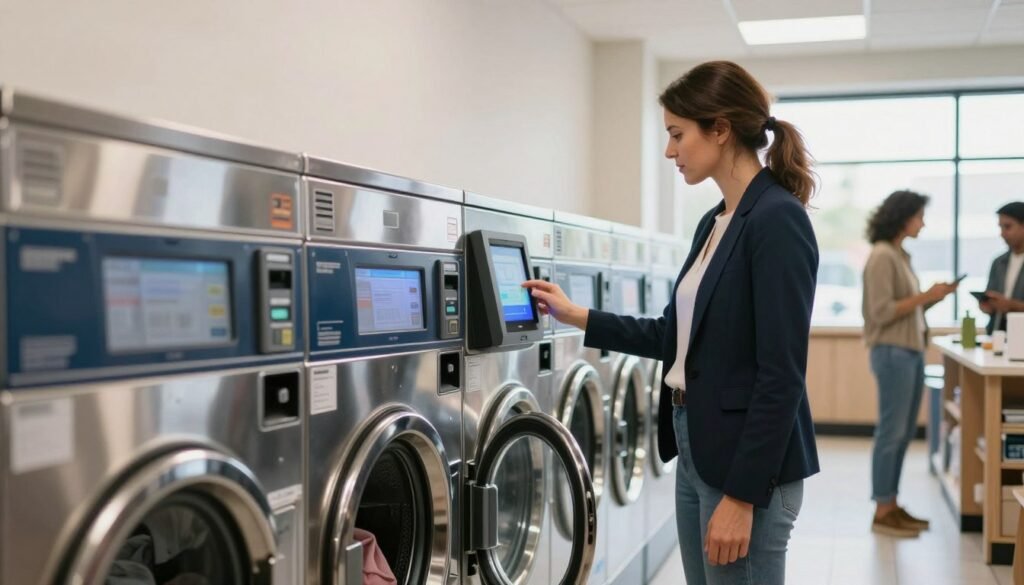
Useful questions are “How much is this washer?” and “Can I pay by card?” You can also ask, “Does this price cover one cycle?” Look for a displayed price near the payment panel, and ask the attendant if the sign is hard to read. Machine payment options may include coins, a laundry card, or another method, but the available choices depend on that location and machine.
Customer and Laundromat Attendant Dialogue
Customer: “Hi, how much is this washer?”
Attendant: “The price is displayed on the panel.”
Customer: “I see it. Can I pay by card, or does it take coins?”
Attendant: “This one takes the laundry card. The card reader is below the display.”
Customer: “Is that price for one cycle?”
Attendant: “Yes, it covers one wash cycle.”
Customer: “Great. I’ll check the instructions before I start.”
If you cannot find a posted price, ask the laundromat attendant rather than guessing. The same simple questions work for comparing payment methods at nearby machines. After checking the cost, you can ask which detergent to use.
English Conversation at the Laundromat: Buying Laundry Detergent
A customer who forgot to bring detergent asks the attendant what is available. Detergent cleans clothes; fabric softener is optional and should be used only as directed. Do not pour fabric softener into a detergent compartment unless its label says that is the correct place.
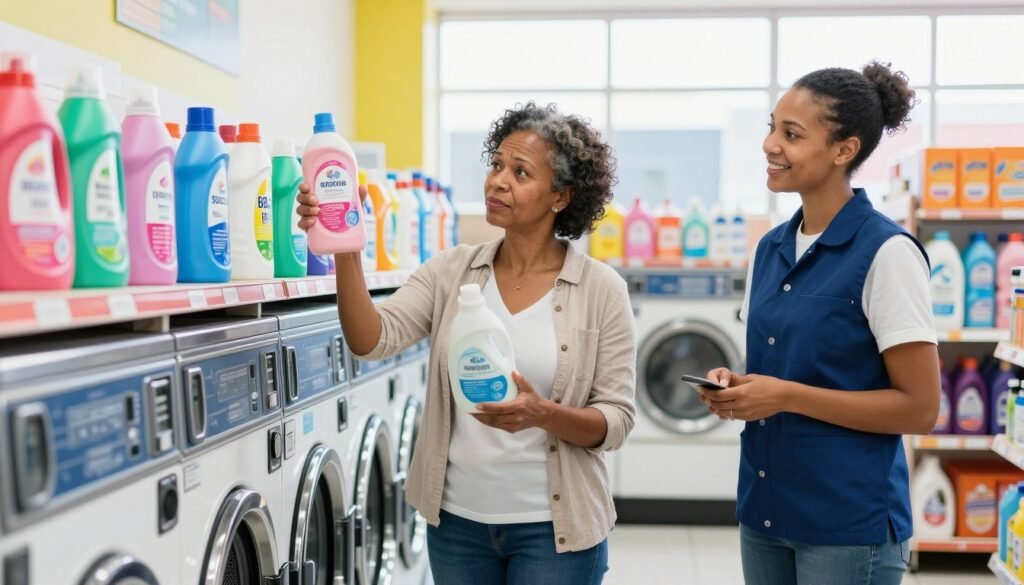
- Read the product label before use.
- Check the washer’s dispenser labels.
- Use the amount directed on the product.
- Ask whether a product is suitable if you are unsure.
Customer and Laundromat Attendant Dialogue
Customer: “Do you sell detergent here?”
Attendant: “Yes, small boxes are available from the vending machine.”
Customer: “Is fabric softener available too?”
Attendant: “Yes. Check the product label for directions.”
Customer: “Which dispenser compartment should I use?”
Attendant: “Look for the detergent label. The softener compartment has a separate marking.”
Customer: “I’ll check both labels before I add anything.”
Detergent and fabric softener may be sold in different forms, and availability varies by location. Follow product and dispenser directions instead of relying on the shape of a compartment. With supplies ready, you can choose an appropriate wash cycle.
English Conversation at the Laundromat: Choosing the Right Wash Cycle
Two piles of clothes sit beside a washer, and the customer is unsure which button to choose. Cycle names and available settings vary by washer, so check clothing care labels and the machine directions before choosing. Use a setting only when the garment labels allow it.
A customer might ask, “Which cycle should I use for these clothes?” You can also ask about water temperature: “Should I choose cold water?” If your load contains mixed clothes, explain what is in it and ask whether one setting is appropriate for the whole load. When labels recommend different care, sorting the clothes is safer than assuming one program suits everything.
| Cycle | Typical load | Setting check |
|---|---|---|
| Normal | Everyday washable clothing | Follow garment labels and washer directions |
| Delicate | Items labeled for gentle washing | Check care labels before choosing |
| Heavy-duty | Sturdy, heavily soiled items | Use only when the item labels allow it |
Customer and Laundromat Attendant Dialogue
Customer: “Which cycle should I choose for these everyday clothes?”
Attendant: “Check their care labels. Normal is for everyday washable clothing.”
Customer: “What about the water temperature? These clothes have different colors.”
Attendant: “Follow the labels. If you’re unsure about mixing them, separate the load.”
Customer: “Would this setting be appropriate for a mixed load?”
Attendant: “Only if the care labels allow it.”
After the wash settings are settled, you can ask about drying.
English Conversation at the Laundromat: Using a Dryer
A customer moves a clean load from the washer to a dryer and checks its control panel. Dryer heat settings and time controls differ by machine, so check garment labels and posted instructions before starting. Do not promise an exact drying time: the load and machine conditions affect how long clothes take.
You can ask, “Which setting should I use for these clothes?” or “Does this dryer stop automatically?” Some dryers use a timed control, while others offer settings with different controls; read the panel for the machine you are using. If a load still feels damp, follow the machine directions before adding more time.
| Setting | Suitable examples when labels allow | Caution |
|---|---|---|
| Low heat | Heat-sensitive items | Check care labels |
| Medium heat | Items whose labels permit moderate heat | Do not assume it suits every fabric |
| High heat | Sturdy items whose labels permit high heat | Avoid for items labeled low heat or no heat |
Customer and Laundromat Attendant Dialogue
Customer: “Which setting should I use for this load?”
Attendant: “Check the garment labels and match them to the dryer settings.”
Customer: “Does this dryer stop automatically?”
Attendant: “The instructions by the controls explain how this one works.”
Customer: “Can you tell me exactly how long the clothes will take?”
Attendant: “I can’t promise an exact time. The load and machine can affect it.”
When a label or setting is unclear, you can ask how to read the washing instructions.
English Conversation at the Laundromat: Asking About Washing Instructions
A customer notices a small instruction label but is unsure what one symbol means. Ask directly, “Could you show me where the instructions are?” or “Does this mean cold water?” Show the wording to the attendant instead of guessing. Garment care labels describe garment care; machine directions explain the equipment.
Machine instructions may be printed beside a control, on the dispenser, or on a sign nearby. If the words are small, you can point to the label and ask the laundromat attendant to explain it. Asking about machine instructions is useful when you cannot tell whether a word refers to a button or a dispenser. A clear question about washer settings can prevent an incorrect selection.
Customer and Laundromat Attendant Dialogue
Customer: “Excuse me, I can’t tell whether ‘softener’ means this button or the dispenser.”
Attendant: “Let me show you. The word on the dispenser identifies the compartment, and the posted directions explain the button.”
Customer: “Could you show me where the full instructions are?”
Attendant: “They’re on the sign beside the machine.”
Customer: “Does this label mean cold water?”
Attendant: “That label is on the garment. The washer directions explain which control selects the water temperature.”
Pointing to the exact wording makes it easier to get a useful answer. Once the instructions are clear, you can ask what to do about a mark on a garment.
English Conversation at the Laundromat: Removing Stains
A customer spots a dark mark on a shirt just before loading the washer. Stain treatment depends on the stain and fabric, so check the garment label and product directions before applying anything. If the stain is unknown or the fabric is delicate, ask before using a strong treatment.
- Identify the stain if you know what caused it.
- Check the garment care label.
- Ask whether a suitable stain remover is sold.
- Follow the product directions before washing.
Customer and Laundromat Attendant Dialogue
Customer: “I just noticed this mark. Does it need pre-treatment?”
Attendant: “It depends on the stain and the fabric. Check the care label first.”
Customer: “Do you sell a suitable stain remover?”
Attendant: “There may be one in the vending machine. Read its directions before using it.”
Customer: “I don’t know what caused the mark. Should I use a strong product?”
Attendant: “Ask before applying a strong treatment, especially if you’re unsure about the stain or fabric.”
Removing stubborn stains is not a reason to ignore a garment’s care instructions. A product that is unsuitable for the fabric may cause damage. If the item is delicate, confirm how to handle it before washing.
English Conversation at the Laundromat: Washing Delicate Clothes
A customer holds a delicate top beside a pile of towels and pauses before washing. Sort by care-label instructions, color, and fabric instead of combining everything for convenience. Keep delicate items separate from towels when the labels or washer options call for gentler care.
Sorting clothes by color and fabric can help you make a suitable load. Separate laundry by color when color transfer is a concern, especially for new or strongly colored items. Check each care label to see whether the top can be washed with other garments and which settings are allowed.
| Group | Examples | Sorting check |
|---|---|---|
| Light colors | White and pale washable items | Separate from new or strongly colored items |
| Dark colors | Dark washable items | Check labels and separate when color transfer is a concern |
| Delicates | Items labeled for gentle care | Keep separate from towels and use a suitable cycle if available |
Customer and Laundromat Attendant Dialogue
Customer: “Can I wash this delicate top in the same load as these towels?”
Attendant: “Check the labels first. Towels can be rough on delicate fabrics.”
Customer: “Should I keep the top separate?”
Attendant: “If its label calls for gentle care, use a suitable separate load if the washer offers that option.”
Customer: “I’ll check before I combine them.”
If you need more than self-service equipment, the next conversation is about available laundry services.
English Conversation at the Laundromat: Asking About Laundry Services
A customer arrives with more laundry than expected and asks what help is available. Laundry services and machine availability vary by location, so ask the attendant what is offered at this laundromat. Do not assume a machine is available just because its door is open; check its controls and posted signs.
A service question is different from a machine availability question. You might ask whether the laundromat offers wash-and-fold service, whether any washers are free, or whether an attendant can help with a machine question. Check the equipment for signs that it is in use or out of service, then ask staff if its status is unclear. Checking washer and dryer availability can save you from preparing a load for a machine that cannot be used.
Customer and Laundromat Attendant Dialogue
Customer: “Do you offer wash-and-fold service?”
Attendant: “Yes, we do. I can explain how to request it.”
Customer: “Thanks. I’m also looking for a washer. Are any machines free?”
Attendant: “Number eight is available. Please check its display before you use it.”
Customer: “Could you help me if I have a question about the machine?”
Attendant: “Of course. Just let me know.”
Services and equipment vary from one location to another, so ask rather than assume. If a machine appears faulty during your visit, report it before trying to use it.
English Conversation at the Laundromat: Dealing With a Broken Machine
A dryer display goes blank while a customer is trying to start a load. Report the machine number, what happened, and whether clothes or money are inside. Do not force the door or keep restarting a machine that appears faulty; follow staff directions.
Give staff the machine number and symptom, and do not force or repeatedly restart a faulty machine.
- Machine number.
- Whether it is a washer or dryer.
- Visible error or symptom.
- Whether a cycle started or stopped.
If clothes or money are inside, say so when you report the problem. These details help the laundromat attendant understand what happened without asking you to test the machine again. Handling a machine malfunction starts with a clear description, not with another attempt to force the controls.
Customer and Laundromat Attendant Dialogue
Customer: “The display on dryer number six went blank, and it won’t start.”
Attendant: “Did a cycle begin?”
Customer: “No, it never started. My clothes are inside.”
Attendant: “Please leave the door as it is. I’ll check the machine.”
Customer: “What should I do next?”
Attendant: “Wait here, and I’ll give you directions.”
Whether you are reporting a broken dryer or another machine breakdown, share the number and symptom. After resolving a machine problem, you may still need to complete payment for another machine.
English Conversation at the Laundromat: Paying for Laundry
A customer reaches the payment screen and sees that the washer needs a laundry card. Payment systems vary, so check posted instructions before loading value or inserting payment. Confirm that the machine accepts your payment method before you pay.
If you need to load a prepaid laundry card, ask, “Where can I add value to this card?” You can also ask, “What should I do if the machine doesn’t accept my payment?” Follow the directions on the machine or ask the attendant; do not assume the same payment methods work on every washer or dryer.
| Method | What the customer needs | Check before paying |
|---|---|---|
| Coins | The coins accepted by that machine | Confirm the machine accepts coins and check the displayed price |
| Laundry card | A card with enough value loaded | Check where and how to add value |
| Contactless or app payment | A supported card or phone setup | Confirm the machine offers this option |
Customer and Laundromat Attendant Dialogue
Customer: “This washer needs a laundry card. Where can I load a prepaid card?”
Attendant: “Use the card station beside the office. The screen shows how to add value.”
Customer: “What should I do if the machine doesn’t accept it?”
Attendant: “Check the display, then come ask me for help.”
Customer: “I’ll follow the instructions before trying again.”
Once the cycle is paid for and finished, you can collect your clothes and ask about anything missing.
English Conversation at the Laundromat: Collecting Clean Clothes
A customer unloads a finished cycle and notices one sock is missing. Check the washer or dryer for small items, then ask staff about the lost clothing policy before searching elsewhere. Move finished laundry promptly when others are waiting, and leave shared folding space clear when you are done.
Folding-table and lost-item policies vary by location. Keep your belongings together while folding, avoid spreading them across the whole table, and clear the surface when finished. If you think an item was left behind, ask the laundromat attendant where lost items are kept. Do not search in a staff-only or restricted area.
Customer and Laundromat Attendant Dialogue
Customer: “I can’t find one of my socks. I checked inside the dryer.”
Attendant: “I’m sorry. You can also check the washer drum and the area around your machine.”
Customer: “Where are lost items kept?”
Attendant: “Ask me, and I can check the lost-item area for you.”
Customer: “Is there a policy for how long items are kept?”
Attendant: “The policy is posted by the counter.”
When people are waiting, gathering your clothes and folding without delay helps keep the table available. You can use a short set of common phrases to handle similar exchanges independently.
Common Laundromat English Phrases Used in Conversations
A useful phrase lets you ask a clear question without rehearsing a long speech. A friendly greeting followed by one direct question is enough; you do not have to make small talk with strangers. Choose the phrase that matches the task, then give the other person time to answer.
- “Is this washer available?” Use this to check a machine.
- “Could you show me how this works?” Use this when you need help.
- “Where do I add the detergent?” Use this to locate a dispenser.
- “Is anyone using this folding table?” Use this to ask about shared space.
- “Do you know where lost items are kept?” Use this when something is missing.
- “Thanks for your help.” Use this to close an exchange politely.
You can use these words with the attendant or another customer, depending on what you need to know. Laundry folding tables are shared spaces, so ask before moving someone else’s belongings. Folding clothes at a folding table is simple to coordinate with a brief, courteous question. Folding table etiquette does not require a long conversation; keeping your things together and clearing the surface is considerate.
Point yourself toward the FAQ for answers to common practical concerns.
Frequently Asked Questions About English Conversation at the Laundromat
The answer to many first-visit questions is to check the machine instructions and ask staff when a local rule is unclear. Cycle duration depends on the washer and selected program, while unattended-laundry rules depend on the location. Do not guess when a display, posted policy, garment label, or product direction can answer the question. Use the information for your specific machine and load.
Check the machine instructions, garment labels, and posted policies, and ask staff when a local rule is unclear.
Sort light and dark clothes according to their labels, and separate new or strongly colored items when color transfer is a concern. You may need to bring detergent if the location does not sell it, so ask what is available. For the right amount, follow the product label and washer directions. If a washer stops mid-cycle, note its number and symptom, then contact the attendant. Do not force the door or repeatedly restart the machine. These practical checks also help when you are asking about machine availability or reporting a problem. A clear description of what you see makes it easier for staff to direct you. Move from these answers to one simple next step you can take on a visit.
Conclusion
A clear question can make an unfamiliar laundry task feel manageable. Two habits will help you: a short, polite question is enough to request help, and machine directions and garment labels should guide your choices. You do not have to memorize laundry vocabulary for beginners before you go. When choosing a wash cycle or asking about an unfamiliar control, explain what you need and let the attendant point you to the right instruction. You can keep the exchange simple and friendly without starting a longer conversation. Before your next visit, practice saying “Could you show me how this works?” aloud once or twice. Try that one question at your next visit.