
Example Sentences of Simple Future Tense
When you talk about events that have not happened yet,…

When you talk about events that have not happened yet, you rely on a specific grammatical structure. The simple future tense helps you describe actions or situations expected to occur later. It is a fundamental building block for clear communication in daily life.
In American English, speakers frequently form this pattern by combining “will” with a base-form verb. This approach makes the future tense in english incredibly approachable for beginners. By mastering these structures, you can confidently share your plans and predictions.
This guide provides practical future tense examples to help you see how these words function in real-world contexts. You will discover how time expressions add precision to your statements. Let’s explore how to use these tools to express your intentions effectively.
Key Takeaways
- The structure uses “will” followed by a base verb to indicate upcoming events.
- It is commonly used for making predictions or stating planned actions.
- Time markers like “tomorrow” or “next week” clarify when an event occurs.
- This grammatical form is essential for everyday conversations in the United States.
- Beginners can easily grasp the pattern due to its consistent structure.
What Is the Simple Future Tense?
Mastering the basic future tense allows you to express your plans and predictions with confidence. This verb form is specifically designed to describe events that have not happened yet. Whether you are talking about a meeting next week or a dream for next year, this structure provides the clarity you need.
At its core, the future simple relies on the auxiliary verb “will” placed before the base form of the main verb. For example, you might say, “Sarah will arrive at the station soon.” A key advantage of this structure is that “will” remains the same regardless of the subject, making it very easy to learn.
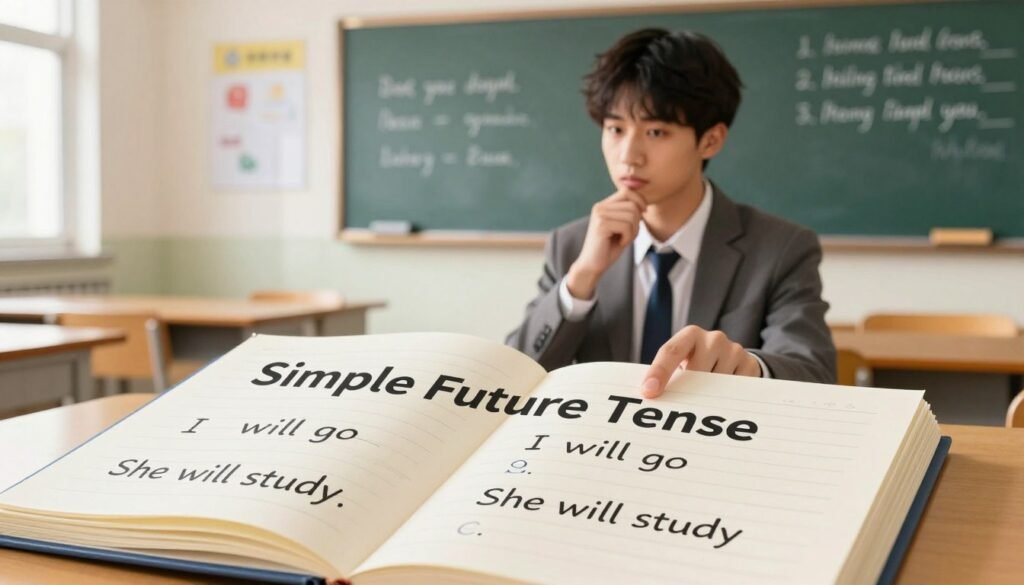
Unlike the present tense, which describes current habits, or the past tense, which covers completed actions, the future tense looks forward. It creates a bridge between your current moment and the possibilities that lie ahead. As the famous author Peter Drucker once noted:
“The best way to predict the future is to create it.”
By using the future simple correctly, you can effectively communicate your intentions and expectations to others. It is a versatile tool that helps you navigate conversations about upcoming schedules, promises, and spontaneous decisions. Once you grasp this future tense, you will find it much easier to share your vision for what comes next.
Simple Future Tense Structure
Mastering the future tense structure is a vital step for anyone learning English. By understanding how to arrange your words, you can express your thoughts about upcoming events with clarity and ease.

Affirmative Simple Future Sentences
The future tense formation for affirmative statements is straightforward. You simply combine the subject with the auxiliary verb “will” and the base form of the main verb.
This pattern remains consistent regardless of the subject. Whether you are talking about yourself or a group, the rule stays the same:
- Subject + will + base verb
- Example: She will attend the meeting tomorrow.
- Example: They will finish the project by Friday.
Negative Simple Future Sentences
When you want to express that something will not happen, the process of forming simple future tense sentences is just as simple. You insert the word “not” between “will” and the verb.
In casual conversation, most speakers prefer to use the contraction “won’t.” Both forms are grammatically correct and widely accepted in American English.
- Subject + will not (or won’t) + base verb
- Example: I will not forget your birthday.
- Example: He won’t arrive until late tonight.
Interrogative Simple Future Sentences
Asking questions requires a slight shift in the future tense grammatical structure. To create an inquiry, you move the auxiliary verb “will” to the very beginning of the sentence, right before the subject.
This inversion is the standard way to ask about future events. It helps listeners immediately identify that you are seeking information about a later time.
- Will + subject + base verb?
- Example: Will they join us for dinner?
- Example: Will you help me with this task?
When to Use the Simple Future Tense
Knowing the right time to use the simple future tense helps you sound more natural in English. Understanding how to use future tense correctly allows you to express your thoughts about upcoming events with total confidence.

General Actions in the Future
The simple future tense is perfect for describing events that are certain to happen. These are often general facts or routine occurrences that lie ahead. For example, you might say, “The sun will rise at 6:00 AM tomorrow.”
There are many uses of future tense when discussing these inevitable events. It provides a clear way to state what is expected to occur without needing complex grammar structures.
Future Plans and Intentions
While we often use other forms for fixed plans, the simple future is useful for stating intentions. It is important to distinguish between a spontaneous thought and a long-term plan. Intentions often feel more deliberate than simple predictions.
If you decide to do something in the moment, you use “will.” If you have already booked a flight or scheduled a meeting, you might use a different structure. Choosing the right form makes your speech sound much more authentic.
Future Predictions and Expectations
We frequently use this tense to share our beliefs about what might happen. Proper future tense usage involves using “will” to express an opinion or a guess about the future. You might say, “I think it will rain later this afternoon.”
This helps listeners understand that you are sharing a personal expectation. It is a very common way to engage in casual conversation about the weather, sports, or upcoming news.
Future Decisions and Promises
One of the most helpful ways to learn how to use simple future tense is by practicing spontaneous decisions. When you offer to help someone, you naturally use “will.” For instance, saying “I will carry those bags for you” shows a quick, helpful response.
This tense is also ideal for making promises. When you say, “I will be there on time,” you are committing to a future action. Using this tense correctly builds trust and clarity in your daily interactions.
Examples of Simple Future Tense
Seeing real-world future tense examples helps clarify how to express upcoming plans and intentions. By organizing these phrases into categories, you can easily see how the grammar works in different parts of your life.
Everyday Simple Future Sentences
Using the simple future tense for daily routines is a great way to practice. You might describe small habits or chores you need to finish later today.
For instance, you could say, “I will wash the dishes after dinner.” Another common example is, “She will feed the cat before she leaves for work.”
Future Activities and Events
When you talk about social gatherings or public events, these future tense sentences become very useful. They help you coordinate with friends and family effectively.
You might tell a friend, “We will meet at the park at noon.” You could also say, “The concert will start at eight o’clock tonight.”
Future Work and Study Examples
In a professional or academic setting, clear communication is essential. Using simple future sentences allows you to set expectations for deadlines and meetings.
A student might say, “He will study for the exam tonight.” A colleague might confirm, “I will send the report by Friday morning.”
Future Travel and Leisure Examples
Planning a vacation or a hobby project is much more exciting when you can talk about it clearly. These examples of simple future tense help you share your enthusiasm for upcoming trips.
You might say, “We will fly to Chicago next month.” You could also mention, “They will visit the museum during their weekend trip.”
“The best way to predict the future is to create it.”
| Category | Example Sentence | Context |
|---|---|---|
| Everyday | I will call you later. | Routine |
| Events | The party will begin soon. | Social |
| Work/Study | She will finish the project. | Professional |
| Travel | We will book the hotel. | Leisure |
50 Example Sentences of Simple Future Tense
Learning how to use future verb forms will help you communicate with confidence. By observing how these words function in daily life, you can master the structure of the English language more effectively. Here are 50 examples of simple future tense sentences to guide your practice.
“The limits of my language mean the limits of my world.”
These future tense verb forms are categorized to show how we express plans, promises, and predictions. You will notice how the auxiliary “will” remains consistent across different subjects.
- I will finish my report by tomorrow.
- She will call you later this evening.
- They will arrive at the airport at noon.
- We will visit our grandparents next weekend.
- He will study for his exam tonight.
- It will rain later today.
- You will enjoy the movie.
- Sarah will bake a cake for the party.
- The team will win the championship.
- I will not forget your birthday.
- Will you join us for dinner?
- Will they move to a new city?
- Mark will start his new job on Monday.
- We will travel to Japan next summer.
- The store will close at nine o’clock.
- I will send the email shortly.
- She will not attend the meeting.
- Will he bring the documents?
- The sun will rise at six.
- We will celebrate our anniversary soon.
- They will paint the house blue.
- I will help you with your homework.
- You will learn a lot in this class.
- Will it be cold tomorrow?
- The train will depart on time.
- He will buy a new car next month.
- We will watch the game together.
- She will sing a song at the event.
- I will not change my mind.
- Will you call me when you arrive?
- The company will launch a new product.
- They will fix the fence this weekend.
- I will cook dinner tonight.
- He will read that book eventually.
- We will meet at the park.
- The concert will start at eight.
- She will write a letter to her friend.
- Will they play soccer later?
- I will save money for a vacation.
- You will see the difference soon.
- The cat will sleep on the sofa.
- We will clean the garage on Saturday.
- He will not be late again.
- Will she accept the invitation?
- The flowers will bloom in spring.
- I will try my best to succeed.
- They will build a new library.
- We will order pizza for lunch.
- He will call the doctor tomorrow.
- Will you remember this day?
Practicing these future tense verbs helps you internalize the patterns of English grammar. As you continue to use these future verb forms, you will find that constructing your own sentences becomes second nature. Keep these future tense verb forms in mind whenever you discuss upcoming events or personal goals.
Simple Future Tense Examples With Time Expressions
Adding words like “tomorrow,” “soon,” or “next week” helps define exactly when an action will occur. These markers provide necessary context, making your future tense sentence structure much clearer to the listener. By placing these expressions at the start or end of a sentence, you can easily shift the focus of your message.
Consider how these future tense sentence patterns function in daily conversation. For example, you might say, “I will finish the report later,” or “In two years, she will graduate from college.” Whether you place the time expression at the beginning or the end, the core meaning remains consistent and easy to understand.
One of the best features of English grammar is that future tense conjugation does not change based on the subject. Whether you use “I,” “you,” “he,” or “they,” the word “will” remains exactly the same before the base verb. This simplicity allows you to focus on your message rather than worrying about complex verb endings.
To help you visualize these patterns, here are a few common ways to integrate time expressions:
- Tomorrow, we will visit the new museum downtown.
- They will arrive at the airport soon.
- I will start my new job next week.
- He will complete the project in two years.
Using these expressions effectively ensures that your communication is precise and professional. Remember that consistency is key when practicing these structures. By mastering these simple additions, you will gain confidence in your ability to describe future events accurately.
Simple Future Tense With Will and Shall
While will is the most common way to express the future, other options like shall and going to serve specific purposes in English. Understanding these variations is a key part of mastering future tense rules to ensure your communication remains clear and accurate.
In modern American English, the will tense is the standard choice for almost all subjects. You can use it to express promises, spontaneous decisions, or general predictions about what lies ahead. It is versatile and fits naturally into both casual and professional conversations.
On the other hand, shall is much less common today. You will mostly encounter it in formal suggestions or when asking polite questions using “I” or “we.” For example, saying “Shall we begin the meeting?” sounds more refined than using “will” in that specific context.
When you want to discuss prior plans or predictions based on present evidence, the going to future is your best option. Unlike “will,” which often signals a sudden decision, “going to” implies that you have already thought about or prepared for the action. Following these simple future tense rules helps you distinguish between a spontaneous thought and a firm intention.
Ultimately, choosing between these forms depends on the context of your sentence. If you are making a quick promise, the will tense works perfectly. If you are describing a scheduled event or a clear sign of what is coming, the going to future provides the necessary clarity. Mastering these simple future tense rules will significantly improve your ability to express time accurately.
Simple Future Tense vs. Future Continuous Tense
Let’s explore the nuances that separate the simple future from the future continuous tense. Mastering these verb tenses is essential for anyone looking to communicate clearly about upcoming events. While both forms refer to the future, they serve very different purposes in conversation.
The simple future uses “will” plus the base form of a verb to describe a completed action or a general fact. For example, you might say, “I will finish my report by five.” This implies the task will be done at that specific time.
In contrast, the future continuous uses “will be” plus the present participle to describe an action in progress at a specific moment. If you say, “I will be working at five,” you are emphasizing that the activity is ongoing. Engaging in regular future tense practice helps you identify when to focus on the duration of an event rather than just its completion.
To sharpen your skills, try completing various future tense exercises that force you to choose between these two forms based on context. Look at the table below to see how the structure and meaning change depending on your choice.
| Tense | Structure | Primary Meaning | Example |
|---|---|---|---|
| Simple Future | Will + Verb | Completed action | I will eat lunch. |
| Future Continuous | Will be + Verb-ing | Ongoing action | I will be eating lunch. |
| Simple Future | Will + Verb | Future fact | She will arrive soon. |
| Future Continuous | Will be + Verb-ing | Action in progress | She will be arriving soon. |
Common Mistakes With Simple Future Tense
Even experienced speakers sometimes stumble when applying simple future tense rules in daily conversation. Understanding how to use simple future tense correctly is essential for clear communication, yet small errors often creep into our speech. By identifying these frequent pitfalls, you can refine your grammar and sound more natural.
One of the most common errors involves forgetting the auxiliary verb. Many learners mistakenly say, “I go to the store tomorrow,” instead of the correct form, “I will go to the store tomorrow.” Always remember that the future marker is necessary to indicate that an action has not happened yet.
Another frequent mistake is adding an extra suffix to the main verb. You must always use the base form of the verb after “will.” For example, saying “She will goes” is grammatically incorrect; the proper phrasing is “She will go.” The verb should never change, regardless of the subject.
Watch out for double future markers or misplaced question words. A common error is saying, “Will you will come?” when the correct structure is simply, “Will you come?” Additionally, ensure your question words like “when” or “where” are placed at the very beginning of the sentence to maintain proper order.
Finally, consider the difference between “will” and “going to.” While “will” is great for spontaneous decisions, using it for a long-term, established plan can sound slightly off. In those cases, “going to” is often the more natural choice. Mastering these small adjustments will help you communicate your future intentions with total confidence.
Frequently Asked Questions About Simple Future Tense
Learning a new grammar structure often brings up many questions. Whether you are looking for future tense exercises or simply trying to understand how to form sentences, clarity is key. Below are the most common inquiries regarding how we talk about what is coming next.
Many students wonder if the word “will” changes based on the subject. The answer is simple: it does not change. Whether you use “I,” “you,” “he,” or “they,” the word “will” remains the same, followed by the base form of the verb.
“The future belongs to those who believe in the beauty of their dreams.”
If you need future tense practice, consider how we differentiate between “will” and “going to.” We typically use “will” for spontaneous decisions or promises made at the moment of speaking. In contrast, “going to” is often reserved for plans that were already decided before the conversation started.
For those seeking simple future tense practice, the following table provides a quick reference for common sentence structures. Mastering these patterns will improve your overall future tense usage in daily conversations.
| Sentence Type | Structure | Example |
|---|---|---|
| Affirmative | Subject + will + verb | She will arrive soon. |
| Negative | Subject + will not + verb | He will not go there. |
| Interrogative | Will + subject + verb? | Will they join us? |
Do not worry if you make mistakes while learning. The best way to improve is to keep writing and speaking. Try to create your own sentences using the table above to solidify your understanding of these rules.
Conclusion
Gaining confidence in your English skills starts with understanding how to talk about what lies ahead. You now possess the core formula for the simple future tense, which relies on the subject plus will and the base verb. This structure serves as the foundation for your daily conversations.
You can now build negative sentences and questions with ease. Remember to practice these patterns using common time expressions to add clarity to your speech. Distinguishing between will and going to helps you sound more natural when you discuss your plans or make quick decisions.
Consistent practice remains the best way to improve your command of the future tense. Try writing down your goals for the week using these new sentence structures. You might even share your plans with friends to see how well you apply these rules in real life.
Keep exploring how language shapes your world. Your ability to express yourself clearly in the simple future tense opens doors to better communication. Start using these tools today to speak with greater precision and ease.