
100 Most Important Phrasal Verbs Examples in English
Mastering conversational fluency often feels like a daunting challenge for…
Mastering conversational fluency often feels like a daunting challenge for language learners. You might find that standard vocabulary is not enough to sound like a native speaker. This guide serves as your friendly reference to bridge that gap by focusing on common two-word combinations.
We have curated a collection of essential phrases to help you communicate with confidence. You will discover clear definitions and practical usage tips designed to improve your daily speaking and writing skills. Our approach moves from basic grammar structures to real-world scenarios.
By exploring these sets, you gain the tools needed to navigate casual chats and professional settings alike. We provide helpful advice to ensure you use these terms naturally. Let’s start your journey toward better communication today.
Key Takeaways
- Learn the essential building blocks for natural-sounding speech.
- Access clear definitions for common multi-word expressions.
- See how these terms function within everyday sentence structures.
- Improve your writing style by using more dynamic vocabulary.
- Follow expert advice to master tricky grammar rules easily.
What Are Phrasal Verbs?
Many learners find themselves asking what are phrasal verbs when they encounter common expressions like “give up” or “look after.” At their core, these units consist of a standard verb paired with one or more particles, such as an adverb or a preposition. This simple combination creates a distinct new meaning that often differs from the original verb.

These expressions appear constantly in natural American English because they provide a concise way to describe complex actions. Native speakers rely on them to keep conversations fluid and informal. However, they can be quite tricky for students because their meanings are rarely literal.
If you translate these phrases word-for-word, you will often miss the intended message. Learning what are phrasal verbs is the first step toward mastering the nuances of the language. By building a solid foundation now, you will be well-prepared to explore the 100 examples that follow.
Types of Phrasal Verbs With Examples
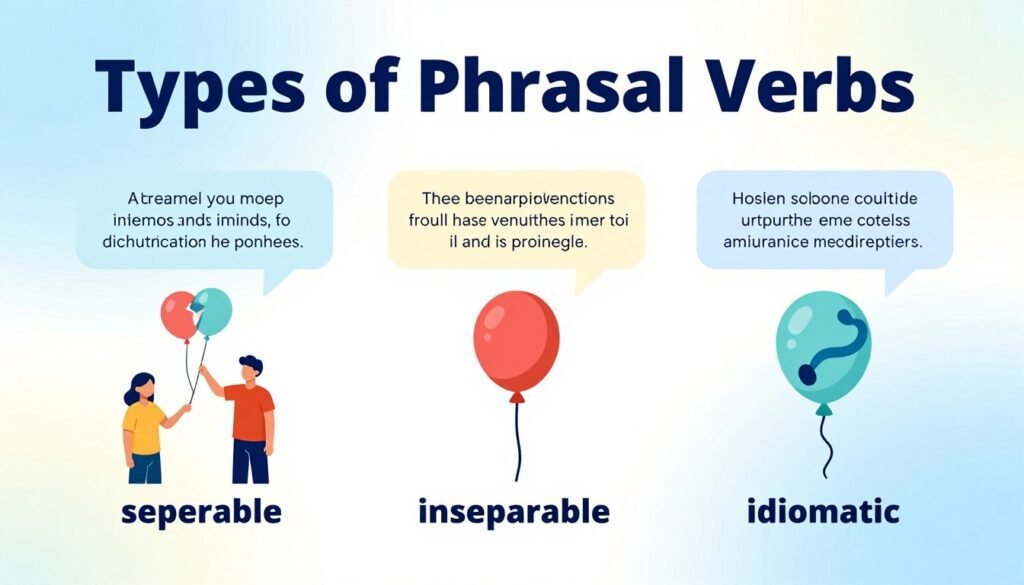
You might notice that some phrasal verbs behave differently than others when you build sentences. Understanding the different types of phrasal verbs is essential for mastering English fluency and speaking with confidence.
These categories depend on whether the verb requires an object and if the parts of the verb can be split apart. By learning these patterns, you will avoid common mistakes and sound much more natural in your daily conversations.
Transitive Phrasal Verbs Examples
A transitive verb always requires a direct object to complete its meaning. Without an object, the sentence feels incomplete or confusing to the listener.
For example, you would say, “I picked up the groceries.” In this case, “the groceries” is the object that receives the action of the verb.
Intransitive Phrasal Verbs Examples
Unlike their transitive counterparts, intransitive phrasal verbs do not need an object. The action is complete on its own without needing to affect anything else.
Consider the phrase “break down.” You can simply say, “My car broke down.” No object is required to make this sentence grammatically correct.
Separable Phrasal Verbs Examples
Some verbs allow you to place the object between the verb and the particle. These are known as separable phrasal verbs, and they offer flexibility in how you structure your thoughts.
You can say, “Turn off the light” or “Turn the light off.” Both versions are perfectly acceptable in American English, though the choice often depends on the emphasis you want to place on the object.
Inseparable Phrasal Verbs Examples
Finally, some verbs must stay together at all times. These inseparable phrasal verbs require the particle to remain immediately after the verb, regardless of where the object is placed.
An example is “look after.” You must say, “I will look after the dog.” It would be incorrect to say, “I will look the dog after,” as the verb and particle cannot be split.
100 Phrasal Verbs Examples With Meanings
Learning 100 phrasal verbs is a major milestone for any English learner. These combinations of verbs and prepositions are the building blocks of natural, conversational speech. By mastering these phrasal verbs with meanings, you will find it much easier to understand movies, podcasts, and daily interactions in the United States.
The following list provides a clear reference for your studies. Each entry is designed to help you grasp the concept quickly so you can start using them in your own sentences right away.

To make your learning process more effective, we have organized these expressions into a structured format. Focus on how the meaning changes when the preposition is added to the base verb.
| Phrasal Verb | Meaning | Example |
|---|---|---|
| Ask out | Invite on a date | He asked her out to dinner. |
| Back up | Support or reverse | Please back up your files. |
| Blow up | Explode or inflate | The balloon blew up quickly. |
| Break down | Stop working | My car broke down today. |
| Bring up | Mention a topic | Don’t bring up that issue. |
| Call off | Cancel | They called off the meeting. |
| Carry on | Continue | Please carry on with work. |
| Check in | Register arrival | We checked in at the hotel. |
| Clean up | Tidy | Clean up your room now. |
| Come across | Find by chance | I came across an old photo. |
| Dress up | Wear formal clothes | We dressed up for the party. |
| Drop off | Deliver someone/something | I will drop off the keys. |
| Eat out | Eat at a restaurant | Let’s eat out tonight. |
| Fall apart | Break into pieces | The old book fell apart. |
| Fill out | Complete a form | Fill out this application. |
| Find out | Discover | I found out the truth. |
| Get along | Have a good relationship | They get along very well. |
| Give up | Stop trying | Never give up on dreams. |
| Go over | Review | Let’s go over the notes. |
| Grow up | Become an adult | She grew up in Chicago. |
This list represents the most essential 100 phrasal verbs you will encounter. Practice using them in your daily writing to ensure they become a natural part of your vocabulary. Consistent review of these phrasal verbs with meanings will significantly boost your confidence in English.
Common Phrasal Verbs Examples for Everyday English
Mastering common phrasal verbs is the secret to sounding like a native speaker in your daily life. By integrating everyday English phrasal verbs into your conversations, you can bridge the gap between textbook learning and real-world fluency. These expressions help you communicate with ease in almost any situation.

Phrasal Verbs Examples for Daily Activities
When you start your morning, you likely use several daily activities phrasal verbs without even realizing it. These small phrases help describe your routine from the moment you wake up until you go to bed.
- Wake up: To stop sleeping and open your eyes.
- Get up: To physically leave your bed.
- Put on: To dress yourself in clothing.
- Clean up: To organize or tidy a messy space.
Phrasal Verbs Examples for Work and Study
Professional and academic environments require specific work and study phrasal verbs to keep things moving. Whether you are finishing a project or collaborating with a team, these terms are essential for clarity.
- Hand in: To submit an assignment or report to a teacher or boss.
- Look over: To review or examine a document quickly.
- Call off: To cancel a meeting or an event.
- Catch up: To reach the same level as others after falling behind.
Phrasal Verbs Examples for Travel and Social Situations
Navigating new places or meeting friends becomes much simpler when you know the right travel phrasal verbs. These expressions help you manage logistics and enjoy your social interactions with confidence.
- Check in: To register your arrival at a hotel or airport.
- Set off: To begin a journey or trip.
- Show up: To arrive at a social gathering or meeting.
- Hang out: To spend time relaxing with friends.
Using these phrases will make your speech sound more natural and fluid. Try practicing one or two of these every day to see how quickly your confidence grows.
Phrasal Verbs Examples in Sentences
Let’s explore how these common expressions function within complete, everyday sentences. Seeing phrasal verbs in sentences helps you understand the natural rhythm of American English. When you see these words in context, you can easily identify whether they are separable or inseparable.
To master these, you must look at how they behave in different types of statements. Whether you are asking a question or making a negative claim, the structure remains consistent. Here are some practical phrasal verbs examples to help you visualize their usage.
Consider the separable verb “turn off.” You can say, “Please turn off the light,” or “Please turn the light off.” Both are correct because the object can sit between the verb and the particle. However, inseparable verbs like “look after” do not allow this. You must say, “She looks after her brother,” and never “She looks her brother after.”
The following table provides a clear breakdown of how these expressions function in various sentence structures.
| Verb | Sentence Type | Example |
|---|---|---|
| Call off | Affirmative | They decided to call off the meeting. |
| Give up | Negative | He did not give up his dream. |
| Find out | Question | Did you find out the truth? |
| Pick up | Separable | Can you pick the kids up? |
Using phrasal verbs in sentences correctly requires practice with both transitive and intransitive forms. Always pay attention to the object placement to ensure your speech sounds natural. These phrasal verbs examples serve as a foundation for your daily communication skills.
Easy Phrasal Verbs Examples for Beginners
Let’s explore some essential, easy phrasal verbs for beginners that you can use right now. Starting with simple expressions helps you sound more natural when speaking English at home or with friends. These small building blocks are the secret to improving your fluency quickly.
When you are at home, you might wake up early or turn on the lights. These actions are part of your daily routine and are very common in American English. Using these simple terms makes your communication feel much more relaxed and authentic.
Mastering these easy phrasal verbs for beginners does not have to be difficult. You can practice them by creating short sentences about your own life. Take a look at the table below to see how these verbs work in everyday situations.
| Phrasal Verb | Meaning | Example Sentence |
|---|---|---|
| Wake up | To stop sleeping | I wake up at 7:00 AM. |
| Turn on | To start a machine | Please turn on the TV. |
| Go out | To leave your home | We will go out for dinner. |
| Sit down | To take a seat | Please sit down and relax. |
| Look for | To try to find | I am looking for my keys. |
Common Phrasal Verbs and Their Meanings
Let’s explore a quick reference guide to help you navigate the nuances of everyday English expressions. Mastering common phrasal verbs is a vital step toward sounding like a native speaker in the United States.
When you study phrasal verbs and their meanings, you will notice that some look very similar but carry different definitions. Using these correctly can make your speech sound much more natural and professional.
The following table highlights how small changes in the preposition can completely alter the intent of your sentence. Reviewing these pairs will help you avoid common mistakes during daily conversations.
| Phrasal Verb | Meaning | Example |
|---|---|---|
| Look up | To search for information | I will look up the address online. |
| Look after | To take care of someone | Can you look after my dog today? |
| Call off | To cancel an event | They had to call off the meeting. |
| Call on | To ask someone to speak | The teacher will call on you next. |
It is highly recommended to practice these in context rather than memorizing long lists. By focusing on how these common phrasal verbs appear in real-world scenarios, you will retain the information much faster.
Always remember that context is key when learning phrasal verbs and their meanings. If you are ever unsure, try replacing the verb with a single-word synonym to see if the sentence still makes sense.
How to Use Phrasal Verbs Correctly
Learning how to use phrasal verbs correctly will transform your daily communication. While these phrases might seem tricky at first, they follow specific patterns that make them easier to master. Instead of trying to translate every word individually, focus on the meaning of the entire phrase within a sentence.
One of the most important rules involves object placement. If a phrasal verb is separable, you can place the object between the verb and the particle. However, if the object is a pronoun like “it” or “them,” it must go in the middle. For example, you should say “pick it up” rather than “pick up it.”
Tense changes also play a vital role when you use English phrasal verbs. You only need to conjugate the verb part of the phrase, while the particle remains unchanged. For instance, if you are talking about the past, “run into” becomes “ran into.”
Understanding the difference between separable and inseparable constructions is essential for natural speech. Some verbs, like “look after,” are inseparable, meaning the object must always follow the particle. Practicing these in context helps you develop a natural rhythm in both your speaking and writing.
| Verb Type | Rule | Example |
|---|---|---|
| Separable | Object can go in middle or end | Turn off the light / Turn the light off |
| Inseparable | Object must follow the particle | Look after the baby |
| Pronoun | Pronoun must go in the middle | Turn it off |
To improve your skills, try to learn these phrases in groups or themes. This approach helps you remember how to use phrasal verbs in real-life situations. By focusing on usage rather than memorization, you will gain confidence in your English phrasal verbs proficiency.
Phrasal Verbs Examples: Frequently Asked Questions
If you are confused about how to use phrasal verbs, you are certainly not alone. Many learners find these combinations tricky because they often change the meaning of the original verb entirely. This phrasal verbs FAQ aims to clear up common misunderstandings and help you feel more confident in your daily conversations.
One of the most common questions is whether phrasal verbs are too informal for professional writing. While some are casual, many are standard in business settings. For example, you might “look into” a project or “carry out” a task during a meeting. These are perfectly acceptable in almost any workplace environment.
How can you memorize these effectively? Instead of trying to learn long lists, try grouping them by theme or particle. For instance, focus on phrasal verb examples that use the word “up,” such as “wake up,” “clean up,” or “give up.” Seeing them in context makes them much easier to remember than studying them in isolation.
Here are a few quick answers to common concerns:
- Are they always separable? No, some are inseparable, like “get over” a cold.
- Can I use them in essays? Yes, but choose precise ones like “point out” rather than slang.
- Do they change meaning? Yes, “take off” can mean removing clothes or an airplane departing.
Ultimately, the best way to master these is through consistent practice. Try to use one new phrase each day in a sentence. By keeping your phrasal verbs FAQ study sessions short and focused, you will notice significant progress in your English fluency over time.
Conclusion
Learning to speak like a native requires more than just memorizing vocabulary lists. You now possess a comprehensive guide featuring 100 common English phrasal verbs to elevate your daily conversations.
Understanding the grammatical rules behind transitive and separable structures helps you place words correctly in your sentences. These tools allow you to express complex ideas with ease and precision.
Consistent review remains the best way to internalize these expressions. Try using these common English phrasal verbs in your writing or during casual chats with friends. Focus on context to see how these phrases change the tone of your speech.
Pick a few new terms each week to incorporate into your routine. Real progress happens when you apply these lessons to your own life. Keep practicing to build your confidence and sound more natural in every interaction.