
100 Past Continuous Tense Example Sentences in English
Mastering English grammar often feels like a challenge, but you…

Mastering English grammar often feels like a challenge, but you can build real confidence with the right tools. This guide provides 100 past continuous tense example sentences to help you speak more naturally. Whether you are a student or a professional, these clear illustrations will sharpen your communication skills quickly.
We start by exploring basic definitions and common patterns. You will discover how to use these structures effectively in daily life. Our journey covers helpful usage rules, practical comparisons, and ways to avoid frequent errors. By reviewing these sentence examples in past continuous, you will gain a deeper understanding of how to describe ongoing actions. We also include a list of past continuous tense examples to ensure you feel ready for any conversation.
Key Takeaways
- Learn how to form and use the progressive aspect correctly.
- Improve your fluency with 100 diverse practice items.
- Understand the difference between simple and progressive forms.
- Identify and fix common mistakes that learners often make.
- Boost your speaking confidence through clear, real-world usage.
What Is the Past Continuous Tense?
Have you ever wondered how to describe an action that was happening at a specific moment in the past? The past continuous tense is a vital tool for anyone looking to add depth and detail to their storytelling. By focusing on the duration of an event, this tense helps you paint a clearer picture of what was occurring during a particular timeframe. Understanding proper past continuous tense usage allows you to move beyond simple facts and into more descriptive, engaging communication.

Learning how to use past continuous tense is simpler than you might think. At its core, this tense describes an ongoing action that was interrupted or was happening simultaneously with another event. Whether you are talking about what you were doing when the phone rang or describing the background of a story, this form provides the necessary context for your listeners.
When it comes to past continuous tense grammar rules, the structure is quite consistent. You simply combine the past tense of the verb “to be” either was or were with the present participle of your main verb, which ends in -ing. For example, you might say, “I was reading a book” or “They were playing soccer.” This straightforward construction makes it an essential building block for mastering English fluency.
Past Continuous Tense Structure
Learning the past continuous tense formation allows you to describe ongoing actions in the past clearly. By mastering these patterns, you gain the ability to paint a vivid picture of events that were happening at a specific moment.
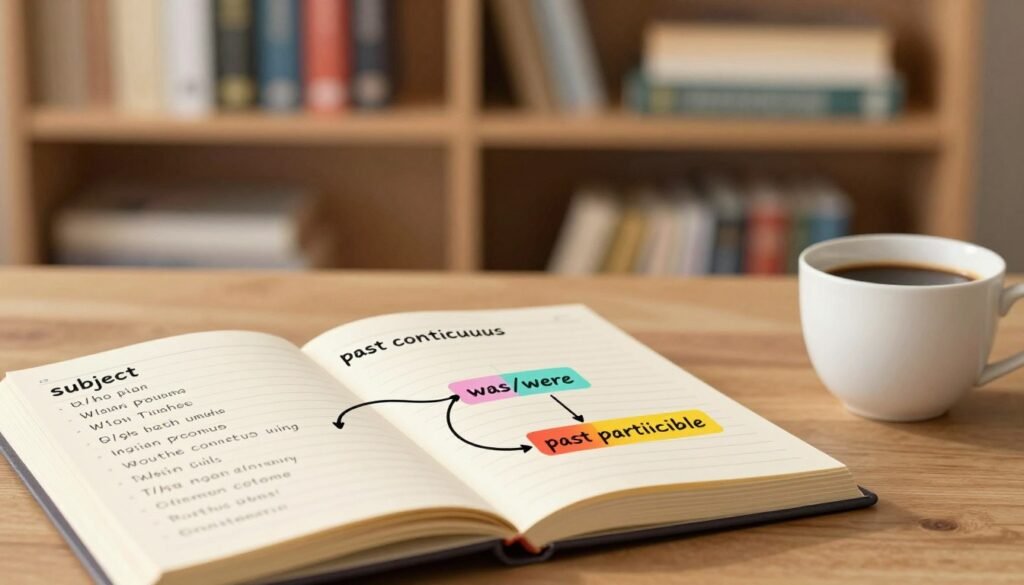
Affirmative Past Continuous Sentences
To build a positive sentence, you follow a specific past continuous tense formula. You start with the subject, add the correct auxiliary verb (was or were), and finish with the present participle, which is the base verb plus “-ing.”
Use was for singular subjects like I, he, she, and it. Use were for plural subjects and the pronoun you, such as you, we, and they. For example, “She was reading a book” or “They were playing soccer.”
Negative Past Continuous Sentences
Creating negative sentences is just as straightforward. You simply insert the word “not” between the auxiliary verb and the main verb. These past continuous construct examples show how easy it is to negate an action.
“Language is the road map of a culture. It tells you where its people come from and where they are going.”
You can say, “He was not watching television” or “We were not listening to the music.” In casual conversation, native speakers often use contractions like “wasn’t” or “weren’t” to sound more natural.
Interrogative Past Continuous Sentences
To ask a question, you move the auxiliary verb to the very beginning of the sentence. This shift in the past continuous sentence structure turns a statement into an inquiry instantly. Always remember to place a question mark at the end.
For instance, you might ask, “Was she working yesterday?” or “Were they eating dinner when you arrived?” This simple inversion is the key to mastering questions in this tense.
| Sentence Type | Formula | Example |
|---|---|---|
| Affirmative | Subject + was/were + verb-ing | I was studying. |
| Negative | Subject + was/were + not + verb-ing | She was not sleeping. |
| Interrogative | Was/were + subject + verb-ing? | Were they running? |
When to Use the Past Continuous Tense
Mastering the past continuous usage helps you paint a vivid picture of events that happened long ago. By understanding the specific contexts for this tense, you can move beyond simple statements and add depth to your English sentences.
Whether you are telling a story or explaining a sequence of events, knowing when to use the past continuous tense is a vital skill. It allows you to describe the flow of time rather than just isolated facts.

Actions in Progress at a Specific Time in the Past
We often use this tense to describe an activity that was already happening at a precise moment. For example, you might say, “At 9:00 PM last night, I was watching a movie.”
This structure highlights that the action started before that time and continued after it. It is perfect for setting the scene for a specific point in your day.
Interrupted Actions in the Past
Sometimes, a longer action is cut short by a sudden event. You can use the past continuous to describe the ongoing activity, while the simple past marks the interruption.
Consider this example: “I was cooking dinner when the doorbell rang.” The cooking was the background activity, and the ringing was the sudden interruption.
Two Ongoing Actions in the Past
You can also describe two things happening at the same time. This is common when you want to show that multiple people were busy with different tasks simultaneously.
For instance, “While Sarah was studying for her exam, Mike was playing video games.” Using the past continuous usage here emphasizes that both actions were happening in parallel.
Background Actions in Stories
When writing or telling a story, you need to establish the setting. Using the past continuous tense is the best way to describe the atmosphere or the “stage” of your narrative.
You might write, “The sun was shining, and the birds were singing in the trees.” These descriptive details provide the necessary context before the main action of your story begins.
100 Past Continuous Tense Example Sentences
Mastering the past continuous tense becomes much easier when you explore a variety of practical examples. By looking at how these past continuous sentences function in real-life scenarios, you can quickly improve your fluency. This collection provides a wide range of continuous past tense examples to help you grasp the nuances of the language.
Everyday Past Continuous Sentences
These sentences describe activities that were happening at a specific moment in the past. They often focus on routines or ongoing states.
- I was reading a book at 8:00 PM.
- Sarah was cooking dinner for her family.
- They were playing soccer in the park.
- The dog was barking loudly all morning.
- We were studying for our final exams.
- He was working on his car in the garage.
- She was painting a beautiful landscape.
- The children were laughing at the funny movie.
- I was waiting for the bus for twenty minutes.
- It was raining heavily during the night.
Past Continuous Sentences With While
Using “while” helps show two actions happening at the same time. These past progressive sentences highlight parallel events.
- While I was sleeping, the phone rang.
- She was listening to music while she was cleaning.
- While they were eating, the lights went out.
- He was driving while he was talking on the phone.
- While we were walking, we saw a deer.
- The baby was crying while the mother was busy.
- While you were working, I was resting.
- They were dancing while the band was playing.
- While it was snowing, we were staying warm inside.
- She was reading while her brother was playing games.
Past Continuous Sentences With When
The word “when” often introduces a short action that interrupts a longer one. These continuous past tense examples show how to combine different tenses.
- I was washing the dishes when the glass broke.
- When he arrived, we were having dinner.
- She was writing an email when the power failed.
- When the teacher walked in, the students were talking.
- They were watching TV when the doorbell rang.
- When I saw him, he was running to the station.
- We were playing cards when it started to rain.
- When she called, I was taking a shower.
- He was fixing the sink when he cut his finger.
- When the sun set, we were still hiking.
Past Continuous Questions and Answers
Asking questions is a vital part of communication. These past continuous sentences demonstrate how to inquire about past activities.
| Question | Affirmative Answer | Negative Answer |
|---|---|---|
| Were you studying? | Yes, I was studying. | No, I was not studying. |
| Was she working? | Yes, she was working. | No, she was not working. |
| Were they playing? | Yes, they were playing. | No, they were not playing. |
| Was it raining? | Yes, it was raining. | No, it was not raining. |
Past Continuous Tense Examples With Time Expressions
Mastering time expressions is a key step in forming past continuous sentences effectively. These markers act as anchors, helping your listener understand exactly when a specific action was in progress. Without them, your stories might feel vague or disconnected from a clear timeline.
When you use phrases like at five o’clock or yesterday evening, you provide a clear frame for your narrative. These expressions transform simple statements into vivid descriptions of background moments. By setting the scene, you allow your audience to visualize the action more clearly.
To sound more natural in everyday American English, try incorporating duration markers such as all morning or the whole day. These phrases emphasize the length of an activity, which is a common way to use past continuous tense sentences in casual conversation. Consider these examples to see how they function in practice:
- Sarah was reading a book at five o’clock yesterday.
- We were cleaning the garage all morning on Saturday.
- They were watching a movie while it was raining outside.
- I was preparing dinner yesterday evening when the phone rang.
When forming past continuous sentences, remember that the time expression often dictates the flow of your sentence. Placing the time marker at the beginning or the end of the clause can change the emphasis of your statement. Experimenting with these positions will help you develop a more fluid and professional speaking style.
Using while is particularly helpful when you want to highlight two ongoing actions happening simultaneously. This simple addition makes your past continuous tense sentences sound much more sophisticated. By practicing these structures, you will gain confidence in describing complex past events with ease.
Past Continuous Tense vs. Simple Past Tense
Choosing the right tense depends on whether you want to highlight a completed event or an ongoing action. While the simple past focuses on finished moments, the past continuous emphasizes the duration of an activity. Mastering these past continuous grammar rules allows you to paint a vivid picture of your experiences.
Think of the simple past as a snapshot of a finished event. In contrast, the past continuous acts like a video clip showing an action in progress. When these two tenses work together, they often show how one event interrupts another.
For example, consider the sentence: “I was reading a book when the phone rang.” Here, the reading was already in progress, and the ringing of the phone interrupted that specific moment. Using both tenses helps the listener understand the sequence of events clearly.
To build your own sentences, you can refer to this helpful past continuous verbs list. These common action verbs are perfect for describing ongoing situations in your daily life.
| Action Verb | Simple Past | Past Continuous |
|---|---|---|
| Study | I studied | I was studying |
| Work | She worked | She was working |
| Cook | He cooked | He was cooking |
| Play | They played | They were playing |
Common Mistakes With the Past Continuous Tense
Even experienced English learners sometimes stumble when using the past continuous tense. One of the most frequent errors involves mixing up the auxiliary verbs was and were. Remember that was is used for singular subjects like “I,” “he,” “she,” and “it,” while were is reserved for plural subjects and “you.”
Another common pitfall is forgetting the -ing ending on the main verb. Without this suffix, the sentence loses its continuous meaning and often sounds like a simple past construction. You must ensure that the verb form clearly indicates an ongoing action to maintain grammatical accuracy.
To overcome these hurdles, many students find success by utilizing targeted past continuous tense worksheets. These resources provide a structured way to practice subject-verb agreement and verb endings in a controlled environment. Consistent repetition helps solidify these rules in your memory.
If you feel stuck, try incorporating diverse past continuous grammar exercises into your daily study routine. These exercises often highlight the difference between simple past and continuous forms, which is a frequent point of confusion. Focusing on the context of the action will help you choose the correct tense every time.
Finally, engaging in interactive past continuous tense activities can significantly boost your confidence. Whether you are working with a partner or using digital tools, active participation makes learning feel less like a chore. Consistent practice is the ultimate key to mastering these structures and speaking with greater fluency.
Frequently Asked Questions About Past Continuous Tense Example Sentences
Let’s address the most common questions learners have about using this tense in daily conversation. Many students find that understanding past continuous tense rules is the key to sounding more natural when describing past events.
One frequent question involves the use of auxiliary verbs. You must always use was or were followed by the verb’s -ing form. For example, use “was” with singular subjects like “he” or “she,” and “were” with plural subjects like “they” or “we.”
Another common point of confusion is how to handle interruptions. When a short action interrupts a longer one, we use the simple past for the interruption and the past continuous for the ongoing background action. This structure helps clarify the timeline of your story effectively.
To help you practice, we have compiled a set of past continuous examples with answers. Reviewing these scenarios will strengthen your grasp of how to apply these grammar concepts in real-world American English.
| Question | Correct Answer | Grammar Focus |
|---|---|---|
| What were you doing at 8 PM? | I was studying for my exam. | Ongoing action |
| Was it raining when you left? | Yes, it was raining hard. | Interrupted action |
| Were they talking during the movie? | No, they were watching quietly. | Two ongoing actions |
| Why was she running so fast? | She was catching the bus. | Reason for action |
Remember that the simple past is for completed actions, while the past continuous emphasizes the duration of an event. By keeping these distinctions in mind, you will communicate your past experiences with much greater precision.
Conclusion
Grasping the past continuous formula allows you to describe ongoing actions with precision. You now understand the clear distinction between events that were in progress and those that reached completion. This knowledge provides a solid foundation for your language journey.
Reviewing these 100 past continuous tense example sentences helps solidify your understanding of how to frame your own experiences. Try writing your own sentences about a typical day at Google or a weekend trip to New York City. Applying these rules to your personal stories makes the grammar feel natural and intuitive.
Consistent practice remains the best way to improve your accuracy. Using these past continuous tense example sentences as a guide builds your confidence during daily conversations. You will soon find that your ability to communicate complex ideas in English becomes much sharper and more fluid.
Keep exploring new ways to use these structures in your writing and speech. Your dedication to learning will lead to better fluency and clearer expression. Start crafting your own narratives today to see how much your skills grow.