
Past Perfect Continuous Tense Example Sentences
Mastering English grammar can feel like a challenge, but understanding…

Mastering English grammar can feel like a challenge, but understanding the past perfect continuous tense is a major step forward. This specific structure helps you describe actions that were ongoing before another point in time. Whether you are writing an essay or chatting with friends, knowing how to use it correctly adds clarity and depth to your storytelling.
In this guide, we provide clear past perfect continuous tense examples to help you grasp the concept quickly. You will learn the essential rules, discover how to build accurate past perfect continuous sentences, and see how this form compares to other common verb structures.
We also highlight frequent mistakes to avoid and include a helpful FAQ section. By the end of this article, you will feel confident using this grammar tool in your daily communication.
Key Takeaways
- Learn the core definition of this verb form for better fluency.
- Review practical examples to see the structure in action.
- Understand the specific rules for building correct sentences.
- Compare this form with other similar verb structures easily.
- Identify and fix common errors that many learners make.
What Is the Past Perfect Continuous Tense?
If you want to describe actions that were ongoing before a specific point in the past, you need the past perfect continuous tense. This grammatical form helps you clarify that an activity started in the past and continued up until another action or time in the past.
Using the past perfect continuous in English allows you to provide context for your stories. It shows the duration of an event that happened before something else took place. Think of it as a way to set the stage for a past narrative.

To form this tense, you combine the past form of “have,” which is “had,” with “been” and the present participle of the verb. The present participle is simply the base verb with an “-ing” ending. Following these past perfect continuous rules ensures your sentences remain clear and grammatically accurate.
“Language is the road map of a culture. It tells you where its people come from and where they are going.”
The following table illustrates how this tense compares to other common past forms to help you visualize the differences in usage.
| Tense | Focus | Example |
|---|---|---|
| Past Simple | Completed action | I worked. |
| Past Continuous | Ongoing action | I was working. |
| Past Perfect Continuous | Duration before past event | I had been working. |
By mastering this structure, you gain the ability to express complex timelines with ease. It is a vital component for anyone looking to sound more natural and precise when speaking or writing in American English.
Past Perfect Continuous Tense Structure
The past perfect continuous formula provides a clear roadmap for talking about long-running past actions. By mastering this past perfect continuous structure, you can describe events that started in the past and continued up until another point in time.

Affirmative Past Perfect Continuous Sentences
To create a past perfect continuous affirmative sentence, you simply combine the subject with “had been” and the present participle of the verb. This pattern remains the same regardless of whether the subject is singular or plural.
For example, you might say, “Sarah had been working at the bakery for five years before she moved.” Another common example is, “They had been playing soccer until the rain started.”
Negative Past Perfect Continuous Sentences
When you need to express that an action was not happening over a period of time, you use the negative past perfect continuous form. You achieve this by inserting “not” between “had” and “been.”
The resulting structure is subject + had not been + verb-ing. You can also use the contraction “hadn’t” to sound more natural in casual conversation. For instance, “He hadn’t been sleeping well before the vacation.”
Interrogative Past Perfect Continuous Sentences
Forming an interrogative past perfect continuous sentence requires moving the auxiliary verb “had” to the very front of the sentence. This simple shift turns your statement into a question about a duration of time.
The pattern follows: Had + subject + been + verb-ing? You might ask, “Had you been waiting long before the bus arrived?” or “Had she been studying all night?”
| Sentence Type | Formula | Example |
|---|---|---|
| Affirmative | Subject + had been + verb-ing | I had been running. |
| Negative | Subject + had not been + verb-ing | I had not been running. |
| Interrogative | Had + subject + been + verb-ing? | Had I been running? |
When to Use the Past Perfect Continuous Tense
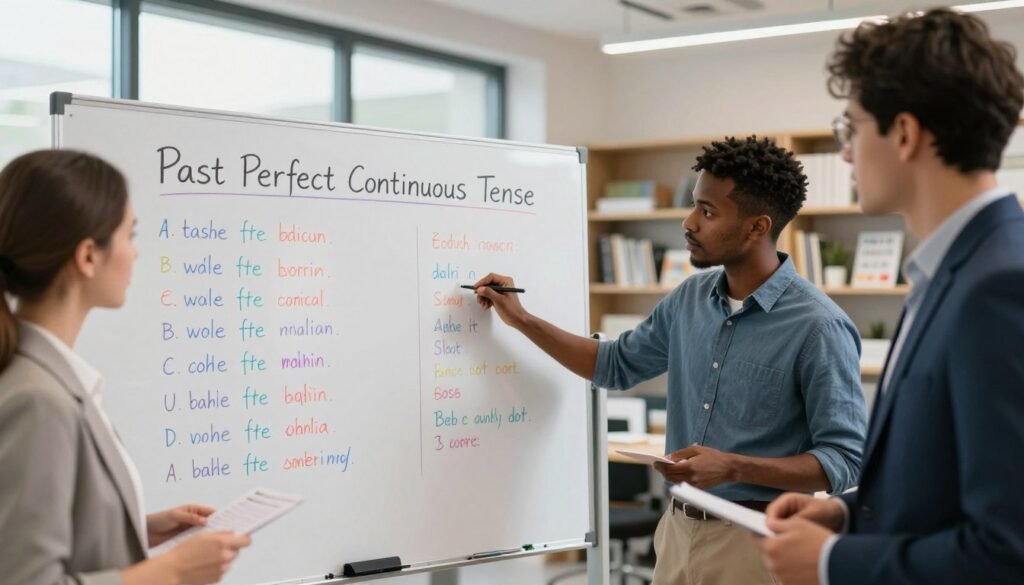
Mastering the past perfect continuous rules allows you to describe complex timelines with ease. Knowing exactly when to use past perfect continuous structures helps you clarify the sequence of events in your stories. This tense acts as a bridge between two moments in the past, showing that one activity was already in progress before something else happened.
Actions That Continued Before Another Past Action
We use this tense to highlight an activity that started in the past and continued up until another point in the past. It emphasizes the ongoing nature of the first event. For example, you might say that you had been waiting for an hour before the bus finally arrived.
Duration of Past Actions
This tense is perfect for showing how long something lasted before a specific moment. It is often paired with time expressions like “for” or “since” to provide clarity. By focusing on the duration, you give the listener a better sense of the effort or time involved in the action.
Causes and Results in the Past
Sometimes, we use this tense to explain the cause of a past situation. If you see a result in the past, you can use this structure to describe the activity that led to it. For instance, the ground was wet because it had been raining all morning.
Interrupted or Completed Past Actions
You can also use this tense to describe an action that was interrupted by another event. It is also useful for actions that finished just before a later point in time. Following these past perfect continuous rules ensures your narrative remains logical and easy to follow.
| Usage Scenario | Primary Focus | Example Context |
|---|---|---|
| Ongoing Action | Duration | Working for hours before a break |
| Cause and Effect | Visible Result | Tiredness after running a marathon |
| Interruption | Shift in Focus | Studying when the power went out |
| Completion | Recent Finish | Cooking before guests arrived |
Examples of Past Perfect Continuous Tense
Understanding the nuances of this tense becomes simple when you look at clear, real-world applications. By observing how these structures function in context, you can easily distinguish them from other past forms. These past perfect continuous tense examples highlight how we describe actions that were ongoing before another point in the past.
Everyday Past Perfect Continuous Sentences
Daily routines often involve actions that lasted for a specific duration before something else happened. Using past perfect continuous sentences helps clarify the timeline of your day.
- Sarah had been cooking dinner for an hour when the guests finally arrived.
- I had been cleaning the living room all morning before my sister called.
- They had been waiting for the bus for twenty minutes when it started to rain.
In these cases, the tense emphasizes the continuous nature of the activity leading up to a specific moment.
Past Work and Study Examples
In professional or academic settings, we often explain how long a project or task had been underway. These past perfect continuous examples show how to frame your work history effectively.
- Mark had been studying for his final exams for weeks before he felt ready.
- The team had been working on the software update for months before the launch.
- She had been practicing her presentation for days before the board meeting.
These sentences are useful because they show the effort and duration invested before a final result was achieved.
Past Travel and Activity Examples
Travel stories often require describing long-term activities that were interrupted by new events. Using the correct grammar helps your audience visualize the journey.
- We had been hiking through the mountains for three hours when we lost the trail.
- They had been traveling across Europe for a month before they decided to settle in Paris.
- He had been playing tennis for years before he finally won the local tournament.
The focus here is on the length of the activity rather than just the completion of the trip.
Past Events and Situations
Sometimes, we need to explain the cause of a past situation by describing what had been happening previously. These past perfect continuous sentences provide the necessary background information for any story.
- The ground was wet because it had been raining all night.
- She was exhausted because she had been running errands since early morning.
- The house was quiet because the children had been sleeping for hours.
By using this tense, you clearly link a past result to an action that preceded it, making your narrative much easier to follow.
50 Example Sentences of Past Perfect Continuous Tense
Mastering grammar requires seeing how language works in real-life scenarios. By reviewing these past perfect continuous sentences, you can better understand how to describe actions that were ongoing before another point in the past.
Below are 50 past perfect continuous tense examples categorized by their grammatical structure. These sentences illustrate how we use this tense to show duration, cause, and sequence.
Affirmative Sentences
- Sarah had been studying for three hours before the test started.
- They had been waiting for the bus when it finally arrived.
- I had been working at the firm for five years before I resigned.
- The team had been practicing all morning before the game.
- He had been feeling sick before he went to the doctor.
- We had been living in Chicago before we moved to New York.
- The kids had been playing outside until it started to rain.
- She had been writing her novel for months before it was published.
- The engine had been making a strange noise before it broke down.
- They had been saving money for a trip to Europe.
- I had been reading that book all afternoon.
- The sun had been shining brightly before the clouds rolled in.
- He had been training for the marathon for six months.
- We had been talking about the project for an hour.
- The dog had been barking at the mailman all morning.
- She had been learning French before she moved to Paris.
- They had been planning the wedding for over a year.
- I had been feeling tired because I had been working late.
- The fire had been burning for hours before the crew arrived.
- He had been trying to fix the sink all day.
Negative and Interrogative Sentences
- I hadn’t been sleeping well before I bought a new mattress.
- They hadn’t been listening to the instructions.
- Had you been waiting long before I showed up?
- She hadn’t been feeling happy at her old job.
- Had he been studying before the exam began?
- We hadn’t been expecting such a large crowd.
- Had they been arguing before the meeting started?
- I hadn’t been paying attention to the news.
- Had she been working on this project for long?
- They hadn’t been training for the competition.
- Had you been feeling better before the medicine?
- He hadn’t been driving very fast.
- Had we been talking about this earlier?
- She hadn’t been practicing her piano lessons.
- Had the machine been running smoothly?
- I hadn’t been thinking about the consequences.
- They hadn’t been following the safety rules.
- Had he been waiting for a response?
- We hadn’t been planning to stay that long.
- Had you been enjoying the movie before it ended?
Additional Contextual Examples
- The chef had been cooking for ten years before opening his restaurant.
- Had the team been losing before they changed the coach?
- I hadn’t been feeling well, so I stayed home.
- They had been traveling for weeks before they returned home.
- Had she been searching for her keys all morning?
- We had been discussing the issue before the boss arrived.
- He hadn’t been eating healthy before he started the diet.
- Had the wind been blowing hard before the storm?
- I had been waiting for a sign before I made my move.
- They hadn’t been communicating before the mediation.
| Form | Structure | Example |
|---|---|---|
| Affirmative | Subject + had been + verb-ing | She had been running. |
| Negative | Subject + had not been + verb-ing | She hadn’t been running. |
| Interrogative | Had + subject + been + verb-ing? | Had she been running? |
To improve your skills, try these past perfect continuous exercises: take a simple sentence like “I was tired” and expand it into a past perfect continuous sentence by adding a cause, such as “I was tired because I had been running.” These past perfect continuous examples are essential for mastering English fluency.
Past Perfect Continuous Tense Examples With Time Expressions
Time expressions act as anchors that help define the duration and sequence of past actions. By using past perfect continuous time expressions, you provide your reader with a clear sense of when and for how long an event occurred. These small but powerful words transform simple sentences into detailed narratives.
When you want to emphasize the length of an activity, words like “for” and “since” are essential. For instance, you might say, “Sarah had been studying for three hours before the library closed.” In this case, the expression highlights the total duration of the action leading up to a specific point in the past.
Other past perfect continuous signal words help establish a sequence or a specific reference point. Phrases like “by the time,” “until,” and “before” connect your action to another event. Consider this example: “By the time the guests arrived, we had been cooking for the entire afternoon.” Here, the phrase “by the time” sets the stage for the action that was already in progress.
Using these markers correctly ensures your past perfect continuous examples sound natural and precise. Whether you are describing a long-term project or a brief interruption, these expressions provide the necessary context for your audience. Review the table below to see how these markers function in different scenarios.
| Time Expression | Primary Function | Example Sentence |
|---|---|---|
| For two hours | Duration | He had been running for two hours. |
| Since morning | Starting Point | They had been working since morning. |
| By the time | Reference Point | By the time I left, it had been raining. |
| Until | Sequence/Limit | She had been waiting until the bus arrived. |
Past Perfect Continuous Tense With For and Since
Mastering the past perfect continuous with for and since allows you to describe the duration of past events with precision. These two words act as essential time markers that help listeners understand exactly how long an action lasted before another event occurred.
The word “for” is used to indicate a specific length of time or a duration. For example, you might say, “She had been working for three hours before the manager arrived.” In this case, the focus is on the total amount of time spent on the task.
In contrast, the word “since” identifies the exact starting point of an action. If you say, “He had been waiting since noon,” you are highlighting when the waiting began rather than the total duration. Using the past perfect continuous with for and since correctly ensures your sentences remain clear and accurate.
To help you distinguish between these two, consider the following breakdown:
- For: Used with periods of time like “two days,” “a long time,” or “ten minutes.”
- Since: Used with specific points in time like “Monday,” “2015,” or “this morning.”
By practicing these markers, you will find it much easier to express complex timelines in your writing and speech. Remember that consistency is the key to mastering these grammar rules in your daily communication.
Past Perfect Continuous Tense vs. Past Perfect Tense
Many English learners struggle to distinguish between the past perfect tense vs past perfect continuous when describing past events. While both tenses look back at a time before another action, they serve very different purposes in your sentences.
The past perfect continuous tense focuses on the duration of an activity that was in progress. For example, saying “Sarah had been studying for three hours” emphasizes the effort and the time spent on the task before she took a break.
In contrast, the past perfect tense highlights the completion of an action or a specific result. If you say “Sarah had studied the chapter,” you are focusing on the fact that the work was finished. The past perfect continuous tense is your best choice when you want to show that an action was ongoing up until a certain point in the past.
Consider the following table to see how these two tenses compare in practical, everyday situations:
| Feature | Past Perfect Continuous | Past Perfect |
|---|---|---|
| Primary Focus | Ongoing duration | Completed result |
| Example Verb | Had been working | Had worked |
| Key Nuance | Emphasizes the process | Emphasizes the outcome |
| Common Usage | Actions leading up to a point | Actions finished before a point |
Using these tenses correctly helps you paint a clearer picture for your listener. Always remember that if you want to stress how long something lasted, use the continuous form. If you want to stress that the task is done, stick to the standard past perfect.
Past Perfect Continuous Tense vs. Past Continuous Tense
Comparing the past continuous vs past perfect continuous reveals how we frame time in our stories. While both tenses describe actions that were happening in the past, they serve very different purposes depending on your focus.
The past continuous describes an action that was in progress at a specific moment in the past. For example, if you say, “I was working at 5:00 PM,” you are highlighting the activity happening right at that point in time.
In contrast, the past perfect continuous tense places an action before another past reference point. It emphasizes the duration of an activity that happened up until that moment. If you say, “I had been working for three hours when the boss arrived,” you are showing the length of time spent on the task before the interruption.
To help you visualize these differences, consider the following comparison:
| Feature | Past Continuous | Past Perfect Continuous |
|---|---|---|
| Primary Focus | Action in progress | Duration before a point |
| Reference Point | A specific moment | Another past action |
| Example | I was reading. | I had been reading. |
Using these tenses correctly will make your English sound much more natural. Keep these simple tips in mind when you write or speak:
- Use the past continuous to set the scene or describe background actions.
- Use the past perfect continuous tense to explain the cause or the duration of a situation that led to a later event.
- Always look for a second past action to justify using the perfect form.
By practicing these distinctions, you will gain better control over your narrative flow. Consistency is the secret to mastering these verb forms in your daily communication.
Common Mistakes With Past Perfect Continuous Tense
Understanding the past perfect continuous rules is essential for clear communication. Many learners often forget to include both “had” and “been” in their sentences. This omission changes the meaning entirely and makes the sentence grammatically incorrect.
Another frequent issue involves the verb ending. You must always use the present participle form, which ends in -ing. Forgetting this suffix is one of the most common past perfect continuous mistakes that students make during practice.
It is also easy to confuse this tense with the simple past. Remember that this tense describes an action that started in the past and continued up until another point in the past. If you ignore the time relationship, your sentence may lack the necessary context for the listener.
Using past perfect continuous signal words like “for,” “since,” or “before” helps clarify your timeline. These markers act as guides for your audience. Without them, it becomes difficult to distinguish between a completed action and one that was ongoing.
Review the table below to see how to fix common errors quickly and effectively.
| Error Type | Incorrect Sentence | Corrected Sentence |
|---|---|---|
| Missing Auxiliary | She working for hours. | She had been working for hours. |
| Wrong Verb Form | They had been work hard. | They had been working hard. |
| Tense Confusion | I worked all day when he arrived. | I had been working all day when he arrived. |
| Missing Signal Word | He had been waiting. | He had been waiting for two hours. |
Frequently Asked Questions About Past Perfect Continuous Tense
Let’s clear up the confusion surrounding the past perfect continuous tense with some helpful answers. Many learners often have past perfect continuous questions regarding when to use this structure versus simpler past forms.
The most common inquiry involves the difference between “for” and “since.” You use “for” to describe a duration of time, such as “for two hours,” while “since” marks a specific starting point, like “since 9:00 AM.” Both are essential for showing how long an action lasted before another event occurred.
When forming an interrogative past perfect continuous sentence, you must place the auxiliary verb “had” at the very beginning. For example, asking “Had they been waiting?” follows the standard formula of Had + subject + been + verb-ing. This structure helps clarify that you are inquiring about the duration of an action that happened before a specific point in the past.
If you want to improve your skills, try completing various past perfect continuous exercises. These practice tasks help reinforce the rules and ensure you can identify the tense in both reading and writing. Consistent practice is the best way to gain confidence with this complex grammar point.
The following table provides a quick reference guide to help you distinguish between different sentence types and their specific requirements.
| Sentence Type | Formula | Example |
|---|---|---|
| Affirmative | Subject + had been + verb-ing | She had been working. |
| Negative | Subject + had not been + verb-ing | They had not been sleeping. |
| Interrogative | Had + subject + been + verb-ing | Had you been waiting? |
| Short Answer | Yes/No + subject + had/had not | Yes, I had. |
Conclusion
Grasping the past perfect continuous tense opens new doors for your storytelling and professional writing. This specific structure helps you describe actions that unfolded over time before another event occurred in the past.
You now possess a solid understanding of how to use the past perfect continuous in English to add depth to your sentences. Reviewing the core past perfect continuous rules ensures your communication remains accurate and clear during daily conversations.
Applying these concepts requires consistent effort and attention to detail. You can improve your fluency by creating your own sentences about past work experiences or travel memories. Try writing a short paragraph about a busy day at Google or a long trip to New York City using these verb forms.
Practical exercises turn complex grammar concepts into natural habits. Keep practicing these patterns to build confidence in your writing style. Your ability to express duration and sequence will grow with every sentence you construct.